A digital setup can make orthodontic movement look precise: each tooth has a destination, every stage has a sequence, and the final result appears mapped from the start.
But clear aligners move teeth through biology, not software alone. A tooth may under express a planned movement, a tray may stop tracking, wear may be inconsistent, or the occlusion may change unexpectedly.
Refinement is therefore not simply “more trays.” It is a chance to understand why achieved movement has diverged from the plan and what needs to change.
MDForLives surveyed dentists across six countries. The detailed findings are available in the MDForLives Clear Aligner Treatment Insight Report.
The digital plan is a starting hypothesis, not a guarantee
The virtual setup provides a sequence against which actual tooth movement can be monitored, but it cannot guarantee that every movement will express exactly as simulated.
In the MDForLives survey, 50% of dentists included root torque or bodily space closure among the two least predictable movements with clear aligners. Deep bite opening or intrusion, derotation, and extrusion also appeared among the harder movements.
A precise digital endpoint can still contain biologically demanding steps.
Before treatment, ask: which movements are most likely to under-express, and what is the fallback if they do?
When clear aligner trays stop tracking, identify the reason first
A visible gap between the tooth and the clear aligner trays is a finding, not a diagnosis.
The cause may be wear behavior, movement under-expression, attachment loss, occlusal change, or a treatment plan that needs revision.
When a case did not progress as planned, 34% of surveyed dentists pointed first to inadequate wear or patient compliance, while 32% identified the need to revise the treatment plan or approach.
That near split matters. Loss of tracking should not automatically become a compliance conversation.
Clinicians need to decide whether the patient is not following the plan, or whether the plan no longer matches what is happening clinically. That shapes the next step.
A refinement should correct the cause, not simply restart the sequence
Once tracking is lost, another aligner series can feel like the obvious next step. But refinement is most useful when it responds to why the sequence diverged.
If wear is inconsistent, replacing trays without addressing wear may reproduce the problem. If a movement is under-expressing, staging, attachments, auxiliaries, or the movement goal may need to change. If occlusion or periodontal response has shifted, the endpoint may need reassessment. This is why clear aligner treatment should be reviewed clinically before a rescan becomes automatic.
The qualitative cases reinforce that divergence can be behavioral, biomechanical, occlusal, or plan related.
“Needs refinement” describes what happened; it does not explain why it happened.
A useful refinement starts by diagnosing the mismatch.
Refinements are common enough to discuss before treatment starts
Refinement also has an expectation management dimension.
If patients expect the original series to deliver the final result exactly as shown, additional aligners may feel like failure. If refinement is introduced as a possible phase of treatment, it is easier to understand as course correction.
In the survey, 46% of dentists estimated that 15–30% of their clear aligner cases require at least one mid course correction or refinement.
That does not mean every tracking issue should be normalized. It means patients can be told from the outset that actual movement may differ from the simulation and sometimes require a revised sequence.
The “digital visualization” communicates the plan; it does not guarantee the biological response.
Difficult movements deserve more scrutiny before the first tray
The need for refinement also points backward to case selection. In the survey, 56% of dentists said root torque, angulation, and skeletal discrepancies require the most pre-treatment clinical scrutiny.
A patient may comply well and still need refinement because a movement does not express as expected. Another may need auxiliaries, a modified endpoint, or specialist input.
The more treatment depends on difficult root control, skeletal relationships, rotation, extrusion, or complex space closure, the more important it becomes to define the aligner plan’s limits before treatment starts.
Refinement planning therefore begins before the first tray.
Repeated refinements should trigger a new clinical question
One refinement can be a reasonable response to biological variation. Repeated refinements deserve broader reassessment. If the same tooth repeatedly fails to track, generating more aligners may extend treatment without resolving the limiting factor.
Clinicians may need to revisit wear history, tray fit, attachment integrity, staging, root position, periodontal conditions, occlusion, or whether another orthodontic approach would be more predictable.
Patient search languages such as “teeth not moving with Invisalign” can oversimplify this problem. The MDForLives survey was brand neutral: a stalled case can reflect patient behavior, movement limitations, clinical response, or treatment planning.
The same applies to Invisalign refinements or Invisalign treatment as search terms. The useful question is why achieved tooth position no longer matches the intended pathway.
Repeated divergence may require reconsidering the mechanics, endpoint, modality, or referral pathway.
Closing perspective: refinement is part of clinical control
The digital setup provides a map. Monitoring shows whether treatment is following it. Refinement becomes useful when the actual route differs.
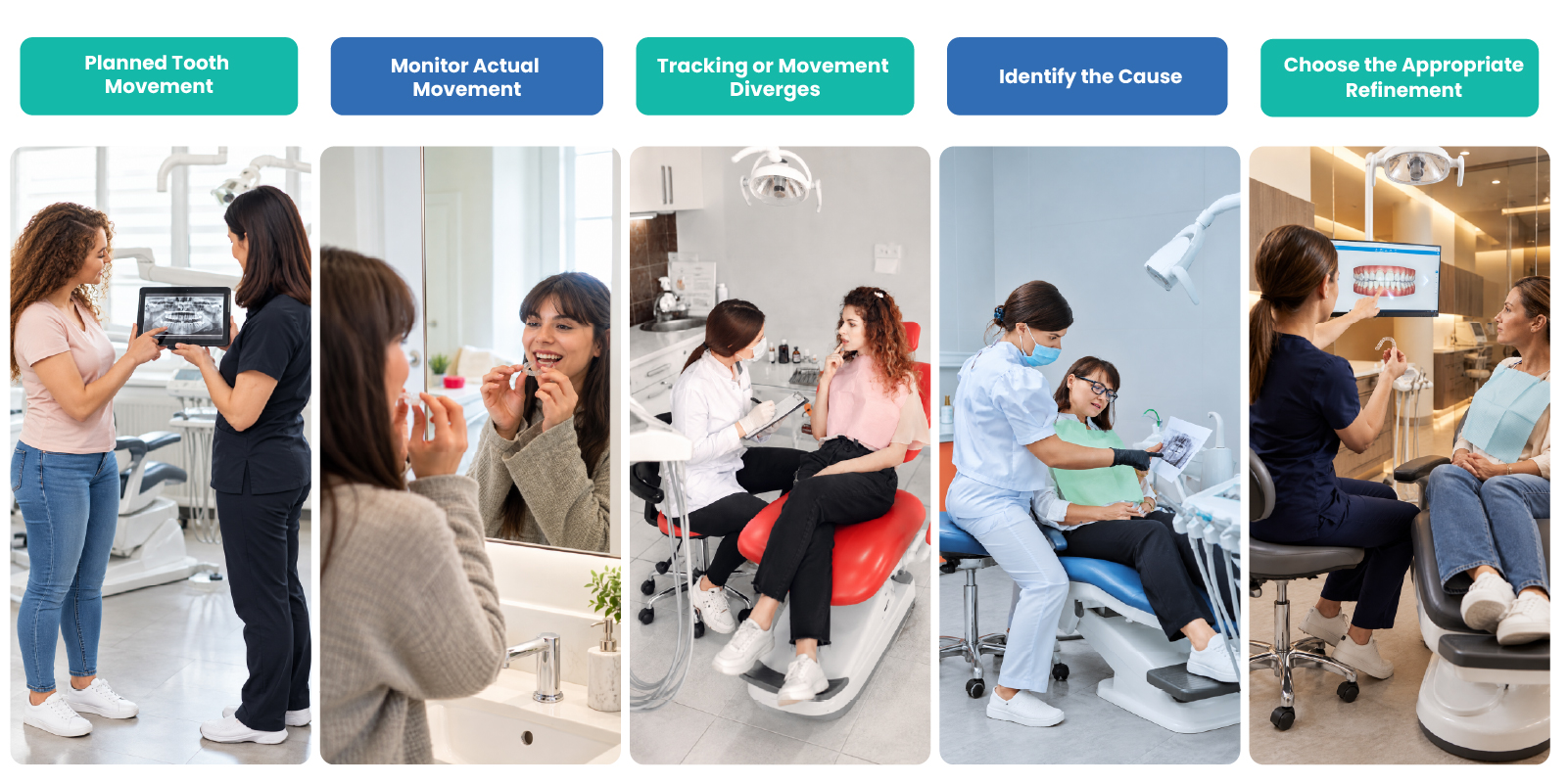
The practical sequence is: compare achieved with planned movement → identify the cause of divergence → decide whether the current plan remains appropriate → refine only what needs to change.
For clinicians, the goal is not to avoid every refinement. It is to recognize divergence early and prevent “more aligners” from becoming a substitute for reassessment.
Used that way, refinement keeps the digital plan connected to what the teeth, occlusion, and patient are actually doing.