
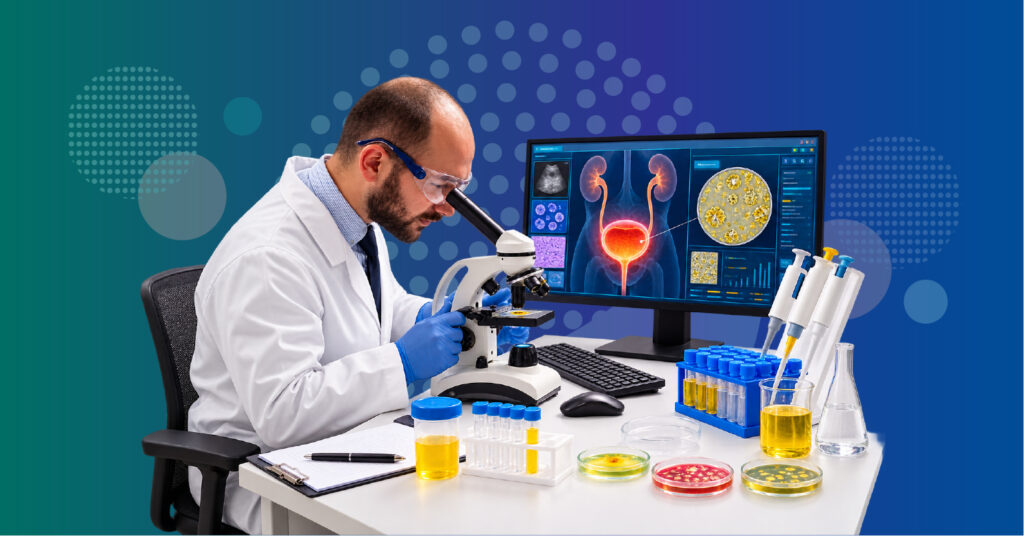
What if part of a bladder cancer diagnosis could begin with a urine sample? That possibility is edging closer to clinical reality.
Bladder tumors can release DNA, RNA and other molecular material directly into urine, and new liquid biopsy technologies are being developed to detect these signals and use them for bladder cancer detection, risk assessment and monitoring.
Does this mean cystoscopy and biopsy are about to disappear?
Not yet.
The more realistic near-term role of a urine liquid biopsy is to complement current evaluation, helping clinicians decide who needs invasive investigation sooner, who might undergo fewer procedures, and how disease is monitored.
How is bladder cancer detected today?
When bladder cancer is suspected, often after hematuria, evaluation can include imaging, cytology, and cystoscopy. Cystoscopy allows direct inspection; if an abnormal area is found, tissue can be obtained by biopsy or transurethral resection for pathology.
That tissue remains important, providing information a molecular bladder cancer test cannot yet replace, including histological type, grade and invasion. Current European Association of Urology (EAU) guidance states that diagnosing papillary bladder cancer ultimately depends on cystoscopy and histological assessment of sampled tissue; urinary molecular markers may add information but remain adjuncts.
Bladder cancer also often requires repeated surveillance: patients with non-muscle-invasive disease may undergo multiple cystoscopies because recurrence is common. That creates an important question:
Could a reliable urine test for bladder cancer reduce some of this invasive testing?
A liquid biopsy test searches for cancer-related material in a body fluid rather than removing tumor tissue. Blood is widely studied, but bladder cancer has an advantage: the tumor is in direct contact with urine, so cancer cells and tumor-derived material enter the urinary tract.
A bladder cancer urine test may analyze:
- cell-free or tumor-derived DNA
- DNA methylation patterns
- RNA expression
- genetic alterations
- DNA fragmentation
- extracellular vesicles and other molecular signals
A 2026 study comparing matched urine and plasma samples found higher tumor fractions in urine, which also resembled bladder tumor tissue more closely in methylation. This proximity helps explain why liquid biopsy for bladder cancer may be especially promising.
A urine RNA test showed high sensitivity
One of the strongest recent studies assessed a three-gene urine RNA panel, uRNAp, in more than 2,000 urine samples from 976 patients undergoing either initial investigation for suspected bladder cancer or surveillance after diagnosis.
In the detection cohort, the test showed 98% sensitivity and 51% specificity. In surveillance, it showed 94% sensitivity for recurrence and 99% sensitivity for high-grade recurrence.
High sensitivity is only part of the picture: lower specificity means some patients without cancer may still test positive and need further investigation. The researchers therefore positioned the test as a non-invasive adjunct to cystoscopy, able to help defer or expedite the procedure depending on clinical risk, an important framing for any new non-invasive bladder cancer test.
Urine DNA can provide additional signals
RNA is not the only approach; research into bladder cancer biomarkers is also examining cell-free DNA. A 2025 study analysed urinary cfDNA from 156 patients with bladder cancer and 79 controls, assessing DNA fragment size and integrity from several genes. Fragments involving genes such as MYC were associated with disease presence and severity, suggesting fragmentation itself carries diagnostic information.
The same 2026 study combined DNA methylation and copy-number variation in a urine-based model. In an independent test set, it achieved 91.9% sensitivity at 80% specificity (AUC 0.932) and identified some cancers missed by mutation-based approaches.
Future urine tests may not rely on one mutation or biomarker but combine several molecular signals to improve bladder cancer diagnosis.
Urine liquid biopsy may also monitor treatment
For patients who already have bladder cancer, urine tumor DNA may help answer another question:
Is molecular evidence of disease still present after treatment?
A 2026 Cell study analyzed 261 urine samples from patients with intermediate- or high risk nonmuscle invasive bladder cancer undergoing surgery and BCG. Researchers distinguished tumor-derived mutations from age-related or tumor-adjacent changes that could otherwise cause false positives and identified distinct response patterns: patients responding after surgery, patients responding after BCG, and patients with persistent molecular disease.
This points toward a future role in bladder cancer monitoring rather than relying only on whether a tumor is visible; clinicians may gain information from the molecular signals in urine.
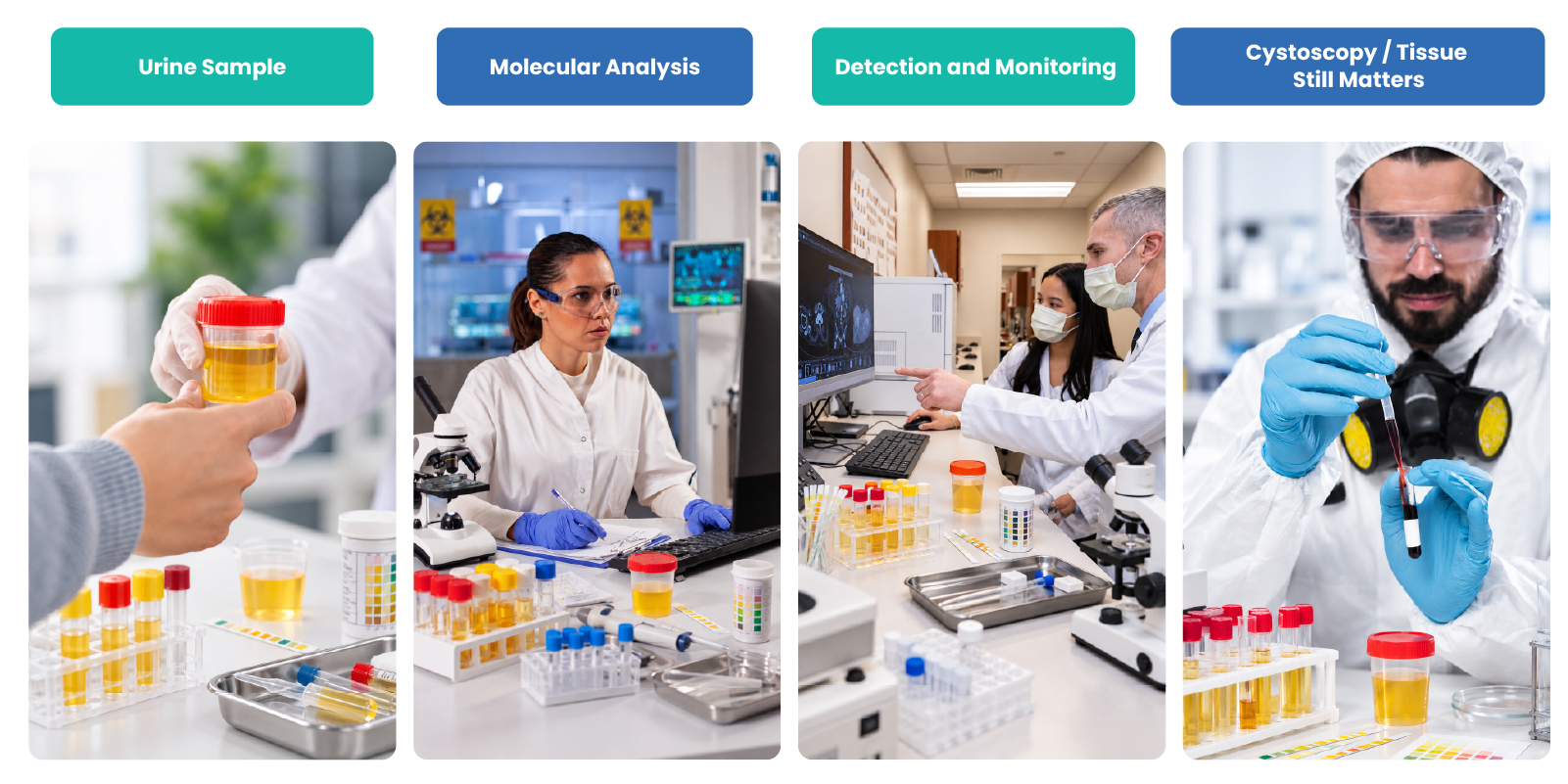
Could urine testing reduce cystoscopy?
This may be the most practical near-term use. A high-performing urine test to detect bladder cancer could support clinical triage, for example:
- a low-risk molecular result might eventually support postponing some cystoscopies in selected patients
- a high-risk result could prompt earlier investigation
- repeated testing could provide information between scheduled surveillance visits
- molecular results could complement cytology, imaging and clinical risk factors
There is already evidence that urinary biomarkers can reduce cystoscopy use; the current EAU guideline cites a randomized study in lower-risk microhematuria in which a urine-marker strategy cut cystoscopy use by 59%, though important methodological limitations remained.
Guidance therefore remains cautious; available urinary tests cannot yet replace cystoscopy for primary bladder cancer diagnosis, and their value depends heavily on clinical context, disease risk, test performance and the consequences of missing a recurrence. The better question is not:
“Can we stop doing cystoscopy?” It is: “Can urine biomarkers help us use cystoscopy more precisely?”
Bladder cancer screening
A convenient urine test for cancer raises the idea of screening before symptoms appear, but that is a different challenge. Routine bladder cancer screening of the general population is not currently recommended: low disease prevalence reduces a test’s positive predictive value and can lead to unnecessary investigation after false positives.
Future research may identify high-risk groups in whom molecular bladder cancer screening becomes useful; for now, findings in hematuria or surveillance populations should not be extrapolated to population-wide screening.
Tissue biopsy still matters
The phrase “no more biopsies” captures the appeal of liquid biopsy for cancer detection, but it oversimplifies what tissue provides. A urine test may show that molecular material is present; pathology shows what the tumor looks like, giving histology, grade and evidence of invasion, features that directly influence treatment. Urine liquid biopsy is therefore better viewed as complementary rather than universally substitutive, most valuable in determining when invasive testing is truly necessary.
Closing perspective: reading the signals tumors leave behind
For decades, bladder cancer diagnosis has depended heavily on visualizing abnormalities and obtaining tissue. Urine liquid biopsy offers another way to detect the molecular signals released by tumours before, between and after invasive procedures. Different approaches including RNA panels, urine cell-free DNA and tumour-derived DNA can provide complementary information on cancer detection, recurrence, DNA fragmentation, methylation patterns and treatment response.
The technology is not ready to make cystoscopy or biopsy obsolete, but replacing every invasive procedure may not be the right measure of success. If a non-invasive bladder cancer test can show who needs cystoscopy sooner, who might safely have less intensive surveillance, and who has persistent molecular disease, a simple urine sample could meaningfully change bladder cancer care.
The future may be less about eliminating biopsy and more about knowing when invasive testing is truly necessary.