

A patient can leave hospital clinically stable and still develop a wound problem, bleeding, dehydration, or cardiopulmonary deterioration before the next review.
Digital tools can make some of these changes visible earlier. But postoperative monitoring becomes useful only when a meaningful signal reaches the right clinical team and leads to an appropriate response.
The practical question is therefore: when a digital signal arrives after discharge, does the care pathway know what to do with it?
MDForLives surveyed surgeons across six countries. The findings suggest that value depends less on collecting more data and more on choosing the right signals, interpreting them in context, assigning ownership, and defining what happens next. The detailed findings are available in the MDForLives Digital Postoperative Monitoring Insight Report.
Start postoperative monitoring with the complication, not the device
Wearables, recovery apps, wound photographs, symptom questionnaires, and connected vital-sign tools can all generate postoperative information.
The better starting point is the complication the surgical team most needs to recognize earlier.
In the MDForLives survey, 65.7% of surgeons selected surgical-site or wound complications as a priority for earlier identification, while 63.9% selected bleeding, cardiovascular, or respiratory deterioration.
The clinical meaning is straightforward: postoperative patient monitoring should start with the risk, not with the technology available to measure it.
A wound pathway may rely on photographs and symptoms. Another patient may need physiological trends, pain, mobility, hydration, or recovery symptoms.
The most useful parameter is therefore the one that helps answer a defined clinical question early enough to influence what happens next.
Postoperative complications can become harder to manage when recognition and response are delayed. Explore why postoperative complication management depends on more than surgical skill and why timely action matters.
Essential monitoring parameters change the next question
There is no universal answer to what monitoring parameters are essential for postoperative care.
A heart-rate alert, wound image, symptom score, or change in activity becomes meaningful only when interpreted against the expected recovery trajectory, patient risk, procedure, and accompanying symptoms. That makes context as important as the measurement itself.
*Postoperative recovery is influenced by more than what happens after discharge; patient condition and preparation before surgery can also shape the recovery journey. Explore how prehabilitation before surgery can support recovery through exercise, nutrition and preoperative optimization.
In the survey, 57.4% of surgeons said virtual follow-up and patient-reported outcome tracking could meaningfully improve postoperative monitoring.
This points toward a broader model in which wound appearance, symptoms, pain, activity, physiological data, and patient-reported recovery can be considered together.
Useful postoperative monitoring should therefore ask more than, “Is this value abnormal?” It should ask: “Does this represent meaningful deviation from expected recovery, and what do we need to know next?”
A postoperative alert should start triage, not make the diagnosis
Once a concerning signal appears, the next step is usually assessment rather than immediate treatment change.
In the survey, 46.7% of surgeons said their most common response to a potentially concerning finding was to contact the patient or arrange further assessment. That distinction matters.
A worsening wound photograph may trigger questions about discharge, pain, fever, or surrounding changes. An abnormal physiological signal may need confirmation alongside symptoms and overall condition. A reported decline in recovery may require examination or testing.
For remote monitoring for postoperative recovery, the alert should therefore function as a triage signal rather than a diagnosis.
Its value lies in shortening the interval between a meaningful change at home and the next appropriate clinical touchpoint.
The most useful digital pathway helps answer three questions quickly: who needs attention, how urgently, and what information or assessment is needed next?
Every digital signal needs a defined owner
Even a clinically useful signal loses value when responsibility for reviewing it is uncertain.
The survey showed a near-even split in monitoring ownership: 34.6% of surgeons said alerts or patient-generated data are primarily reviewed by the operating surgeon or surgical team, while 33.6% pointed to nursing, advanced-practice, or dedicated remote-monitoring teams.
The important point is not which model is better.
Different services may reasonably use different structures. The risk appears when ownership is unclear during handovers, outside normal hours, or when an alert requires escalation from one team to another.
A workable pathway should establish who reviews incoming information, how often it is reviewed, which findings require action, who provides backup, and when responsibility moves between teams.
A good alert without a clear owner is still a clinical blind spot.
More alerts create more work without creating more insight
Remote monitoring is often expected to make postoperative follow-up more efficient. That benefit is not automatic.
Nearly half of surveyed surgeons, 48.6% identified alert burden, data overload, or lack of dedicated staff as barriers to wider use.
This is where monitoring design becomes as important as the technology itself.
If every small deviation creates an alert, clinicians may spend more time reviewing noise. If thresholds are too broad, meaningful deterioration can become harder to identify among low-value signals. If digital follow-up simply sits on top of existing calls and clinic visits, the pathway may add work instead of reducing it.
The answer is not simply fewer measurements. It is better thresholds, clearer routing, and a defined response for different levels of concern.
An alert should lead somewhere; continued observation, patient contact, virtual assessment, testing, in-person review, or escalation.
Otherwise, more postoperative data simply becomes a larger clinical inbox.
Digital data to improve a decision
A digital signal can be clinically useful without directly changing treatment.
In the survey, 47.7% of surgeons said technology-generated postoperative information mainly supports or confirms clinical assessment, while only a minority said it frequently changes management.
That should not automatically be interpreted as limited value.
A reassuring recovery trend may support continued home management. A change in wound appearance may justify an earlier review. A combination of symptoms and physiological change may increase the urgency of assessment.
The value of postoperative monitoring can therefore lie in reducing uncertainty, improving triage, and helping the team decide what needs to happen next.
The better measure of success is not only, “How many alerts changed treatment?” It is also: “Did monitoring help the team recognize the right patient sooner and make the next decision with better information?”
Closing perspective: design the response before collecting the signal
Digital postoperative care can extend visibility beyond the hospital, but technology alone does not create a monitoring pathway.
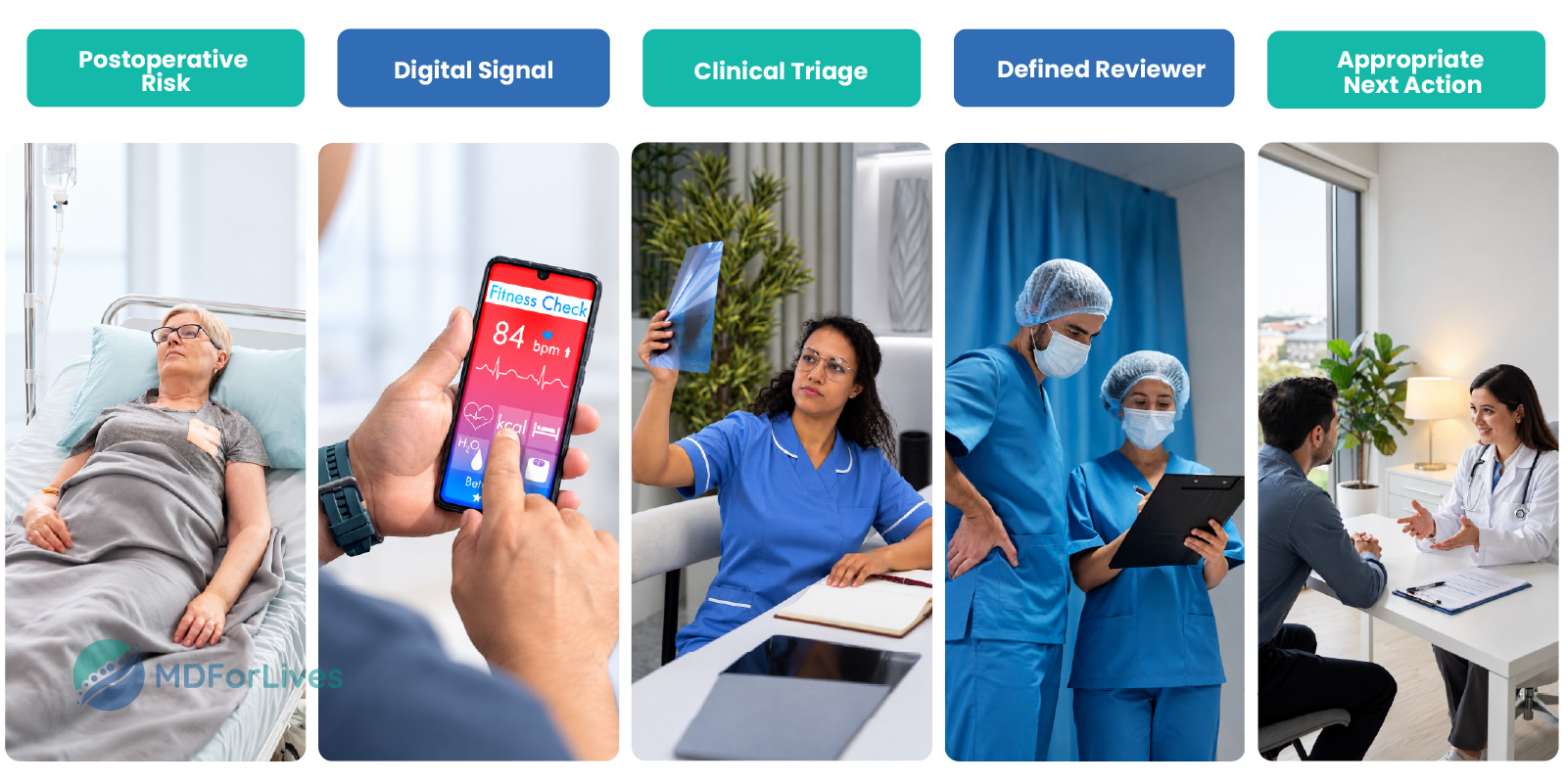
The useful sequence is clear: define the complication, choose the appropriate signal, interpret it in clinical context, assign a reviewer, and decide what should happen when concern crosses a threshold. That reframes the purpose of remote monitoring for postoperative recovery.
The goal is not continuous surveillance for its own sake, or a dashboard containing every available measurement. It is to reduce the blind interval between a patient’s condition changing at home and the care team recognizing that change.
For surgeons, the most valuable digital signal is therefore not necessarily the one that produces the most data.
It is the one that reaches the right reviewer, raises the right clinical question, and when necessary, leads to the right next action.