

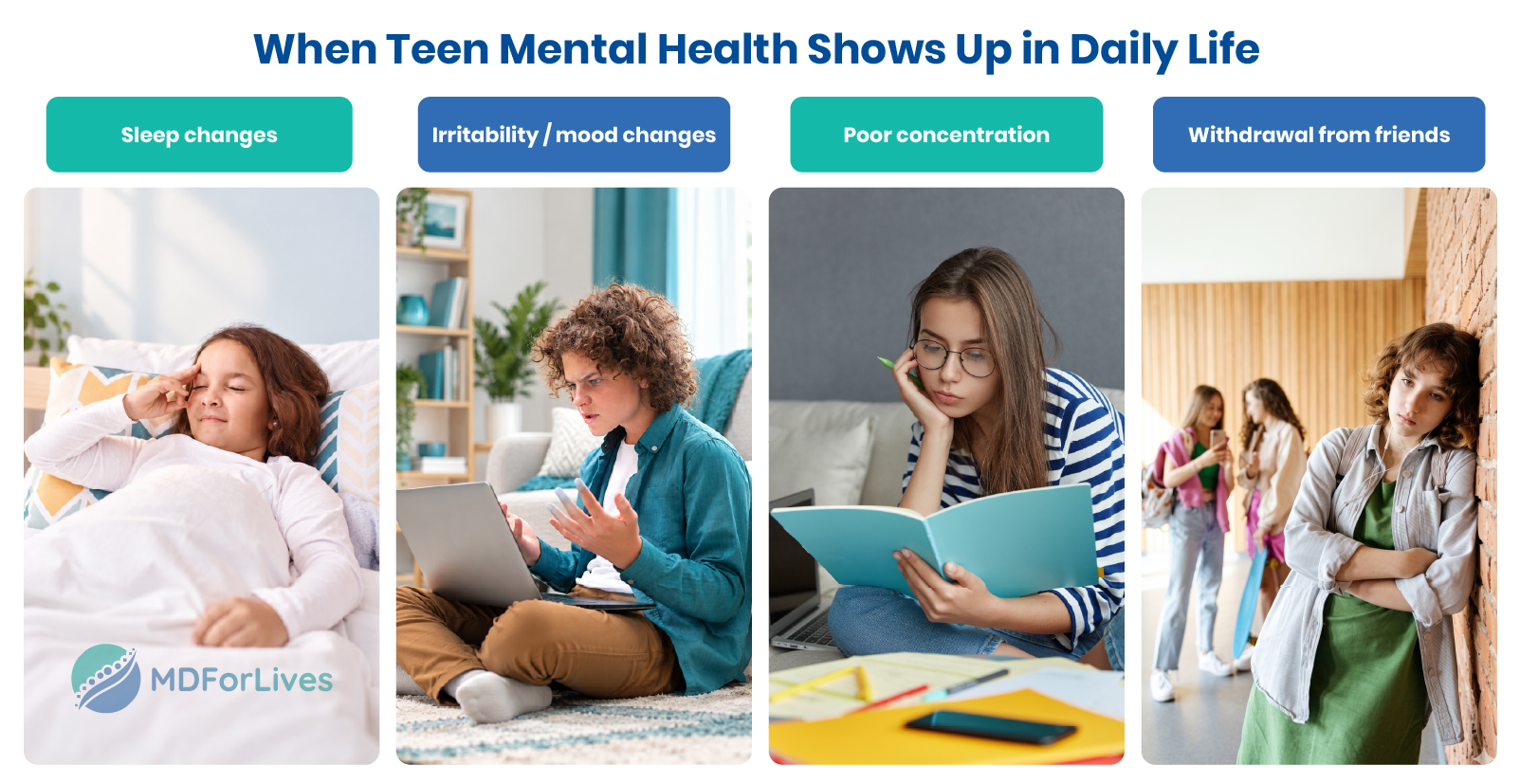
A teenager who is anxious does not always say “I feel anxious”, and one experiencing depression may not simply appear sad. The first signs are often less direct: repeated physical complaints, irritability, trouble sleeping, avoidance, falling school performance, withdrawal from friends, poor concentration or a noticeable change in everyday functioning.
That is what makes anxiety and depression in teens clinically challenging: symptoms overlap and evolve or appear alongside school pressure, family difficulties, social changes or other health concerns. The first symptom starts the conversation, but rarely tells the whole story.
To understand what prompts pediatric clinicians to look beyond the initial presentation, MDForLives surveyed pediatric healthcare professionals across the USA, UK, Canada, Italy and Germany. The detailed research is available in the MDForLives Adolescent Mental Health in Pediatric Care: When Access Shapes Treatment Insight Report.
When common teen changes stop looking temporary
Adolescence naturally brings shifts in sleep, mood, relationships and behavior, making early mental-health symptoms hard to separate from ordinary development. In the MDForLives research, 38.7% of pediatric HCPs identified anxiety symptoms as the presentation most likely to prompt mental-health evaluation, followed closely by depressive symptoms at 34.0%.
Teen anxiety symptoms may include persistent worry, avoidance, reassurance seeking, irritability, sleep difficulty, or physical complaints. On the other hand, depression symptoms in teenagers may appear through low mood, withdrawal, fatigue, reduced interest, poor concentration, or declining function. The clinical signal strengthens when these changes persist, worsen, or interfere with daily life.
Fear involves interconnected biological and psychological processes that influence how people respond to perceived threats. Explore the science of fear and the biology and psychology behind it.
A difficult week may not indicate a disorder, but a sustained change in how an adolescent sleeps, attends school or socializes deserves attention.
When anxiety and depression begin to look less separate
Anxiety and depression do not always arrive as two cleanly different presentations. A teenager who stops attending school may be avoiding anxiety triggers, withdrawing because of depression, struggling with bullying or family stress, or facing several problems at once. Sleep disturbance can occur with both, irritability may appear without sadness, and poor concentration can reflect worry, low mood, sleep loss or another problem.
That is why distinguishing anxiety symptoms in teens from depression is rarely about one defining symptom; clinicians need to ask how the symptoms fit together. Is worry driving avoidance? Has motivation changed? Has it affected friendships, school, or family interaction? Are other factors, such as trauma, substance use, or chronic illness indirectly contributing?
Mental health challenges can be influenced by several overlapping factors, including social experiences and changes in everyday life. Explore the key mental health challenges in the digital age.
When daily functioning starts to change
One of the most useful clues may be what adolescents can no longer do as easily. A teenager may still attend an appointment and answer questions while functioning very differently from months earlier. School attendance falls, assignments go undone, social contact shrinks, and activities that once mattered no longer feel manageable. These changes help clinicians judge whether symptoms carry a meaningful functional cost.
Questions such as “What has become harder recently?” or “What are you avoiding that you used to do?” can sometimes reveal more than asking only whether the adolescent feels anxious or depressed. This also helps answer part of the question of what causes depression and anxiety in teens.
There is rarely one cause that can be identified from a symptom alone. Mental-health presentations can reflect interacting biological, psychological, family, social and medical factors. When the pattern and its impact become clearer, structured screening can add another layer of information.
When screening adds weight to the concern
In the MDForLives survey, 43.2% of pediatric HCPs said a positive depression screen was the finding most likely to trigger formal mental health assessment. A screening score does not provide the diagnosis; its value is to move a broad concern into a structured conversation about symptom severity, duration, functioning, comorbidity, family circumstances and safety.
Pediatric guidance referenced in the research supports mental, emotional, and behavioral screening in adolescence, with clinical assessment when concerns are identified. The practical question after a positive result is whether it fits what the adolescent, family, and clinical history are showing. A positive screen can strengthen the case looking deeper, but the next step depends on the wider picture, which changes immediately when safety becomes a concern.
When safety changes the whole decision
Some findings do not simply add another piece to the assessment; they change its priority. In the MDForLives research, 79.6% of pediatricians identified suicidal ideation or self-harm as the factor most likely to change their management strategy. Once suicidal thoughts or self-harm are identified, the central question is no longer whether the adolescent has anxiety, depression or both, but whether the adolescent is safe.
Assessment may then need to consider current thoughts, intent, planning, access to lethal means, protective factors and the right level of care under local clinical and emergency pathways. This matters because teen anxiety and depression can range from symptoms that need monitoring and structured treatment to cases where risk assessment and urgent escalation take precedence. The takeaway is simple: symptoms define what needs assessment, while safety defines the urgency.
When recognizing the problem is not enough
A deeper assessment may clarify what the adolescent needs, but treatment still depends on whether appropriate care is available. The research found that 55.3% of professionals identified limited psychiatric access as the biggest barrier to adolescent mental healthcare, creating a gap between recognition and treatment.
A clinician may identify a need for psychotherapy, psychiatric input or closer follow-up, yet availability, waiting times, cost and fragmented referral pathways shape what happens next. So, referrals cannot always be where pediatric involvement ends. When specialist support is delayed, the plan may still need monitoring, family support, reassessment of functioning and safety, and a clear route for escalation. Identifying anxiety or depression is only useful when there is a pathway for care to continue afterward.
Closing perspective: look beyond the first symptom
The difference between anxiety and depression in adolescence is not always obvious on the first visit. Anxiety may show as worry, avoidance, physical complaints or sleep problems; depression as withdrawal, fatigue, loss of interest or declining function. Sometimes both are present, sometimes another issue contributes to it.
What prompts clinicians to look deeper is therefore not one perfect symptom but the pattern around it; persistence, functional change, worsening symptoms, a positive screen, a safety concern. Together, they answer a more useful question than “Is this anxiety or depression?” Which is “What has changed for this adolescent, how much is it affecting daily life, and does anything change the urgency of care?”