

A toddler is speaking less than expected. Another is not yet walking independently. A parent notices limited gestures or reduced social engagement. In pediatric practice, these concerns often arrive with the same question: should we act now, or give the child more time?
Children develop at different rates, and not every variation indicates a developmental disorder. But when a concern persists, waiting without a structured plan can postpone assessment and support.
Developmental delays in children describe slower than expected progress in areas such as language, motor skills, cognition, social interaction, or everyday functioning. The clinical task is to understand the developmental pattern, follow it over time, and know when observation should become a more active pathway.
To explore where that pathway can slow down, MDForLives surveyed pediatricians across six countries. The detailed research is available in the MDForLives Pediatric Developmental Screening Insight Report.
Early concern is useful only if it leads to a plan
In the MDForLives survey, 59.2% of pediatricians said suspected speech, motor, or social delays are commonly identified, or first raised by parents, between 12 and 18 months.
That creates an important opportunity. Communication, movement, gesture use, play, and social interaction become increasingly informative during the second year of life, while repeated pediatric contact allows clinicians to observe development over time.
The value of recognizing delayed developmental milestones early is not that every variation should trigger immediate diagnosis. It is that the concern can be followed deliberately.
What matters is whether the practice defines what it is monitoring, when the child will be reviewed, and what change would justify further assessment or support.
Early recognition creates time. A clear follow-up plan determines whether that time is used well.
“Wait and see” is safer when the waiting has an endpoint
Pediatricians identified a belief that the child would simply outgrow the concern as the most common reason families hesitate about screening or formal evaluation, selected by 39.6%.
The response reflects a familiar challenge in delayed development in childhood. Development varies, and families may understandably be cautious about premature labels or unnecessary investigation. But reassurance becomes less useful when there is no defined point for reassessment.
A developmental screen needs a next step, not just a score
Screening can identify a concern, but it cannot complete the pathway. A result still needs interpretation, family discussion, follow-up, and, where appropriate, further assessment or referral.
For pediatric developmental delays, the more important implementation question is:
What happens after the signal appears?
A practice may gain more from a reliable follow-up process than from simply increasing the number of completed screens. Where appropriate, parent-completed information can be gathered before the consultation; scoring can be standardized, follow-up responsibility can be assigned, and referral or reassessment steps can be agreed in advance.
The aim is not simply to complete more screens. It is to ensure that a concerning screen can lead somewhere.
A referral delay turns specialist access into a care interval
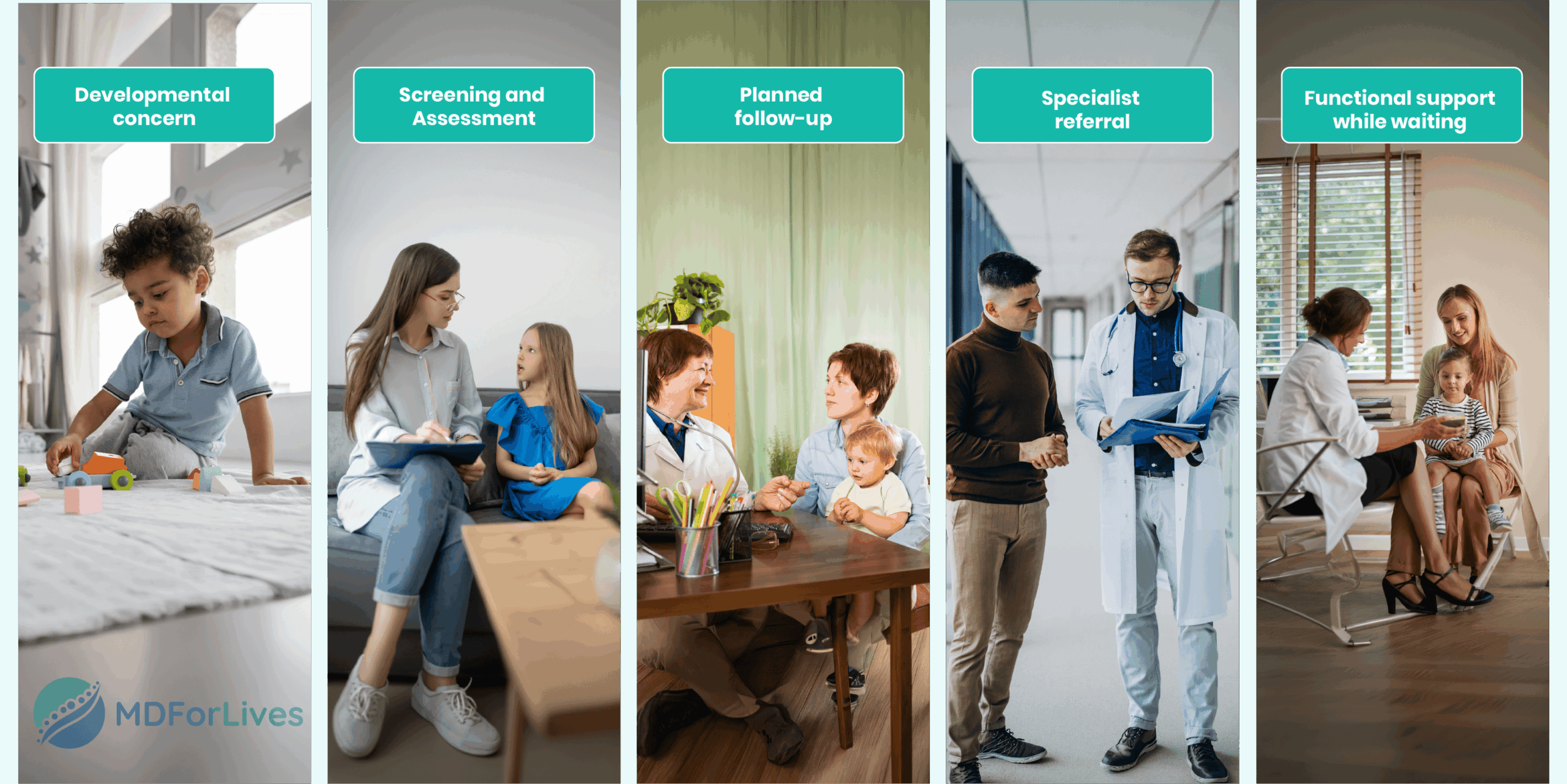
Recognition does not guarantee rapid specialist review. In the MDForLives survey, developmental-behavioral pediatrics and child-neurology waits frequently extended across several months, with 25% of pediatricians reporting typical waits longer than one year.
A wait of that length cannot be treated as an empty space between referral and diagnosis. The child continues to develop. Family concerns may change. Communication, movement, behavior, or social differences may become clearer before the specialist appointment. The referral queue therefore becomes part of developmental care.
For clinicians, the practical question shifts from:
‘Has the referral been made/’ to ‘What should happen while the referral remains pending?’
Ongoing surveillance, appropriate medical evaluation, family guidance, functional support, and scheduled reassessment can continue alongside specialist referrals.
The specialist appointment remains important, but it should not necessarily become the point at which developmental care resumes.
Support can begin while diagnostic questions remain open
When specialist waitlists were excessively long, 45.8% of surveyed pediatricians said they referred directly into public early-intervention pathways. The broader lesson remains relevant across health systems even though service structures differ by country.
A broader pediatric care approach may also involve addressing other childhood health needs, including Pediatric Obesity Care when clinically appropriate
Developmental support and diagnostic clarification do not always need to occur one after the other. A child may have a clear functional need while the underlying diagnosis is still being investigated. Depending on individual needs and available services, support may involve speech-language, occupational, physical, developmental, educational, behavioral, or other interventions.
For pediatric developmental delays, the pathway can therefore look more like:
recognize the concern → assess what is known now → connect appropriate support → continue developmental follow-up → refine the diagnosis as more information emerges
Support does not imply premature diagnostic certainty. It means responding to current developmental needs while the clinical picture becomes clearer.
The cause and the current need are not always answered together
Families naturally ask what causes developmental delays. There is no single answer. Delays can be associated with genetic or neurological conditions, hearing or vision difficulties, prematurity or other perinatal factors, medical conditions, environmental circumstances, or other developmental differences. Sometimes the cause is not immediately apparent.
In delayed development in infants and young children, investigation can continue while clinicians respond to current difficulties with communication, movement, participation, behavior, or everyday function.
Diagnostic uncertainty should inform the plan, but it does not always need to suspend it.
Closing perspective: protect momentum after the concern appears
The central challenge in developmental delays in children is not simply whether a milestone arrived on schedule. It is protecting momentum once a credible concern has been identified.
The MDForLives findings suggest that concerns are often recognized while there is still meaningful opportunity for follow-up and support. The pathway can then slow because families hope the child will catch up, specialist access is delayed, or local services are difficult to reach.
None of this means every developmental difference requires urgent diagnosis or intervention. It does mean that waiting should have a purpose.
What are we waiting to see?
When will development be reviewed again?
What would prompt escalation?
What support can begin now?
Those questions transform waiting from passive delay into active developmental follow-up.