Presbyopia has traditionally been managed with reading glasses, progressives, contact lenses, or selected procedures.
Presbyopia eye drops are designed to improve near vision for a limited period, mainly by reducing pupil size and increasing depth of focus. They do not restore youthful accommodation or remove the need for optical correction in every patient or situation. That distinction matters. The value of a treatment for presbyopia is whether the effect fits the patient’s visual goals and daily activities well enough to be useful.
MDForLives surveyed optometrists in the USA and Italy to understand how these therapies are being used in practice. The detailed findings are available in the MDForLives Presbyopia Eye Drops Insight Report.
The practical story is not about replacing reading glasses. It is about deciding where pharmacologic correction fits within a broader near-vision strategy.
The best candidate may be the patient asking for a specific kind of freedom
A patient interested in eye drops for presbyopia may want to read a menu without glasses, check a phone during travel, or gain flexibility during selected activities.
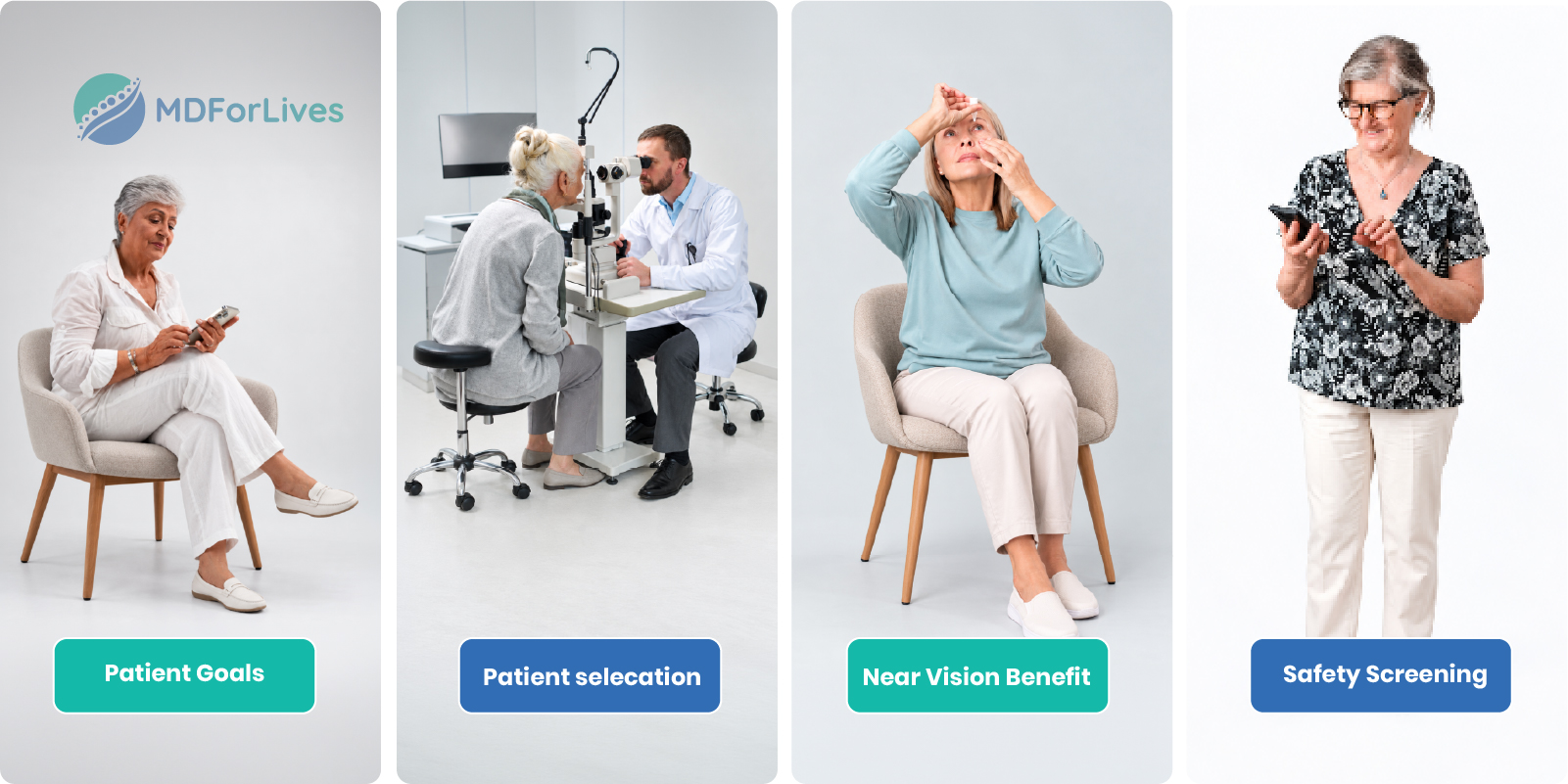
In the MDForLives survey, 60.0% of optometrists identified early presbyopes aged 40 to 47 with minimal distance refractive error as the group associated with the highest long-term satisfaction and success. Patient selection is also an expectation selection. A temporary near-vision improvement may feel meaningful to someone with a good distance vision who wants occasional freedom from readers. The same result may disappoint someone with more advanced presbyopia expecting complete spectacle independence.
For clinicians, the conversation begins with the task the patient wants to improve.
Presbyopia drops may fit better as an option than as a replacement
How therapy is positioned can shape whether the patient later considers it successful.
In the survey, 40.0% of optometrists primarily positioned presbyopia drops as a supplemental or part-time option for selected activities, compared with 32.0% who described them as a primary daily alternative to reading glasses or progressives. A drop positioned as a replacement for reading correction is judged against a high standard. If readers are still needed in some settings, that may feel like failure even when the drop helped.
A more practical approach is to place drops for presbyopia within a broader correction strategy. Glasses, contact lenses, pharmacologic options, and selected procedures can serve different visual needs. The takeaway is to define success before treatment starts. Situational freedom and all-day spectacle independence are not the same goal.
Eye-care products can offer different levels of perceived relief, but their value ultimately depends on whether they address the patient’s actual visual needs and expectations. Explore whether patients are buying relief, reassurance, or real clinical value with blue light glasses.
The refill may tell clinicians more than the first prescription
Interest shows that a patient is willing to try a new option. Continued use shows whether that option fits real life.
In the MDForLives survey, 56.0% of optometrists reported that fewer than 20% of their presbyopia-drop patients continued to refill and use the treatment after 90 days. That shifts the question from “Did the drop work?” to “Was the benefit valuable enough to continue?”
A patient may experience near improvement and still decide not to refill. The benefit may not be sufficient for important tasks, the visual experience may not fit daily routines, or recurring cost may not feel justified. A non-refill can therefore be useful feedback. Follow-up can explore functional benefit, expectations, tolerability, cost, and whether the intended use matched the patient’s needs.
Long-term use depends on whether the benefit feels worth the trade-off
No single issue explains why patients stop, and the factors may overlap.
The survey found that 48.0% of optometrists selected out-of-pocket cost or lack of insurance among the top two reasons patients discontinue or refuse a refill. Insufficient near-vision improvement followed at 44.0%, while headache or brow ache and dimness or reduced low-light vision were also commonly selected. These are clinician-reported reasons, not patient-reported incidence rates. They show how optometrists perceive the trade-offs that can influence continued use.
Real-world effectiveness is multidimensional. The treatment has to provide enough functional benefits to outweigh cost, inconvenience, and tolerability concerns.
Across markets, that may involve price, reimbursement, coverage, or availability. Counseling should cover what the drop may improve, what it may not replace, and which visual or ocular symptoms should prompt reassessment. Expectations, visual demands, and affordability are best discussed together.
Safety screening belongs inside the treatment decision
Because these therapies are administered as eye drops, they may appear simple to start. The prescribing decision is more involved.
In the survey, 68.0% of optometrists said they require a dilated fundus examination for all patients before initiating presbyopia drops. The MDForLives report notes that current U.S. labeling for newer miotic products includes precautions around temporary dim or blurred vision and rare retinal tears or detachments, with retinal evaluation advised before treatment for some products.
Suitability is not determined by near-vision need alone. Ocular history, retinal status, low-light demands, tolerability, and product-specific prescribing information can influence whether pharmacologic presbyopia correction is appropriate.
Prescription eye drops can serve different therapeutic purposes, but their use still depends on appropriate clinical assessment, patient suitability, and treatment expectations. Explore the latest approaches to dry eye treatments.
Presbyopia eye drops belong within a clinical assessment, not simply a convenience of conversation.
Closing perspective: near-vision care is becoming more flexible, not less clinical
Pharmacologic options expand what optometrists can discuss with adults who want more flexibility for near tasks.
But presbyopia eye drops may be most useful as another option rather than the next replacement for reading glasses. For the right patient, a temporary near-vision boost may create meaningful freedom during selected parts of the day. For another, glasses, contact lenses, or another strategy may remain more predictable, economical, or comfortable.
The MDForLives findings suggest that the practical challenge is matching the treatment to the patient. Patient goals, expectations, functional benefit, affordability, tolerability, and safety assessment all influence whether a trial becomes a treatment the patient values enough to continue.
That may be how pharmacologic treatment for presbyopia changes near-vision care most meaningfully: not by eliminating established forms of correction, but by giving clinicians another option to match the patient’s visual priorities.