

A technically well-performed operation does not begin with every patient carrying the same infection risk. One patient may arrive with well-controlled comorbidities and a clean elective procedure; another may have poorly controlled diabetes, immunosuppression, a contaminated surgical field or implanted material that increases the consequences if infection develops.
That is why surgical site infection prevention cannot be reduced to either patient risk or a checklist. Evidence-based protocols create consistency around antibiotic prophylaxis, skin preparation, sterile technique and glucose management, but the pathway may need extra attention when baseline risk or operative context changes.
To understand where surgeons place the greatest weight, MDForLives surveyed surgeons across the USA, UK, Canada, Italy, France and Germany. The detailed findings are available in the MDForLives Surgical Site Infection Prevention: Where Patient Risk Meets Protocol Adherence Insight Report.
Start by asking what makes this patient different
Some surgical site infection risk factors are visible before the patient enters the operating room. In the MDForLives research, 51.9% of surgeons identified poorly controlled diabetes as the patient profile most likely to increase their SSI prevention efforts, since poor glycemic control can influence preoperative optimization, wound risk, timing and postoperative monitoring.
Immunosuppression, severe obesity, previous infection, and other factors may also change the starting risk. None automatically determines whether surgery proceeds, but each can change how deliberately prevention is planned. The useful question is: which risks can realistically be modified, and which should change how closely we plan and monitor the pathway?
Preparing patients before surgery involves more than assessing procedural requirements. Exercise, nutrition and preoperative optimization can also support recovery. Explore how prehabilitation before surgery supports recovery.
Ask what the operation adds to that risk
Patient risk is only one side of the equation. A clean elective procedure, surgery involving prosthetic material and an already contaminated field do not carry the same microbial exposure or consequences if infection develops. In the survey, 36.8% of surgeons said contaminated wound classification was the finding most likely to change their preoperative SSI strategy.
That makes wound class more than a documentation category; it becomes a planning trigger. This is why risk factors for surgical site infections need to include both patient and procedural factors. A low-risk patient may still undergo a high-contamination procedure, while a high-risk patient may undergo relatively clean surgery. The practical takeaway is to understand the baseline risk, what the procedure adds, and where prevention needs additional attention before surgery starts.
Before incision, the priority shifts from planning to reliability
Once risk has been assessed, the core prevention steps still need to happen consistently. When asked which measure they prioritize before incision, 52.9% of surgeons selected timely antibiotic prophylaxis, and the measure also must be delivered reliably.
Agent selection, timing, procedure type and local guidance all influence prophylaxis. A correct order given outside the intended perioperative window is not the same as a workflow designed to make appropriate timing difficult to miss. The same logic applies to skin preparation, sterile practice, glucose management, and procedure-specific measures. For surgical site infection prevention, the protocol defines what should happen; the system around it determines whether it happens consistently.
A prevention bundle is only as strong as its least reliable step
This becomes especially important when teams already have detailed SSI policies. In the MDForLives research, 69.7% of surgeons identified protocol non-adherence as the biggest limitation to delivering consistent SSI prevention, which points less to a knowledge gap and more to an implementation gap.
A clinically sound bundle can still lose reliability during handovers, time-pressured workflows or unclear ownership. Clear responsibility for antibiotic timing, standardized perioperative checks, communication across teams and audit of repeatedly missed steps can reduce avoidable variation. Standardization should reduce reliance on memory without treating every patient as clinically identical. The strongest model is often standardized at its core and risk-sensitive where it needs to be.
When prevention fails, review both the patient and the process
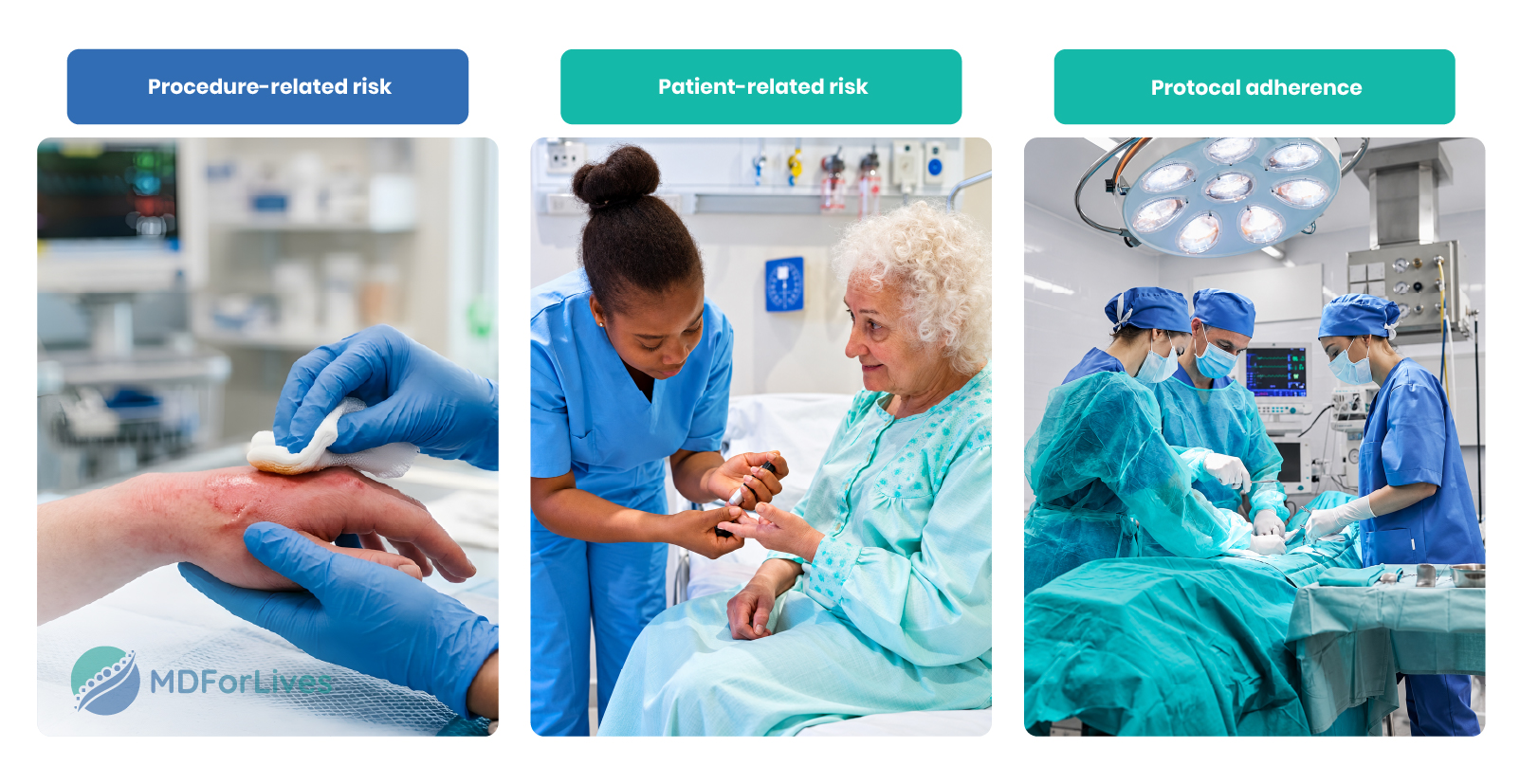
If an infection of the surgical site develops, asking whether the cause was “patient risk” or “protocol failure” can oversimplify the problem. The survey points to both uncontrolled patient risk and protocol non-adherence as important contributors to prevention failure.
A high-risk patient may develop an SSI despite appropriate preventive care; conversely, recognizing high risk cannot compensate for a key prevention step being missed. A useful review therefore asks what patient and procedural risks were present before surgery, which could reasonably have been modified, whether the planned prevention measures were completed as intended, and whether timing, communication or workflow created avoidable variation. The aim is to identify where the pathway could realistically become safer.
Prevention continues after the operation
Even the strongest prevention strategy cannot eliminate every SSI, so postoperative surveillance and early recognition remain part of the wider prevention pathway. Superficial wound concern and suspected deep infection raise different clinical questions. When deeper infection is suspected, the focus may shift toward defining the site and extent of infection, obtaining appropriate microbiology, and determining whether a drainable or surgically correctable source is present.
Recognizing postoperative complications early can make a meaningful difference to patient management and recovery. Explore why postoperative complication management depends on more than surgical skill.
At that point, an SSI is no longer only an antimicrobial problem: anatomy, clinical stability, implanted material, microbiology and source control can all influence management. The practical lesson is that prevention of surgical site infection does not finish when the incision is closed. The pathway moves from risk reduction before surgery, to reliable execution around the operation, to early recognition and appropriate escalation afterward.
Closing perspective: standardize what should not vary, personalize what must
A surgical site infection rarely reflects one decision made at one moment. Risk begins with the patient and procedure, and prevention depends on identifying modifiable concerns and applying evidence-based measures reliably.
The MDForLives findings reinforce both sides of that equation: poor glycemic control can intensify planning, wound contamination can alter the preoperative strategy, timely prophylaxis remains an operational priority, and protocol adherence can still be the weak point. For surgical teams, the goal is not to choose between standardized prevention and individualized care, but to make the two reinforce each other. Standardize the measures that should happen reliably, identify the risks that make one patient or procedure different, then adjust the pathway without losing consistency in the core prevention bundle. That is where patient risk and protocol adherence meet.