
Repeated intravitreal injections work. That is not the debate.
The harder question is what happens when treatment works, but the routine around it becomes difficult to sustain.
For many retina practices, anti-VEGF therapy has changed outcomes across retinal disease. But it has also created a long-term care model built around repeated visits, scheduling pressure, patient persistence, procedural tolerance, and clinic capacity. The burden is not only clinical. It is operational, behavioral, and logistical.
That is why sustained retinal drug delivery is becoming a more practical conversation. The question is no longer whether repeated injection burden exists. The question is what kind of alternative would feel clinically worth adopting.
MDForLives survey data shows a clear tension: ophthalmologists recognize the burden of repeated intravitreal therapy, but remain cautious about implantable sustained-delivery platforms unless safety, durability, logistics, and patient selection become clearer.
Repeated Injection Burden Is Real, but Not Uniform
The burden signal is strong. In the survey data, 21.6% described repeated intravitreal injection burden as extremely high, affecting both adherence and clinic workflow. Another 32.4% described it as high, with visible strain on persistence and scheduling.
Together, that means more than half of responding ophthalmologists see injection burden as a major pressure point.
But the data also shows nuance. Nearly 29.7% called the burden moderate, manageable but suboptimal. This suggests that sustained retinal drug delivery is not being viewed as a universal replacement. It is being considered where the current injection model starts to strain continuity, persistence, or capacity.
The Biggest Limitation Is Not the Injection Alone
When asked about the single greatest limitation of repeated intravitreal therapy, 35.1% selected visit and scheduling burden. Clinic capacity constraints and procedural burden or patient tolerance followed at 21.6% each.
This matters because the problem is broader than the procedure itself.
A patient may tolerate injections medically, but still struggle with transportation, caregiver support, time off work, anxiety, follow-up frequency, or cumulative fatigue. A clinic may deliver injections efficiently, but still face capacity limits when chronic retinal disease requires long-term, repeated treatment.
The data points to a practical insight: burden accumulates around the injection, not only inside it.
That is where sustained retinal drug delivery becomes relevant. Its value would not be judged only by drug durability. It would be judged by whether it reduces the care-system load without introducing equal or greater complexity elsewhere.
Which Patients Make the Case Strongest?
Ophthalmologists are not thinking about sustained delivery as a broad first-line shift. They are identifying specific patient profiles.
In the survey data, 34.3% said patients with high injection frequency over time most strongly make them consider a sustained-delivery alternative. Another 22.9% pointed to patients losing persistence with follow-up, while 20.0% selected patients in whom visit burden threatens continuity.
This creates a clear adoption logic.
The case for sustained retinal drug delivery becomes strongest when repeated treatment is not only frequent, but fragile. If ongoing injection frequency threatens adherence, continuity, or clinic feasibility, an alternative delivery model becomes more clinically meaningful.
That is different from adopting innovation because it is new. It is adopting it because the existing care model is beginning to fail a specific patient need.
Familiarity Is Growing, but Confidence Is Conditional
The survey data shows that 17.1% are very familiar with sustained-delivery retinal platforms and following them closely. Another 45.7% are familiar with the main data and practical issues.
This indicates that awareness is no longer low.
Still, confidence remains measured. About 37.1% said implantable sustained-delivery systems could meaningfully change practice in selected patients. Another 28.6% said they are promising, but still need stronger real-world confidence. Smaller groups expect them to remain niche or say their practical value is still uncertain.
That is a balanced adoption posture.
Ophthalmologists are not dismissing sustained retinal drug delivery. But they are also not treating it as a simple burden-reduction solution. For many, the promise is credible only if real-world safety, durability, and workflow value hold up beyond selected scenarios.
Surgical Risk Is the Main Adoption Barrier
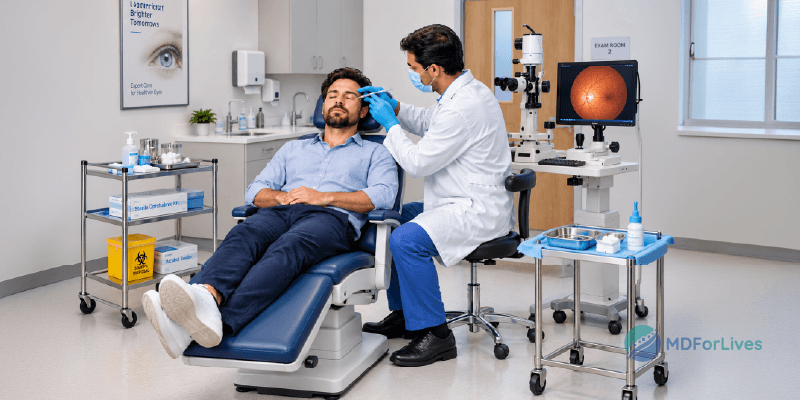 The strongest hesitation around implantable delivery is risk. In the survey data, 45.7% selected surgical risk and device-related complications as their greatest concern. Cost and reimbursement barriers followed at 20.0%, while refill, monitoring, and clinic logistics were selected by 17.1%.
This is the central trade-off.
Repeated injections carry ongoing burden, but they are familiar. Implantable delivery may reduce frequency, but it introduces procedural and device-related considerations that change the risk profile.
That is why the most important adoption question is not, “Can this reduce visits?”
It is, “Does the reduction in visits justify the procedural risk, monitoring model, refill logistics, and long-term uncertainty?”
When Would Sustained Delivery Feel Justified?
The answer is practical and patient-specific. In the survey data, 40.0% said sustained delivery feels most justified when disease control requires long-term frequent treatment. Another 37.1% selected cases where injection burden is clearly affecting persistence.
This suggests that ophthalmologists want the threshold for adoption to be anchored in real patient burden and long-term treatment need.
The trade-off data reinforces this. Durability versus procedural risk and reduced visit burden versus monitoring complexity were each selected by 34.3% as the most important decision trade-off.
That is the core of sustained retinal drug delivery today: durability is valuable, but only when the added procedural and monitoring demands are acceptable.
Topical Therapies Are Interesting, but Not Replacements Yet
The survey also explored topical retinal therapies as a future burden-reduction strategy. The leading view, at 37.1%, was that topical approaches are more likely to serve as an adjunct than a replacement. Another 25.7% saw them as potentially meaningful in selected settings, while 20.0% called them scientifically interesting but clinically uncertain.
This reinforces the same theme.
Ophthalmologists are open to less burdensome delivery. But the retina is a high-efficacy environment where promise must translate into sufficient drug exposure, durable effect, and meaningful outcomes. Convenience alone is not enough.
What Would Move the Field Forward?
The strongest answer is evidence. Nearly 48.6% said stronger long-term safety and durability data would most increase willingness to adopt advanced retinal drug delivery systems. Another 25.7% wanted stronger real-world evidence of adherence or outcome benefit.
This is the clearest message in the MDForLives survey data.
The path forward for sustained retinal drug delivery is not just better technology. It is better confidence.
Ophthalmologists need to see whether these systems can reduce burden without compromising safety, whether patients remain persistent, whether refill and monitoring logistics work in routine practice, and whether outcomes remain comparable or better over time.
Closing Perspective
Repeated intravitreal injections remain effective, but effectiveness does not erase burden.
The MDForLives survey data shows that ophthalmologists are actively weighing the next phase of retinal drug delivery. Sustained delivery is not being rejected. It is being evaluated through a practical clinical lens: which patients benefit, what risks are acceptable, how durable the effect is, and whether the model truly reduces burden rather than shifting it.
The future of sustained retinal drug delivery will depend less on novelty and more on fit.
For retina specialists, the question is not simply whether treatment can last longer.
It is whether longer-lasting treatment can be delivered safely, sustainably, and with enough real-world confidence to change routine care.