
A patient with mild memory concerns can now arrive in neurology with something that was rare only a few years ago: a positive Alzheimer blood test.
That result can speed up the path to identifying Alzheimer-related pathology, but it also changes the question. It is no longer just whether the biomarker is positive. It is what the result means for this patient, and whether it should move them closer to treatment.
Blood biomarkers now mean the first diagnostic step no longer has to be PET imaging or a lumbar puncture. But a positive result does not, on its own, make a patient eligible for treatment. The neurologist still must weigh the assay used, the disease stage, whether confirmation is needed, and whether treatment can be given safely.
MDForLives surveyed neurologists across six countries to see how this shift is playing out in practice. The detailed findings and methodology are available in the MDForLives Anti-Amyloid Therapy in Early Alzheimer’s Insight Report.
An Alzheimer blood test can change who reaches neurology
The first effect of an Alzheimer blood test may be on referral, not treatment. The survey suggests referral patterns are already changing. Neurologists described primary-care referrals after a positive blood biomarker as emerging but uneven, and some networks do not use these tests in primary care at all.
The underlying shift is from symptom-led referral toward biomarker-led referral, though it is happening unevenly. A positive result can bring a patient into neurology sooner, but the handoff still needs context: which assay was used, what prompted the test, and whether the result is meant for triage or confirmation. The test can speed up referral, but it does not replace clinical judgment.
A positive Alzheimer blood test is not automatically a diagnosis
The appeal of blood testing is clear: it is less invasive and easier to scale than amyloid PET or cerebrospinal-fluid (CSF) testing. Current guidance separates blood biomarkers used for triage from higher-performing tests that can support confirmation in a specialist work-up. The first FDA-cleared Alzheimer blood test was authorized to aid diagnosis in people with cognitive impairment, not as a stand-alone screening test for everyone.
The appeal of Alzheimer’s blood biomarkers is clear: they are less invasive and easier to scale than amyloid PET or cerebrospinal-fluid (CSF) testing.
Practice is still in transition. After a symptomatic patient tests positive, 35.7% of neurologists said they require CSF analysis before considering disease-modifying therapy; others were willing to rely more on a validated, high-accuracy blood biomarker alongside clinical MRI. The main point is that these results are not interchangeable. What a positive test means depends on the assay, its intended use, the patient’s pre-test probability, and the clinical picture. So, the question is not just “Is the test positive?” but “How much diagnostic weight should it carry?”
Earlier diagnosis matters because the treatment window is early
An Alzheimer blood test matters most when earlier detection changes what happens next. Current anti-amyloid therapies are used in early symptomatic Alzheimer’s disease, once amyloid pathology is confirmed, and the benefit-versus-risk balance is assessed. In the survey, 56.1% of neurologists chose mild cognitive impairment as the group most likely to gain the greatest benefit from current disease-modifying treatment.
That makes early diagnosis more than a label. It can decide whether a patient reaches treatment assessment while impairment is still mild. Earlier detection also adds complexity, because a biomarker-positive patient may still need a conversation about prognosis, other conditions, expected benefit, treatment burden, ARIA risk, and what they and their family expect.
Treatment readiness starts after the blood result
A positive Alzheimer blood test can support the diagnostic pathway, but it cannot answer everything needed before early-stage Alzheimer’s treatment begins. In the survey, 61.0% of neurologists said they would not prescribe an anti-amyloid disease-modifying therapy without knowing ApoE4 carrier status, because of ARIA risk.
That is why a positive biomarker should not be read as treatment readiness. ApoE testing, baseline MRI, comorbidity review, counseling, shared decision-making, and ARIA monitoring are all still part of the pathway. The workflow moves from detection to interpretation to risk assessment, not straight from blood test to prescription.
More blood testing could mean more triage, not simply more treatment
What happens if blood testing becomes far more available? Neurologists expected wider primary-care testing to bring stricter specialist triage, longer backlogs, and more pressure from false positives. A bigger diagnostic funnel needs clearer referral rules, and enough capacity to act on them.
The survey also points to friction along the anti-amyloid pathway. Depending on the health system, the barriers may include reimbursement, formulary restrictions, authorization requirements, specialist capacity, MRI availability, treatment infrastructure, or local prescribing rules. In short, a more accessible blood test for Alzheimer’s can widen the diagnostic pathway faster than treatment capacity can grow.
Closing perspective: the Alzheimer blood test changes the starting point
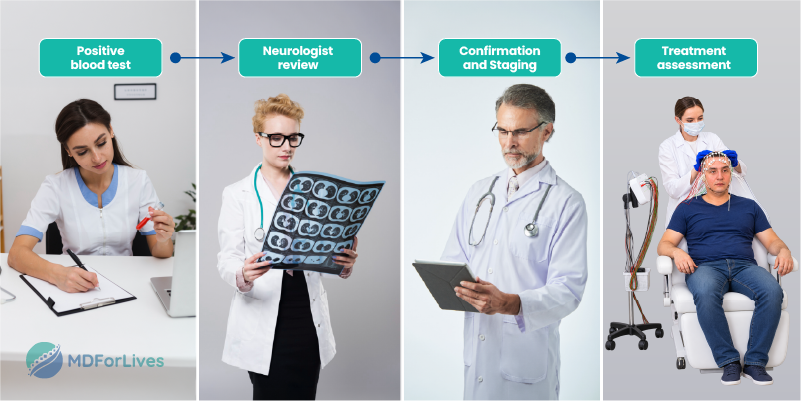
The Alzheimer blood test is not replacing neurological judgment. It is changing where that judgment begins. A positive result can prompt earlier specialist review and shorten the route to confirmation and treatment assessment, but its value still depends on the assay, the clinical picture, disease stage, safety, and system capacity.
Instead, it reinforces the continuing role of clinical judgment in neurology when interpreting results and deciding what happens next.
The MDForLives findings suggest neurology is moving past the question, “Can blood biomarkers help diagnose Alzheimer’s?” The more practical question now is, “What should this result mean for this patient?” That may be the real change: not one test replacing established care, but a new starting point for earlier, clearer, and more individualized treatment decisions.