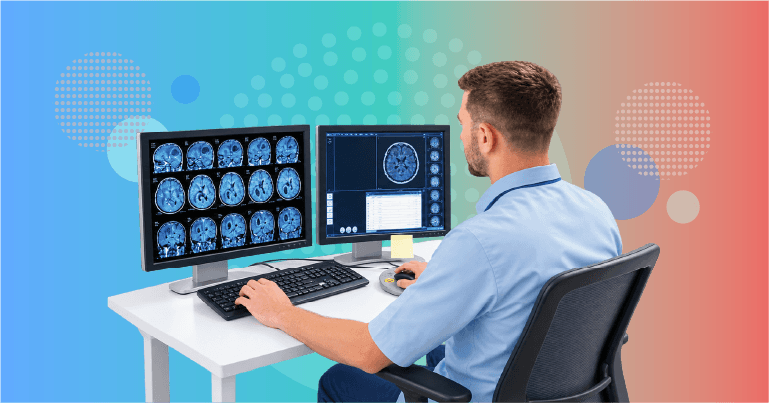
A scan can show a lesion. A biomarker can support a hypothesis. A lab result can change the direction of care.
But in neurology, the hardest question often comes before the test result: does the patient’s story make sense?
That is why clinical judgment in neurology remains so central, even in an era of advanced imaging, biomarkers, digital tools, and increasingly data-rich diagnostics. Neurologists now have more objective information than ever before. Yet the nervous system does not always present neatly. Symptoms fluctuate. Findings can be subtle. Imaging can reveal incidental abnormalities. Biomarkers can raise probability without closing the case.
The MDForLives survey data shows a clear pattern: neurologists are not choosing between data and instinct. They are integrating both. But when uncertainty appears, clinical context still carries significant weight.
The modern neurologist is not replacing bedside judgment with diagnostics. They are using diagnostics to sharpen, challenge, or confirm the clinical picture.
History and Examination Still Set the Direction
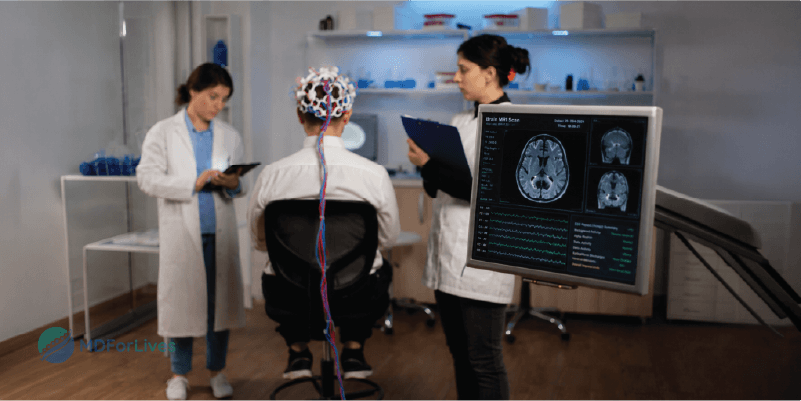
The strongest signal in the MDForLives survey data is the continued importance of first principles.
When evaluating a new patient with neurological symptoms, 57.4% of neurologists said that detailed clinical history and neurological examination form the primary diagnostic framework. Another 19.1% start with an initial clinical impression and then use diagnostics selectively to confirm or challenge it.
This is a strong statement about clinical judgment in neurology.
Despite rapid advances in imaging and biomarkers, the first diagnostic direction still often comes from listening, examining, localizing, and recognizing patterns. The neurological examination is not simply a tradition. It helps determine whether the problem localizes to the central nervous system, peripheral nerves, neuromuscular junction, muscle, or a more diffuse process.
That localization step is where many diagnostic paths begin.
Data and Judgment Are Not Opposites
The survey does not suggest that neurologists dismiss objective data. In fact, 44.7% said clinical judgment and diagnostic data are usually balanced in decision-making. Another 34.0% said clinical judgment remains primary, with data mainly used to confirm or refine decisions.
This balance is important.
In modern neurology, imaging, biomarkers, CSF studies, EEG, EMG, genetic testing, and laboratory data can be decisive. But they are most useful when interpreted within the patient’s clinical context.
That is why clinical judgment in neurology is not the opposite of data. It is the framework that gives data meaning.
A test result can answer a question. But the clinician must decide whether the right question was asked.
Final Diagnosis Often Emerges From Integration
When asked what most often determines the final diagnosis, responses were more distributed. Imaging findings led at 34.0%, while 31.9% said diagnosis emerges from integrating multiple inputs without a single dominant factor. Clinical pattern recognition based on history and examination followed at 21.3%.
This is the key tension.
Initial direction is often clinically led. Final diagnosis may depend more heavily on imaging or integrated evidence. That does not weaken the role of clinical judgment. It shows how neurological diagnosis evolves.
A neurologist may begin with bedside localization, then use MRI, CT, EEG, biomarkers, or laboratory data to confirm, refine, or redirect the diagnosis. In some cases, the test clarifies. In others, it complicates.
Neurological diagnosis often depends on combining clinical history with targeted testing rather than relying on a single signal. Explore how epileptic seizures while sleeping are approached through diagnosis and treatment.
The practical insight: data often resolves uncertainty, but only after clinical reasoning defines what uncertainty matters.
What Neurologists Think Is Undervalued
The survey data also reveals what neurologists feel may be overlooked.
The most undervalued aspect of clinical judgment was the ability to identify inconsistencies or atypical presentations, selected by 25.5%. Pattern recognition developed through clinical experience followed at 23.4%, while subtle examination findings and contextual interpretation of symptom evolution were both selected by 19.1%.
This finding captures why clinical judgment in neurology remains difficult to automate or standardize.
Neurology often depends on noticing what does not fit: a symptom that is inconsistent with imaging, a pattern that suggests a mimic, a subtle asymmetry, a story that evolves differently from the expected disease course, or a result that should be questioned rather than accepted.
These are not soft skills. They are diagnostic safeguards.
Diagnostic Tools Add Value When Presentations Overlap
The strongest value of diagnostic tools appears when clinical presentations overlap. In the survey data, 42.6% said imaging or biomarkers add the most value in differentiating between conditions with overlapping clinical presentations. Another 29.8% said they add value in confirming high-stakes diagnoses where precision is critical.
This is where data earns its place.
In stroke, multiple sclerosis, epilepsy, neuroimmunology, movement disorders, dementia, infection, and inflammatory disorders, clinical features can overlap. Diagnostic tools can reduce ambiguity, detect early or subclinical disease, and support high-risk decisions.
As blood-based biomarkers develop, earlier detection may change how neurological conditions are investigated and managed. Explore how an Alzheimer blood test could influence the treatment pathway.
But even then, the tool works best when connected to the clinical question.
A useful diagnostic test does not replace clinical judgment. It strengthens it.
When Data and Judgment Disagree, Context Wins First
The clearest sign of neurologists’ decision style appears when clinical judgment and diagnostic data do not align.
In the MDForLives survey data, 34.0% said they prioritize clinical context while treating the data discrepancy with caution. Another 23.4% reassess the clinical evaluation and reconsider the interpretation. Only 8.5% said they prioritize diagnostic data while remaining cautious.
This does not mean neurologists ignore data. It means they slow down.
When evidence conflicts, the next step is not blind acceptance of either side. It is reassessment: repeat testing, additional data, longitudinal follow-up, or deeper review of the clinical pattern.
That is the mature role of clinical judgment in neurology. It does not reject objective data. It decides how much trust the data deserves in that case.
The Risk of Over-Reliance Is Real
Neurologists also recognize the risks of too much dependence on diagnostics. The leading concern was interpreting incidental findings that may not be clinically relevant, selected by 27.7%. Over-testing and reduced emphasis on detailed clinical examination and history-taking each followed at 25.5%.
This is a critical modern problem.
More imaging can reveal more findings. But not every finding explains the patient’s symptoms. Some results create more uncertainty, more referrals, more anxiety, and more testing.
The survey data suggests that neurologists see over-reliance not only as a cost issue, but as a clinical reasoning issue. When the test becomes louder than the patient, diagnostic direction can drift.
Confidence Comes From Alignment
What strengthens clinical confidence most? In the survey data, 31.9% selected strong alignment between clinical findings and diagnostic data. Another 23.4% selected a well-integrated interpretation that connects data with the clinical picture.
That is the final message.
Neurology is strongest when the patient’s history, examination, imaging, biomarkers, and disease course point in the same direction. Confidence does not come from data alone, or instinct alone. It comes from convergence.
Closing Perspective
Modern neurology is more data-rich than ever. Imaging is sharper. Biomarkers are expanding. Diagnostic tools are increasingly precise. But the MDForLives findings show that neurologists still place great value on history, examination, pattern recognition, context, and the ability to question inconsistencies.
Clinical judgment in neurology is not being replaced.
It is being asked to do more.
The future of neurological diagnosis will not be a contest between data and instinct. It will depend on better integration: knowing when data clarifies, when it misleads, when to test again, and when the patient’s clinical story should slow the decision down.
Because in neurology, the right answer often emerges not from one signal, but from how well the signals fit together.