
Healthy aging is often bound to familiar advice: eat well, stay active, sleep enough, and keep appointments. Those habits matter, but healthy aging is also about thinking clearly, moving safely, managing daily life, and continuing to do what matters personally. The World Health Organization frames it around maintaining functional ability and well-being in older age.
That broader view runs through an MDForLives survey of family physicians and general practitioners caring for adults aged 65 and older across six countries.
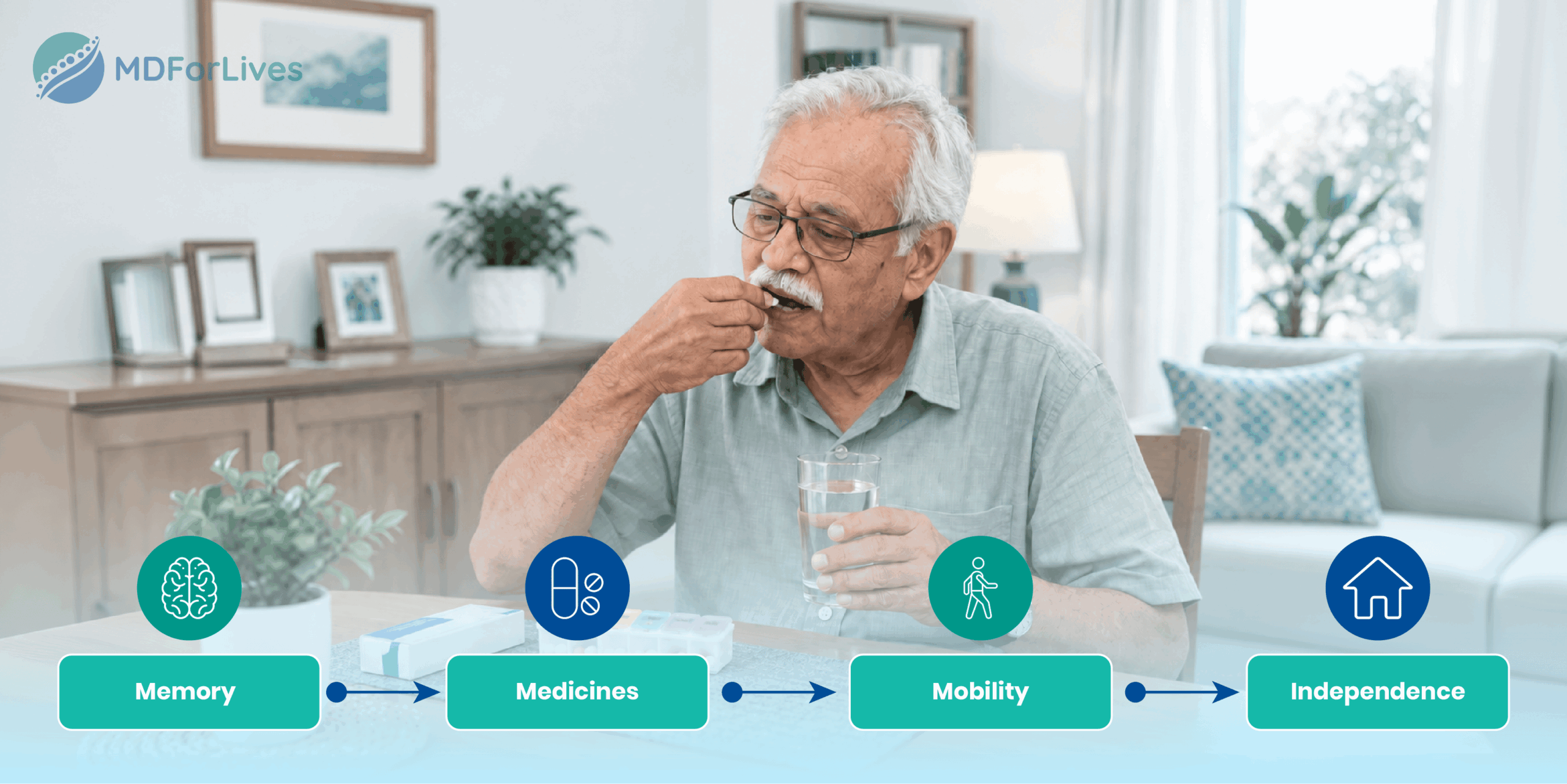
The survey shows why memory, medicines, mobility, and independence are best considered together in healthy aging. Explore the MDForLives Healthy Aging in Primary Care Insight Report for the detailed findings and methodology.
Healthy aging is about function, not just diagnoses
A person can live with several chronic conditions and remain active and independent; another may carry fewer diagnoses yet start struggling with medication schedules, balance, finances, or appointments. The Age-Friendly Health Systems framework captures this through the 4Ms: What Matters, Medication, Mentation, and Mobility.
These areas overlap. Medicines can affect alertness or balance, cognitive change can make medication management harder, and reduced mobility can limit participation. Healthy aging is therefore less about counting diagnoses and more about preserving everyday function.
Medicines need regular reassessment
Medication management for older adults is not only about remembering tablets. Multiple conditions can mean multiple medicines, several prescribers, changing doses, and greater opportunity for interactions or adverse effects. In the MDForLives survey, 36.3% of clinicians ranked polypharmacy and deprescribing as the single highest healthy-aging priority.
Clinicians also pointed to shared decision-making with patients or caregivers, dedicated medication-review visits, and collaborative review with clinical pharmacists as important approaches to reducing high-risk polypharmacy.
The deeper message is that medication safety is not only a checklist of exercise. Deprescribing means reviewing whether each treatment still provides enough benefit, adds burden or risk, and remains aligned with the person’s goals. Medication review also connects directly with cognition, because memory changes can make an appropriate treatment plan harder to manage safely.
Cognitive health in older adults needs time and context
Forgetfulness can be worrying, but not every memory lapse is dementia. Sleep, mood, hearing or vision loss, medicines, acute illness, and other conditions can affect cognition. The National Institute on Aging also notes that medicines can influence memory, sleep, and brain function.
In the MDForLives survey, 39.0% of clinicians said cognitive screening and dementia evaluation were the hardest healthy-aging areas to address adequately. The insight is not that cognition matters less. It is that meaningful assessment often needs history, context, family observation, and follow-up rather than a quick score.
Recommendations on routine screening vary by country. In the United States, the USPSTF currently finds insufficient evidence for universal screening in asymptomatic community-dwelling older adults. New concerns or changes in everyday function still warrant clinical attention.
Cognitive change can affect medicines, finances, safety, and independence. That makes everyday function an important bridge between memory and mobility.
Mobility and functional change can appear before a crisis
Mobility is sometimes discussed only after a fall. Healthy aging asks an earlier question: is moving around or managing daily life becoming harder?
Fall-prevention approaches such as CDC’s STEADI model assess gait, balance, medicines, vision, blood pressure, and home hazards alongside strength and balance exercise. Recommendations vary by country and individual risk.
The MDForLives survey adds a telling signal. 33.7% of clinicians said new difficulty with complex daily tasks, such as managing medicines or finances, is the early indicator of frailty or decline most likely to be missed.
The clinical meaning is that early decline may first appear as lost complexity, not a dramatic symptom. Difficulty organizing pills, managing money, shopping, or walking confidently can matter before a fall or medical crisis. Healthy aging habits are most useful when they protect the function a person wants to keep.
Healthy habits for seniors should protect what matters
Healthy aging tips often focus on exercise and food. Those matter, but the more useful question is what helps an older adult keep doing what matters. The National Institute on Aging highlights physical activity, sleep, nutritious food, medication review, addressing hearing or vision problems, and social and mental engagement.
Regular movement supports more than physical health in later life. Understanding the health effects of physical inactivity can help reinforce why maintaining activity is part of preserving mobility and independence.
Framed in this way, healthy habits for seniors become more meaningful: walking to keep visiting friends, strength work because rising from a chair is getting harder, or a medicine review because dizziness is undermining confidence outdoors. The habit is not the endpoint. Preserving participation and independence is.
Healthy aging also depends on how care is organized
Even when the priorities are clear, one primary-care visit cannot always hold them all. In the MDForLives survey, consultation time remained the biggest barrier to cognitive screening.
Memory, medicines, mobility, vaccination, nutrition, chronic disease, caregiver concerns, and personal priorities can all compete for the same appointment. The implication is not simply that every visit should be longer. Healthy aging may require a better division of work.
WHO’s 2025 ICOPE guidance takes a broad, person-centered approach across cognition, mobility, vitality, sensory health, psychological capacity, and social support. For primary care teams, that support shared workflows involving nurses, pharmacists, rehabilitation professionals, caregivers, and community services where appropriate.
Clinicians’ open-ended responses echoed this need, highlighting more time, community support, multidisciplinary care, rehabilitation, and earlier attention to function. The goal was not simply to detect more conditions, but to help older adults maintain independence.
Closing perspective: healthy aging aims for independence, not perfection
Why healthy aging matters become clearer when the goal is independence rather than perfection. Memory, medicines, and mobility are connected, and small functional changes can reveal risks that a diagnosis list alone may miss.
The MDForLives findings show that clinicians already recognize these priorities. The challenge is addressing them early enough and creating care pathways that do not force every aspect of healthy aging to compete for the same few minutes.
Healthy aging is not about doing everything at once. It is about noticing what is changing, understanding what matters most, and building enough support around the person to help them keep living the life they value.