
A parent enters the consultation with a chart full of sleep scores, step counts, heart-rate alerts, glucose trends, and screenshots from a child’s wearable device.
The data is detailed. The concern is real. But the pediatrician still has to answer the harder question: does this information change care?
That is the central tension around pediatric wearables today. More families are tracking children’s health, activity, sleep, symptoms, and disease-specific signals. More devices are entering daily routines. More data is arriving in consultation rooms.
But greater visibility does not automatically create greater clinical value.
MDForLives survey data shows that pediatricians are not dismissing wearable-generated data. They are filtering it. The data is useful when it is validated, disease-specific, clinically interpretable, and connected to a clear decision. Outside those conditions, it can become context, noise, or a source of unnecessary concern.
Pediatric Wearables Are Visible, but Not Yet Routine Decision Tools
Pediatricians are encountering wearable use in practice, but not uniformly. In the survey data, 22.2% reported frequently encountering pediatric patients or families using wearable devices, while 11.1% reported often, and 27.8% reported sometimes.
This suggests that pediatric wearables are already part of the pediatric conversation, but not yet a universal part of routine care.
That matters because pediatric practice is not only about interpreting data. It is also about interpreting families. A wearable alert can represent a true signal, but it can also reflect anxiety, misinterpretation, device limitations, or normal variation being treated as abnormal.
The clinical question is therefore not, “Is there data?”
It is, “Is this data reliable enough, relevant enough, and actionable enough to guide care?”
Selected Use Is Accepted. Broad Trust Is Not.
The MDForLives survey data shows a balanced view. About 44.4% of pediatricians said both medical and consumer wearables can be useful in selected cases. Another 33.3% said medical-grade wearables are clinically useful, but most consumer devices are not.
That distinction is important.
Pediatricians appear open to wearable data, but not equally across device types. Medical-grade devices, disease-specific monitors, and clinically validated tools are treated differently from general wellness trackers.
This is why pediatric wearables are best understood as a spectrum. At one end are tools like continuous glucose monitoring or disease-specific monitoring, where data may be tied to established care pathways. At the other end are consumer activity, sleep, or wellness metrics that may offer context but are less likely to directly change management.
Disease-Specific Monitoring Leads Trust
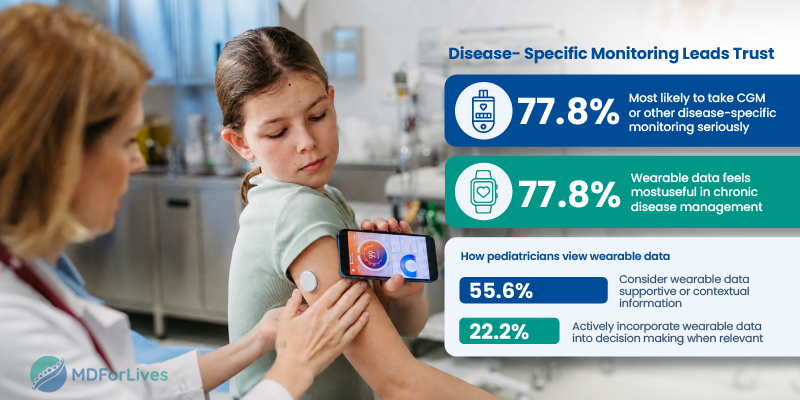
The strongest finding in the survey is where trust concentrates. When asked which wearable data they are most likely to take seriously in clinical care, 77.8% selected continuous glucose monitoring or other disease-specific monitoring.
This is the clearest signal in the data.
Pediatricians are not saying wearable data has no value. They are saying value rises when the data is tied to a known condition, a validated signal, and a clinical decision.
The same pattern appears in use setting. About 77.8% said wearable data feels most useful today in chronic disease management. Only smaller proportions selected lifestyle counseling, cardiac or symptom monitoring, or general use cases.
The insight is practical: pediatric wearables are most trusted when they help manage an existing clinical problem, not when they broadly measure everyday life.
Useful Data Still Has Clear Limits
Trust is not binary. In the survey data, 50.0% said wearable data is generally useful, but with clear limitations. Only 16.7% said it is accurate and reliable enough to support clinical decisions in selected cases. Another 16.7% said it is often inconsistent and needs caution.
This explains how pediatricians are likely to use the data in practice.
They may look at trends. They may use wearable data to support a conversation. They may compare device data with symptoms, clinical history, examination findings, and established tests. But they are unlikely to let an isolated device output override clinical judgment.
That caution is appropriate. In pediatrics, context matters: age, development, growth, family behavior, device fit, activity level, sleep routines, chronic disease status, and caregiver interpretation can all shape how data should be read.
For pediatric wearables to become more clinically useful, accuracy alone is not enough. The data also needs interpretation standards.
Most Data Supports the Conversation, Not the Decision
When parents present wearable-generated data, 55.6% of pediatricians said they consider it supportive or contextual information. Another 22.2% said they actively incorporate it into decision-making when relevant.
This is a useful distinction.
Wearable data may help structure the visit. It may reveal patterns that families are noticing. It may help pediatricians understand sleep, activity, glucose variability, symptoms, or adherence. But most of the time, it appears to support clinical reasoning rather than replace it.
The same pattern appears in management change. About 61.1% said wearable-generated data occasionally changes clinical management, while 27.8% said rarely, and 11.1% said frequently.
In other words, pediatric wearables are influencing care selectively. They are not yet driving it routinely.
The Benefit Is Monitoring, but the Risk Is Overreaction
Pediatricians see the strongest benefit in ongoing care. In the survey data, 44.4% said the most meaningful benefit of wearables is better monitoring in chronic or ongoing conditions. Another 27.8% selected earlier recognition of patterns that may otherwise be missed.
That is the promise: earlier pattern recognition, more continuous context, and better family engagement around chronic conditions.
But the concerns are equally important. About 44.4% cited data that drives unnecessary clinical concern or visits as the greatest concern, while 38.9% cited increased parental anxiety or over-monitoring.
This is the pediatric-specific tension. In adults, self-tracking may mostly affect the individual. In children, wearable data often flows through parents and caregivers. That can support care, but it can also intensify anxiety or create repeated clinical queries around data that may not be actionable.
Validation Is the Barrier That Matters Most
The clearest barrier is trust infrastructure. In the survey data, 55.6% identified lack of validation and standardization as the biggest barrier to integrating wearable data into pediatric care more confidently.
Open-ended responses reinforced the same pattern. Pediatricians called for more standardization, stronger validation, clearer algorithms, better integration into electronic records, and data that is accurate enough to reduce false concern rather than create it.
This is where the next phase of pediatric digital health must focus.
The issue is not simply whether families will use devices. They already are. The issue is whether pediatricians can interpret wearable-generated data consistently, safely, and efficiently inside real clinical workflows.
Closing Perspective
Pediatric wearables are not being rejected by pediatricians. They are being sorted.
The MDForLives survey data shows that pediatricians see real value in disease-specific monitoring, especially in chronic care. They are willing to consider wearable data as context, and in selected cases, as part of clinical decision-making.
But confidence remains conditional.
The future of pediatric wearables will depend on validation, standardization, workflow integration, and clear guidance on when data should influence care. Without that, more data may simply create more interpretation burden for clinicians and more anxiety for families.
The next question is not whether children will be monitored.
It is whether the data being monitored is meaningful enough to trust.