
A skin condition may begin at the surface, but it does not always stay there.
In modern dermatology, clinicians are increasingly seeing what many patients experience in real life: chronic inflammatory skin diseases can overlap with metabolic risk, lifestyle patterns, insulin resistance, weight-related health concerns, stress, sleep disruption, and long-term systemic burden.
But recognizing the link is not the same as acting on it.
That is the real tension in dermatometabolic care today. Dermatologists know that some skin conditions may reflect more than local inflammation. Yet in a busy consultation, the decision to address metabolic factors is shaped by time, patient readiness, visible risk markers, disease severity, and whether there is a practical next step after the conversation.
MDForLives survey data shows that dermatologists are not ignoring the skin-metabolism connection. They are applying it selectively.
Metabolic Thinking Is Triggered by Visible Risk
The strongest trigger in the survey data is not a specific diagnosis alone. It is the patient profile.
When asked what most reliably prompts consideration of underlying metabolic dysfunction, 46.7% of dermatologists selected obesity or visible metabolic indicators. Refractory or treatment-resistant disease followed at 24.4%, while early-onset severe disease was selected by 20.0%.
This suggests that dermatometabolic care often begins when risk is visible, persistent, or clinically difficult to ignore.
That has practical logic. A patient with visible metabolic indicators, severe disease, or poor response to treatment may prompt a broader clinical lens. But it also raises a concern: if action depends mainly on visible risk, some patients with less obvious metabolic dysfunction may be missed.
The opportunity is to move from reactive recognition to more structured identification.
Awareness Is High, but Action Is Selective
The survey data shows a clear perception-practice gap. About 42.2% of dermatologists said they address metabolic factors selectively, depending on condition severity or patient profile. Another 28.9% actively integrate metabolic evaluation and lifestyle counseling into most relevant cases. At the same time, 26.7% recognize the importance but rarely incorporate it because of practical constraints.
This is the heart of dermatometabolic care in practice.
The field is not divided between believers and skeptics. Most dermatologists recognize the relevance. The difference lies in how consistently that recognition becomes action.
For some, metabolic evaluation is already part of care. For many, it depends on the condition, the patient, and the available time. For others, the intent exists, but the workflow does not.
Hidradenitis Suppurativa Stands Out
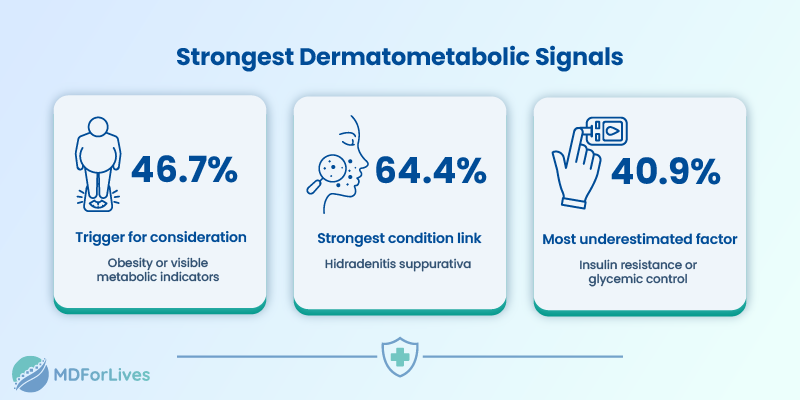
When asked which condition most clearly demonstrates the impact of metabolic health on dermatologic outcomes, 64.4% selected hidradenitis suppurativa. Psoriasis followed at 17.8%.
That is a strong signal.
Hidradenitis suppurativa is often where the dermatometabolic link feels most visible in practice. The disease can be chronic, painful, recurrent, and difficult to control. It may also overlap with obesity, metabolic syndrome, smoking, inflammatory burden, and quality-of-life challenges.
This does not mean every patient with hidradenitis suppurativa has the same metabolic profile. It means dermatologists see the condition as one where broader health context can meaningfully shape care.
Psoriasis also remains important, especially because of its known association with systemic inflammation and metabolic comorbidities. But in this survey data, hidradenitis suppurativa appears to be the condition most strongly prompting dermatologists to think beyond the skin.
Insulin Resistance Is the Overlooked Factor
The most underestimated metabolic or lifestyle factor in dermatology care was insulin resistance or glycemic control, selected by 40.9%. Diet quality, independent of weight, followed at 31.8%.
This finding is important because it shifts the conversation away from weight alone.
Visible weight-related risk may trigger the conversation, but dermatologists are also recognizing that metabolic health is broader than body size. Glycemic patterns, insulin resistance, diet quality, inflammation, stress, sleep, and activity may all influence disease expression or treatment response in selected patients.
For dermatometabolic care to become more clinically useful, the conversation must stay medically grounded and non-stigmatizing. The goal is not to blame the patient for skin disease. The goal is to identify modifiable factors that may affect outcomes, especially when disease is severe, recurrent, or treatment-resistant.
Lifestyle Change Can Help, but It Is Not Simple
The survey data shows that dermatologists do see value in lifestyle change. About 47.7% said lifestyle changes can be highly meaningful in selected patients, while 29.5% described them as meaningful but largely adjunctive.
This is a balanced clinical view.
Lifestyle change is not being framed as a replacement for dermatologic treatment. It is seen as a potential amplifier of care in selected cases. That distinction matters. Patients with chronic inflammatory skin disease may still need topical therapy, systemic treatment, biologics, procedures, or specialist coordination. But lifestyle and metabolic support may help reduce triggers, improve resilience, support comorbidity management, or strengthen long-term outcomes.
The challenge is sustaining it.
About 34.1% said lifestyle interventions most commonly fail because patients do not see visible short-term results. Another 31.8% pointed to initial patient motivation, and 22.7% to sustained adherence over time.
That means the failure point is often not information. It is momentum.
The Missed Opportunity Is Counseling and Follow-Through
The most common missed opportunity in dermatometabolic care was not counseling on lifestyle despite clear risk, selected by 30.2%. Not screening when early signs are present followed at 25.6%, while not following up on lifestyle recommendations was selected by 23.3%.
These findings show that the gap is not one single failure. It appears across the care pathway: recognition, counseling, follow-up, and coordination.
Open-ended responses in the survey data also pointed toward practical needs: individualized plans, better counseling, and clearer routes for support, including coordination beyond dermatology when needed.
This is where dermatometabolic care becomes a systems issue. A dermatologist may identify risk, but without time, referral options, patient education tools, or follow-up structures, the conversation may remain brief and difficult to sustain.
What Actually Drives the Consultation?
When asked what determines whether metabolic or lifestyle factors are addressed during a consultation, two answers led equally: visible patient risk factors and patient willingness or openness to lifestyle discussion, both at 32.6%.
This is one of the most human findings in the survey.
Dermatologists may be clinically ready to raise the topic, but the conversation depends heavily on whether the patient appears at risk and whether the patient is open to discussing it. That is understandable. Lifestyle and metabolic conversations can be sensitive. They require trust, time, and careful framing.
But if patient openness determines whether the conversation happens, clinicians need better tools to make the discussion easier, more respectful, and more actionable.
Closing Perspective
Dermatology is moving beyond a purely skin-focused model, but not evenly.
MDForLives survey data shows that dermatologists increasingly recognize metabolic links, especially in hidradenitis suppurativa, refractory disease, and patients with visible metabolic risk. They see insulin resistance, diet quality, and lifestyle patterns as relevant. They also believe lifestyle changes can be meaningful in selected patients.
But the shift from awareness to action remains selective.
Dermatometabolic care is not limited by belief alone. It is limited by time, patient readiness, short-term visibility of results, limited follow-up, and unclear support pathways.
The next step is not asking dermatologists to become endocrinologists, nutritionists, or lifestyle coaches. It is building practical dermatology workflows that make metabolic risk easier to identify, discuss, refer, and follow up.
Because when skin disease signals something deeper, the value of care may depend on whether the system helps clinicians act beyond the skin.