

A screen that feels ordinary in the morning can become difficult to look at once a migraine begins.
The same can happen with overhead lighting, background conversations, meetings, notifications, or a noisy commute. Working with a migraine is therefore not only about managing head pain. The environment around the person can become harder to tolerate as symptoms develop.
That matters because leaving work immediately is not always possible. A person may still have a meeting to finish, a patient or customer to support, a deadline to meet, or a journey home to manage safely.
MDForLives surveyed people living with migraine across the USA, UK, Canada, Italy, France and Germany. The detailed patient findings are available in the MDForLives Migraine at Work Insight Report. The survey reflects patient-reported experiences of symptoms, productivity, acute treatment, workplace triggers, and support.
Migraine can change the workday before it causes absence
Severe head pain was the symptom most often identified as disrupting work in the MDForLives survey, but it was not the whole story. Light or sound sensitivity was selected by 33.0% of patients. Others identified brain fog or fatigue and nausea, or vomiting.
The important point is that different symptoms affect different parts of work.
Light sensitivity in migraine can make screens and bright rooms difficult. Sound sensitivity may make calls, shared offices, machinery, or busy environments harder to tolerate. Brain fog can affect concentration, memory, communication, and confidence in decision-making.
A person can therefore remain physically present while their ability to work normally has already changed.
For a broader look at how migraine affects daily life beyond individual attacks, explore the chronic migraine experience, including ongoing symptoms and challenges with daily functioning.
For professionals, the useful question may be less about headache intensity alone and more about function. Which symptoms actually interfere with the job? Can the patient still use a screen, communicate clearly, travel safely, or complete a safety-sensitive task?
Screens, bright light and noise can add to the sensory load
Once symptoms begin, the environment may add another layer of difficulty. In the survey, 36.8% of patients selected screen or bright-light exposure as the workplace factor that most triggered or worsened migraine. Noise or workplace stress followed closely.
This does not mean every screen or bright light causes migraine. Migraine triggers vary between people, and the same exposure may not affect every attack in the same way.
Prolonged screen use can also contribute to eye discomfort, and understanding the link between screen exposure and dry eye provides further insight into another possible source of visual discomfort.
Screen glare, overhead lighting, phones, conversations, machinery, or repeated visual tasks may be ordinary parts of the job. But during an attack, those same conditions can become increasingly difficult.
For some people, reducing glare, changing lighting, limiting screen exposure, or moving temporarily to a quieter environment may help. Whereas, for others; stress, long hours, poor sleep, or missed breaks may matter more.
Staying at work does not mean the attack is under control
As symptoms and environmental exposure overlap, function may fall before attendance changes. In the MDForLives survey, 56.8% of patients identified reduced productivity as the greatest work-related impact during migraine attacks.
That matters because absence captures only the most visible part of the burden.
Someone working with a migraine may continue answering emails, attending meetings, or remaining at their workstation while working more slowly, postponing demanding tasks, or struggling with concentration and visual demands.
A patient may describe having “worked through” an attack, but that does not necessarily mean normal function was maintained.
Understanding what happens before absence can reveal where migraine management is breaking down inside the workday.
Acute treatment needs to restore enough function for the situation
When function begins to fall, treatment becomes a race against the demands of the day. A patient may need to complete a shift, leave safely, continue caring for someone, or decide whether work can realistically continue.
In the survey, 40.2% of patients identified incomplete symptom relief as the biggest limitation of their acute migraine treatment.
When the first treatment did not work, patients took different routes. Some stopped work and rested; others used prescribed rescue treatment, while others waited for symptoms to improve or contacted a healthcare provider.
The clinical question is therefore not only whether medication was taken. It is whether restored enough function for the patient to manage what came next.
Treatment review can include how quickly relief begins, which symptoms remain, whether normal activity becomes possible, and what the patient does when the first option is not enough.
There is no universal answer to “how to get rid of a migraine at work.” The more useful goal is an individualized plan for early treatment, inadequate relief, recovery, and when further assessment is needed.
A migraine plan is difficult to follow if there is no room to use it
A clear treatment plan still depends on whether the work environment allows the patient to act on it. Difficulty taking breaks was the most selected workplace barrier in the MDForLives survey, reported by 36.8% of patients. Inflexible schedules were another prominent barrier.
That creates a practical mismatch.
A patient may know they need to take medication, reduce stimulation, rest, or step away, but the job may make that difficult at the moment symptoms begin. For example, a healthcare worker may be with a patient. A teacher may be in a classroom. A production worker may not be able to leave a station. Someone in a meeting may postpone treatment until the meeting ends.
The workplace does not necessarily cause the migraine, but it can affect how quickly the person is able to respond.
Effective migraine control involves more than reducing attack frequency; it also means considering how symptoms affect daily functioning and recovery between attacks.
Migraine-friendly work therefore involves more than removing possible triggers. It also means considering whether there is a realistic route to follow the agreed plan.
Missed work may be the visible end of a longer chain
Some attacks eventually result in absence. In the survey, 35.6% of patients reported missed workdays or shifts because of migraine. Others reported reduced hours or responsibilities.
But absence may be the visible end of a longer sequence.
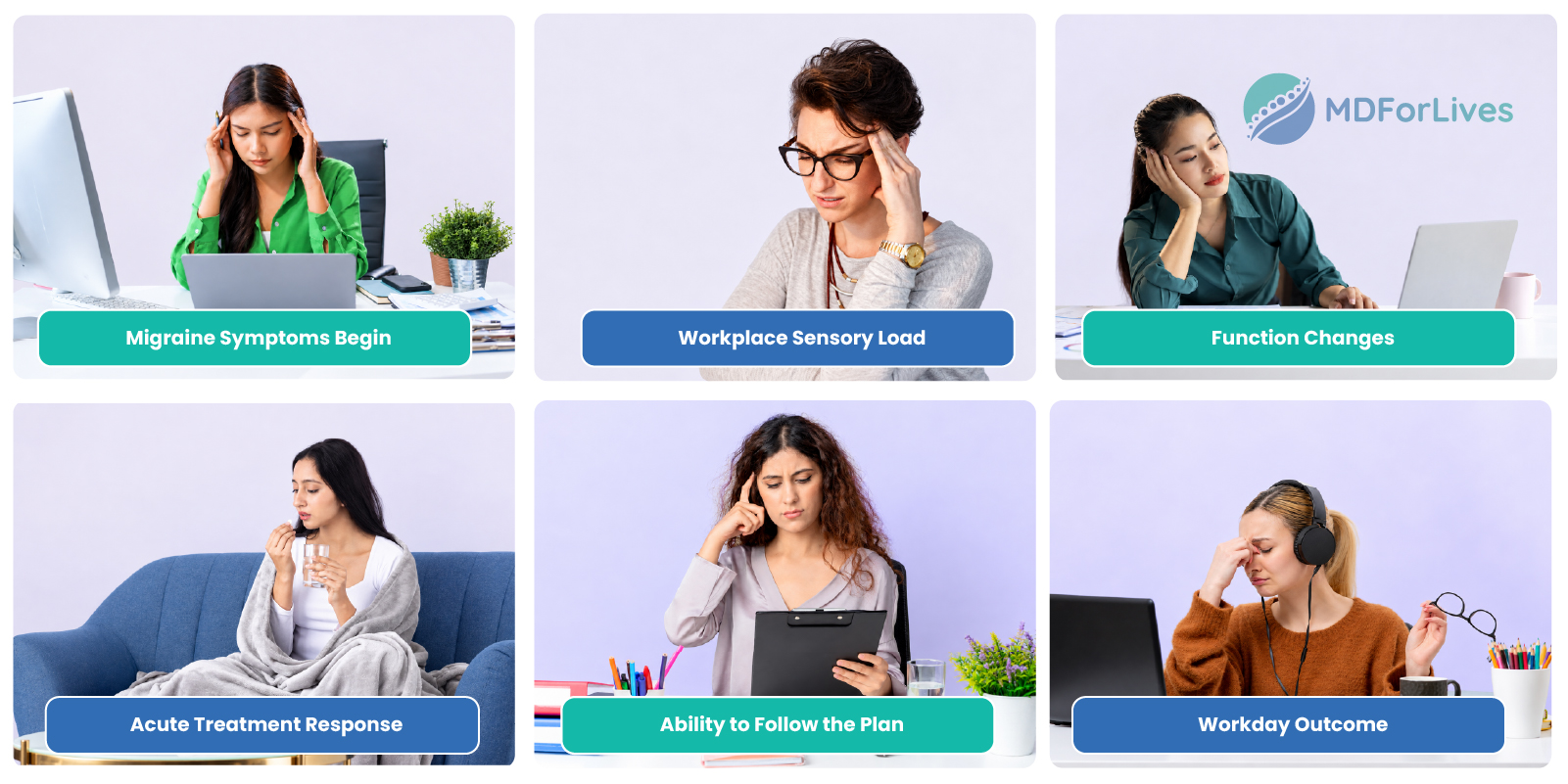
Symptoms begin. Screens or noise become harder to tolerate. Concentration drops. Acute treatment provides incomplete relief. The patient cannot easily step away. Function continues to decline.
This helps explain why treatment and workplace support solve different parts of the same problem.
Patients most often selected more effective acute treatment as the change that would best support continued work, while flexible work arrangements were the next most selected option.
For professionals, understanding whether a patient can take treatment, reduce exposure, rest when needed, or leave safely can help explain why an otherwise reasonable migraine plan may be difficult to use in practice.
Closing perspective: the problem is not only the trigger, but what happens next
Working with a migraine is not simply a test of whether someone can tolerate pain.
A patient may develop light sensitivity while looking at a screen, struggle to concentrate during an important task, receive incomplete relief from treatment, and then discover that taking a break is difficult.
Those pressures can occur together rather than in a fixed sequence. That is why the practical story behind screens, lights, and noise is broader than trigger avoidance.
The goal is not a trigger-free workplace or a promise that every attack can be prevented. It is a more workable response when an unpredictable attack occurs.
For people living with migraine, staying productive may depend less on pushing through symptoms and more on having effective treatment, a clear fallback plan, and enough room to respond when the normal work environment becomes difficult to tolerate.