

A patient may have a good interaction with individual hospital teams and still leave feeling that the overall journey was difficult.
The reason is often what happens between those encounters. Handoffs, discharge, medication instructions, follow-up, and communication may involve different teams. When those connections are unclear, the patient experience can deteriorate even when each department performs well.
That is why the patient’s journey in healthcare needs to be viewed across departments, not as separate touchpoints.
MDForLives surveyed hospital administrators and executives across the USA, UK, and Italy. The detailed findings are available in the MDForLives Hospital Patient Experience Insight Report.
For hospital leaders, the practical question is not simply where patients are dissatisfied. It is where continuity is lost, who owns the next step, and how the same friction can be prevented from recurring.
Patient experience often breaks where ownership changes hands
In the MDForLives survey, 45.5% of administrators identified interdepartmental handoffs and care transitions as the point where patient experience most frequently breaks down.
Every transition requires information, responsibility, and expectations to move together.
A patient may receive appropriate care in one unit but remain unclear about the next appointment, medication change, discharge instruction, or who to contact afterwards. The clinical task may be complete while the journey still feels unfinished.
This is where patient journey mapping becomes useful. Instead of asking only what each department delivers, hospitals can map what the patient needs to know, do, or receive whenever responsibility changes hands.
The key question becomes: what must move with the patient when care moves to the next team?
Fragmented communication can turn small gaps into a poor journey
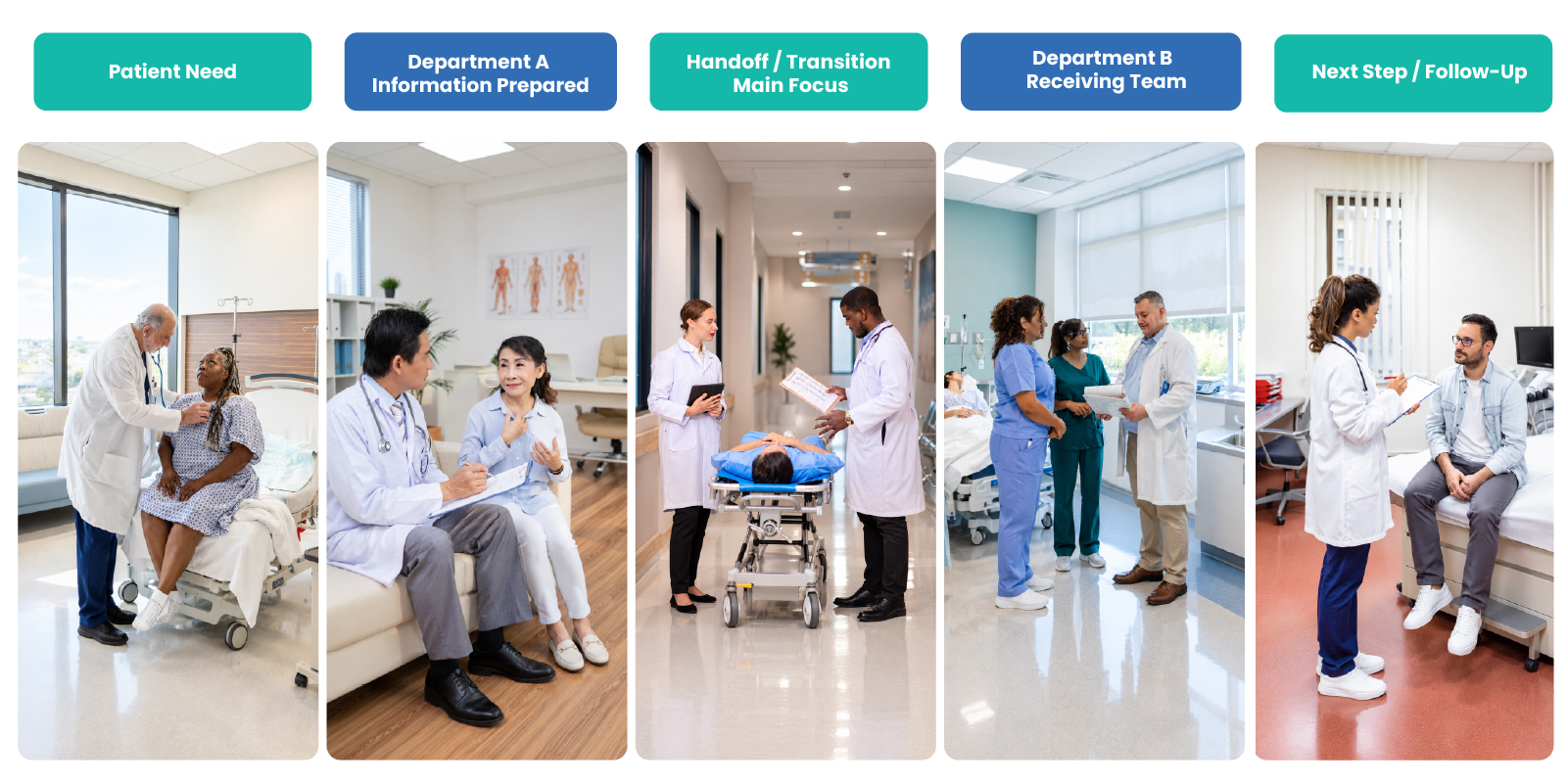
Once ownership changes, communication determines whether the transition feels connected. In the survey, 54.5% of hospital leaders identified fragmented communication across departments as the hardest operational issue to solve.
That friction may appear as repeated questions, conflicting instructions, delayed updates, duplicated work, or uncertainty about who owns the next step. Repeated across the patient experience journey, these gaps can make care feel fragmented.
Hospitals need the right information to reach the right team at the right time, with clarity about who should act.
For leaders asking how to improve the patient experience, a strong encounter can still be undermined by a confusing transition. The improvement target is continuity between departments.
A positive patient experience depends on more than the quality of the clinical encounter. Patients also need clear information about what is happening, what comes next, and what they need to do. Explore what patients are told vs what they need to know.
Patient feedback is more useful when it can trigger action during care
When friction appears, the next challenge is detecting it early enough to respond. Hospitals collect feedback through bedside conversations, surveys, digital tools, complaints, and follow-up. Retrospective feedback supports learning, but it cannot always correct the experience happening now.
The MDForLives findings show bedside rounding remains an important way to capture friction during care.
A patient confused about discharge instructions may benefit more from clarification today than from reporting the issue later. But listening is only the first step. Someone must recognize the signal, route it to the appropriate owner, decide whether action is needed, and close the loop.
The useful operating question is: how quickly can a patient signal become an accountable action?
Experience data needs to connect with the operational story
Patient feedback can identify where friction is felt, but it does not always explain why it happened. In the survey, 54.5% of leaders said patient-experience data is reviewed alongside clinical and operational information but remains largely separate.
That matters because the cause of a poor experience may sit outside the experience data itself.
A complaint about waiting may reflect flow, staffing, or scheduling. Confusion after discharge may point to handoff design. Navigation difficulties may originate in wayfinding or unclear instructions.
Effective patient journey mapping therefore needs two views: what the patient experienced and what was happening operationally when that experience occurred.
The patient tells the hospital where friction is felt; connected data can help explain where it begins.
Digital tools work best when they make the next step easier
Digital patient-experience initiatives can include portals, messaging, check-in, wayfinding, reminders, and follow-up. In the MDForLives survey, 54.5% of administrators selected automated SMS follow-up and care navigation as a digital capability that had delivered measurable reduction in patient-journey friction.
The important point is not that one technology is universally the best. Digital tools create value when they remove a specific obstacle.
A useful message can clarify what happens next. Digital check-in can reduce uncertainty before arrival. Wayfinding can make movement through the hospital easier. Followups can keep the patient connected after discharge.
Technology should therefore be evaluated against a simple question: does this make the next step easier to understand or complete?
If not, another digital channel may simply create another place for patients and staff to manage.
Improving the journey requires shared ownership, not isolated fixes
A journey problem may begin in scheduling, worsen during a handoff, and appear again after discharge. No single department may see the full sequence. That is why improving patient experience requires a shared operating view rather than isolated fixes.
The MDForLives report also points toward real-time patient-experience analytics and journey tracking, selected by 45.5% of leaders as the capability likely to have the greatest impact over the next three to five years.
Their value is not another dashboard. It is the ability to see recurring friction across departments, connect it to operational conditions, and assign responsibility to the team that can act.
A practical improvement cycle is: Map the journey → identify recurring friction → connect experience with operational data → assign ownership → intervene → measure whether the journey improves.
This moves patient experience from a retrospective score toward an operating discipline.
Closing perspective: improve the connections, not only the touchpoints
Hospitals organize care by departments. Patients experience it as a journey. That difference explains why individual encounters can perform well while the overall experience still feels disconnected.
The MDForLives findings point toward a practical story: continuity can weaken at handoffs, fragmented communication can compound the problem, feedback may arrive too late to help, and separate data can make the underlying cause harder to see.
Improving the patient’s journey in healthcare therefore requires more than asking each department to improve independently.
The stronger approach is to make transitions visible, capture friction close to care, connect feedback with operational context, assign ownership when care crosses boundaries, and use digital tools where they remove a defined source of friction.
For hospital leaders, the goal is not a friction-free journey. It is a journey in which patients understand what is happening, what comes next, and who remains responsible as care moves forward.