
A patient may leave the consultation with a diagnosis, a treatment plan, and a folder full of information.
But that does not always mean they feel prepared.
Cancer care is full of moments where information is given, but understanding is still forming. The first conversation after diagnosis can feel overwhelming. Treatment options may sound technical. Side effects may be explained, but not fully imagined. Long-term impact may be mentioned, but not absorbed. Patients may nod in the room and only later realize what they still do not know.
That is the gap at the center of cancer communication.
MDForLives survey data shows that many patients do receive information that feels mostly clear. Yet the same data also reveals persistent gaps in timing, practicality, confidence, and daily-life preparation. The issue is not simply whether clinicians talk to patients. It is whether the right information reaches patients at the right time, in a way they can use.
Mostly Clear Does Not Mean Fully Understood
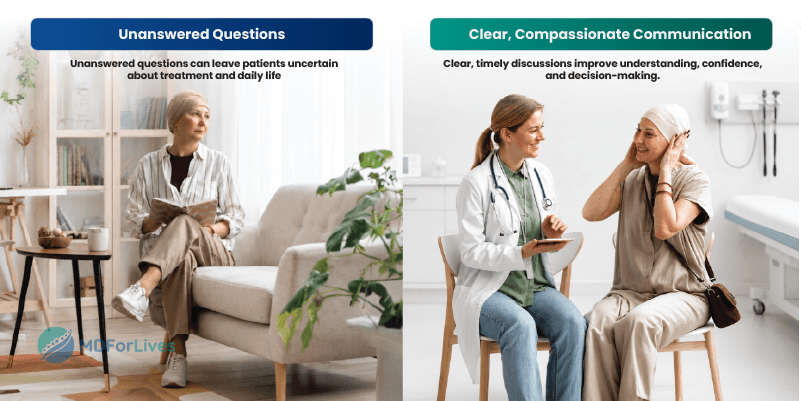
The first finding appears positive at first glance. In the MDForLives survey data, 59.5% of patients said the information they received after diagnosis was mostly clear, with some unanswered questions. Another 27.0% said it was very clear and easy to understand.
This suggests that cancer communication is not failing completely. Most patients are receiving some level of clarity.
But the phrase “with some unanswered questions” matters.
A cancer diagnosis is not a single information event. It is a sequence of decisions, emotions, treatment steps, and practical adjustments. A patient may understand the diagnosis broadly, but still be unclear about what treatment involves, how side effects might feel, what recovery could look like, and how daily life may change.
The insight is simple: information can be clear enough to follow, but incomplete for living through cancer.
Treatment Options Come First
At the time of diagnosis, the top information need was understanding treatment options, selected by 34.3% of patients. Knowing what to expect physically, including side effects, followed closely at 31.4%. Understanding chances of recovery or likely outcomes came next at 28.6%.
This pattern reflects how patients prioritize immediately after diagnosis.
First, they want to know what can be done. Then they want to know what it will feel like. Then they want to understand what it may mean for their future.
Effective cancer communication has to follow that emotional and practical sequence. Patients may not be ready for every detail at once, but they need a clear path: what are my options, what will happen next, what should I expect, and what questions should I return to later?
Understanding treatment options can help patients approach difficult cancer decisions with clearer questions and expectations. Learn more about targeted therapy for cancer, including how these treatments are used in modern oncology.
The Missing Piece Is Often What Comes Next
When asked what was not explained well enough early on, the leading response was alternative treatment options at 27.3%. Long-term impact of treatment followed at 21.2%, while side effects and how to manage them were selected by 18.2%.
These gaps show that patients are not only asking for diagnosis facts. They are asking for decision context.
Knowing the recommended treatment is important. But patients also want to understand why that option was chosen, whether alternatives exist, what trade-offs are involved, and what the treatment may mean months or years later.
Cancer treatment decisions can involve multiple options, potential benefits, and trade-offs. Explore how patients and clinicians navigate precision cancer care and immunotherapy decisions.
This is where cancer communication can shift from “telling” to “preparing.”
A patient does not only need to hear what will happen. They need help understanding how to think about what will happen.
Timing Shapes Understanding
The MDForLives survey data shows that 56.3% of patients felt information was timely and helpful. But 31.3% said information was sometimes given too late, while 9.4% said it was often too early and overwhelming.
This is one of the most important findings.
The same information can feel supportive or stressful depending on when it is delivered. Too much detail at diagnosis can overwhelm. Too little practical guidance during treatment can leave patients unprepared. Information about side effects may be more useful before treatment begins. Information about long-term effects may need to be repeated later, when the patient is ready to think beyond immediate survival.
Good cancer communication is not a one-time handoff. It is staged, repeated, and adjusted to where the patient is in the journey.
Balanced Information Still Leaves Gaps
More than half of patients, 56.3%, said the amount of information they received was mostly balanced and manageable. But 25.0% said they received too much too early, especially around diagnosis, while 18.8% said they received too little when they needed practical guidance.
This reinforces a key tension: patients need both simplicity and completeness, but not all at once.
Clinicians often face the difficult task of communicating enough without overwhelming. Patients, meanwhile, may need information to be repeated, summarized, written down, or explained in daily-life terms.
In cancer communication, balance does not mean giving less information. It means sequencing information better.
Understanding Is Often Partial
The survey data shows that 61.3% of patients felt they understood the information fairly well, but with some gaps. Only 29.0% said they understood it very well.
That is a meaningful difference.
Partial understanding can affect confidence, adherence, preparedness, and the ability to ask informed questions. A patient may know the name of the treatment, but not what side effects need urgent attention. They may understand that treatment is recommended, but not what alternatives were considered. They may know the schedule, but not how treatment may affect work, caregiving, fatigue, appetite, fertility, mood, or independence.
The goal of cancer communication should not be information delivery alone. It should be usable understanding.
Daily Life Is Still Under-Prepared
One of the strongest patient-experience gaps appears around daily life. Only 19.4% of patients said they were very well prepared for how treatment would affect daily life. Another 41.9% felt somewhat prepared, while 32.3% were not well prepared and 6.5% were not prepared at all.
This is where clinical information and lived experience often separate.
A treatment plan may be medically clear, but patients also need to know what a typical week may feel like, when fatigue may peak, whether they may need help at home, what symptoms to track, how to manage appointments, and when to contact the care team.
Advances in oncology can expand treatment options, but turning progress into meaningful patient care also depends on how well new approaches work in everyday clinical practice. Explore why oncology progress can still feel uneven in practice.
For patients, “What will happen to my life?” can be as urgent as “What will happen to my cancer?”
Patients Still Look Beyond the Medical Team
When asked where they relied most for understanding their condition and treatment, 35.5% selected their doctor or medical team. Online resources followed closely at 32.3%, and 22.6% relied on a combination of multiple sources.
This does not mean patients distrust their clinicians. It means information needs continue after the consultation ends.
Patients search online because they want repetition, simpler explanations, patient stories, practical tips, or answers to questions that emerge later. The risk is that online information may vary in quality, accuracy, and relevance.
That makes clinician-guided information more important, not less. Patients need trusted resources they can return to after the appointment.
Closing Perspective
Cancer communication is not only about what patients are told. It is about what they are able to understand, remember, question, and use.
MDForLives survey data shows that many patients experience information as mostly clear and timely. But the gaps are still meaningful: unanswered questions, incomplete explanation of treatment options, limited preparation for long-term impact, and uncertainty around how treatment will affect daily life.
The next step in patient-centered oncology is not simply more information.
It is better-timed information, repeated at the right moments, explained in practical language, and connected to the decisions patients actually face.
Because the best cancer communication does not end when the doctor finishes speaking.
It continues until the patient feels prepared to live through what comes next.