
When a patient hears the word immunotherapy, it can sound like hope.
But the next question is often harder: is it right for me?
That question sits at the center of modern cancer care. Treatment is no longer described only through surgery, radiation, or chemotherapy. Many patients now hear about immunotherapy, targeted therapy, molecular testing, genetic results, biomarkers, precision medicine, and personalized care pathways. These terms can bring optimism, but they can also add pressure.
Because when treatment becomes more personalized, the patient is asked to understand more.
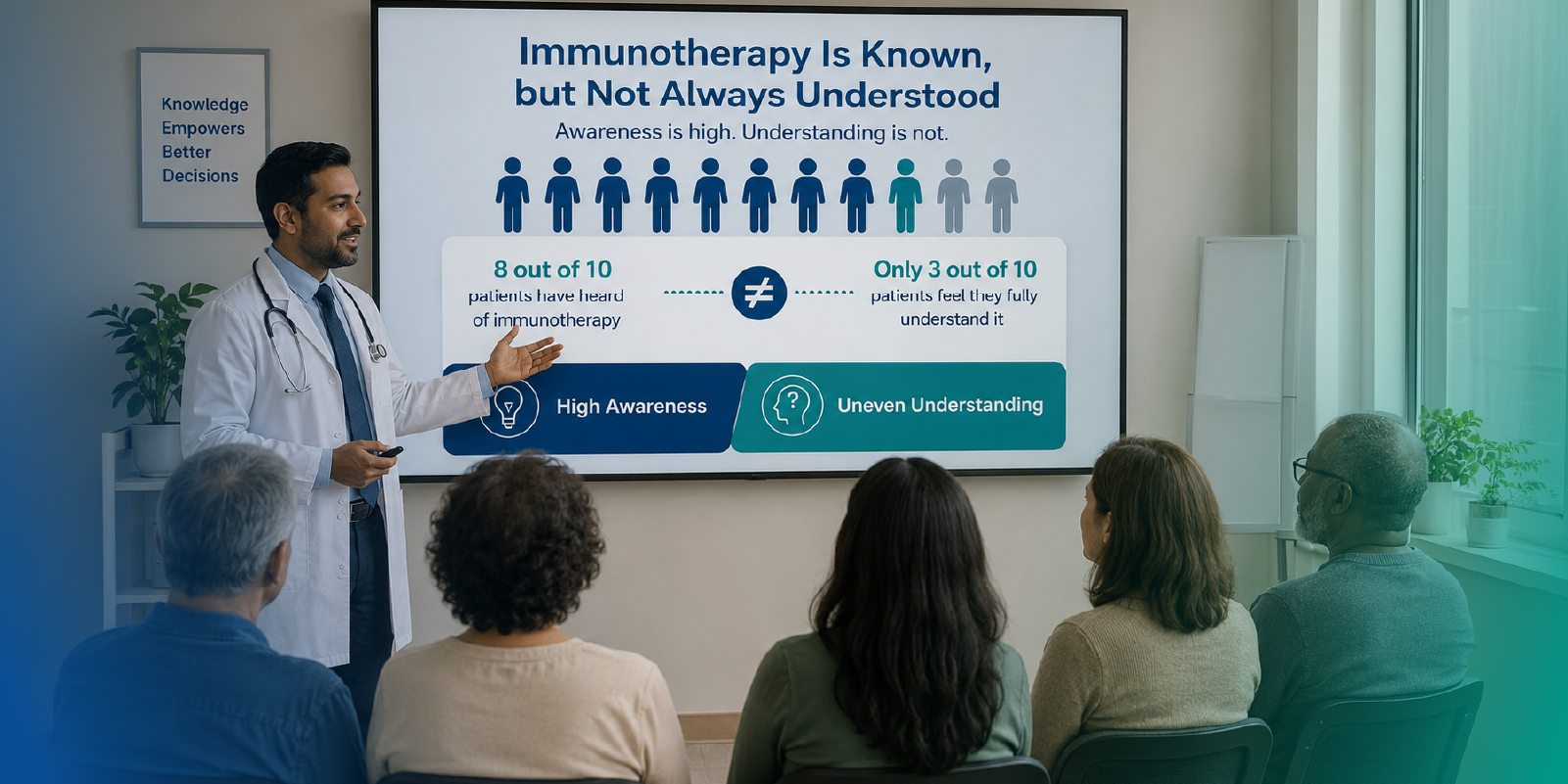
MDForLives insights from a global community of over 2,800 cancer patients reveal a clear pattern: awareness of newer cancer treatments is rising, but clarity is not rising at the same pace. While 42% say they are very familiar with immunotherapy, many still struggle to understand what it means for their own treatment. The gap is no longer only about access to innovation. It is about interpretation.
Immunotherapy Is Known, but Not Always Understood
Immunotherapy has changed the cancer conversation because it works differently from many traditional treatments. Instead of directly attacking cancer cells like some treatments do, it helps the body’s immune system recognize and fight cancer. For some patients and cancer types, it has created meaningful new possibilities.
But patient understanding is uneven.
In MDForLives, 42% of patients said they were very familiar with immunotherapy. That sounds encouraging, but familiarity does not always mean confidence. A patient may know the term, hear it from their doctor, read about it online, or know someone who received it, yet still not understand why it applies to some cancers and not others.
This is one of the most important patient insights: awareness can create expectation, but understanding determines confidence.
Precision Medicine Adds Information, but Also Complexity

Precision medicine is built around the idea that cancer treatment can be guided by the specific features of a person’s cancer, including biomarkers, molecular changes, and genetic test results. That can help identify which treatments may be more likely to work.
But test results are only useful to patients if they can be explained clearly.
For readers interested in how genetic analysis supports diagnosis beyond cancer, understanding genetic testing for rare diseases can provide additional insight into the broader role of genomic testing in personalized healthcare.
The MDForLives data shows that 47% of patients received genetic or molecular test results, while 31% said they did not fully understand them. This suggests that patients are being given information that may influence treatment, but not always the interpretation needed to feel confident.
That creates a dependency gap. Patients may receive a report, but still rely entirely on the care team to translate what it means. That reliance is not wrong. Cancer care should involve expert guidance. But when patients do not understand why a treatment is or is not recommended, the decision can feel distant from them.
Precision medicine promises personalization. Patients need that personalization to be understandable, not just scientifically accurate.
The Hardest Part Is Often Choosing Under Uncertainty
Cancer treatment decisions are emotional, time-sensitive, and deeply personal. MDForLives shows that 50% of patients struggle with balancing treatment benefits against possible side effects, while others face confusion from multiple options and conflicting information.
This is where modern cancer care becomes difficult.
More options can be empowering, but they can also increase decision burden. Patients may need to weigh questions such as: What is the chance this treatment will work? What side effects should I expect? What happens if it fails? Is this recommended because of my test results? What are the long-term unknowns?
The challenge is not that patients do not want to participate in care. It is that participation without clarity can feel overwhelming.
Hope Is Present, but It Is Cautious

The emotional tone in the data is not pessimistic. It is cautious.
In MDForLives, 61% of patients felt cautiously hopeful about new treatments, while only around 17% felt very hopeful. At the same time, 66% expressed concern about long-term unknown effects.
That combination is important.
Patients are not rejecting innovation. They are calibrating hope against uncertainty. They know newer treatments may offer possibilities, but they also know that every treatment comes with questions: side effects, durability, eligibility, response, and what happens next.
For immunotherapy, this can be especially complex because side effects may involve the immune system and may differ from what patients expect from chemotherapy. Patients may need clear guidance on what symptoms to watch for, when to report them, and how treatment risks are monitored.
Some patients also want clearer information about less commonly discussed complications, such as Immunotherapy Side Effects on the Eyes, which can occur with certain immunotherapy treatments and may require prompt medical attention.
Hope becomes stronger when uncertainty is explained, not minimized.
Why Patients Search Online Even When Doctors Are Trusted
One of the most revealing findings is that 94% of patients report feeling supported by their doctors, yet 100% turn to online sources, with 55% doing so frequently.
This should not be read as distrust in clinicians.
It suggests that clinical support and information needs are not the same thing. A patient may trust their oncologist and still search online after the appointment because they need more time, simpler language, repeated explanation, or reassurance from patient communities.
Cancer consultations are often dense. Patients may hear new terms, absorb difficult news, make treatment decisions, and manage emotional reactions all at once. It is understandable that they look for reinforcement later.
Many patients also explore trusted educational resources about other emerging therapies, including new migraine treatments, to better understand how medical innovation is improving care across different health conditions.
The real insight is this: support is present, but clarity is still being sought.
What Patients Need Explained More Clearly
The QnR asks what patients most wish was explained more clearly when discussing newer cancer treatments. Based on the survey themes, the strongest needs are likely around personal relevance, test results, side effects, eligibility, and expectations.
Patients do not only want to know what immunotherapy is. They want to know whether it fits their cancer, why it may or may not work, what test results mean, what side effects are different, and what “precision treatment” means in everyday life.
This is where patient education must shift from treatment description to decision translation.
The question patients are asking is not only, “What are my options?”
It is, “How do these options apply to me?”
Closing Perspective
Cancer care has moved from standardized treatment pathways toward more personalized decisions. That progress matters. But personalization has also introduced a new burden: patients are now asked to understand data, options, eligibility, benefits, risks, and uncertainty.
The MDForLives findings show a clear gap. Patients know more words than before. They hear more treatment possibilities than before. They receive more test information than before.
But understanding is still uneven.
The next challenge in cancer care is not only developing better treatments. It is helping patients understand what those treatments mean for their own lives.
Because better cancer care is not only about offering immunotherapy or precision medicine.
It is about making the decision feel clear enough for patients to carry.