
Choosing a colorectal cancer screening test is no longer simply whether a patient should have a colonoscopy. Depending on individual risk, local guidelines and available services, options can include colonoscopy, fecal immunochemical testing (FIT), stool DNA-FIT and other non-invasive approaches, while blood-based testing is beginning to expand how some average-risk adults enter screening.
That creates a practical question: when should colonoscopy remain the preferred route, and when can a non-invasive test be an appropriate alternative? The answer starts before comparing test characteristics. Symptoms, family history, previous colorectal neoplasia, hereditary risk, prior screening, preference and access to diagnostic follow-up can all change the pathway.
To understand how clinicians navigate these decisions, MDForLives surveyed gastroenterology healthcare professionals across the USA, UK, Italy and France. The detailed clinician findings and methodology are available in the MDForLives Colorectal Cancer Screening: Where Non-Invasive Tests Fit in Practice Insight Report.
Classify the patient first
Before discussing colonoscopy, stool testing or newer technologies, clinicians first need to establish whether the patient is actually being screened. An asymptomatic person without major high-risk features may have several appropriate tests available. But suspected symptoms, hereditary syndromes, previous advanced neoplasia or a strong family history move the task away from routine average-risk screening, toward diagnostic evaluation or a dedicated surveillance pathway.
Non-invasive tests are not universal substitutes for colonoscopy. The findings support this risk-first approach, with family history and hereditary risk among the factors clinicians said change their strategy. Classify the clinical scenario before comparing the tests.
A test the patient will complete
Once a patient is confirmed as appropriate for routine screening, the choice becomes more nuanced. Among gastroenterology HCPs surveyed, 78.6% favored colonoscopy for average-risk adults. A strong preference within this group but not a universal hierarchy, since screening systems differ in how they use colonoscopy and stool-based programs.
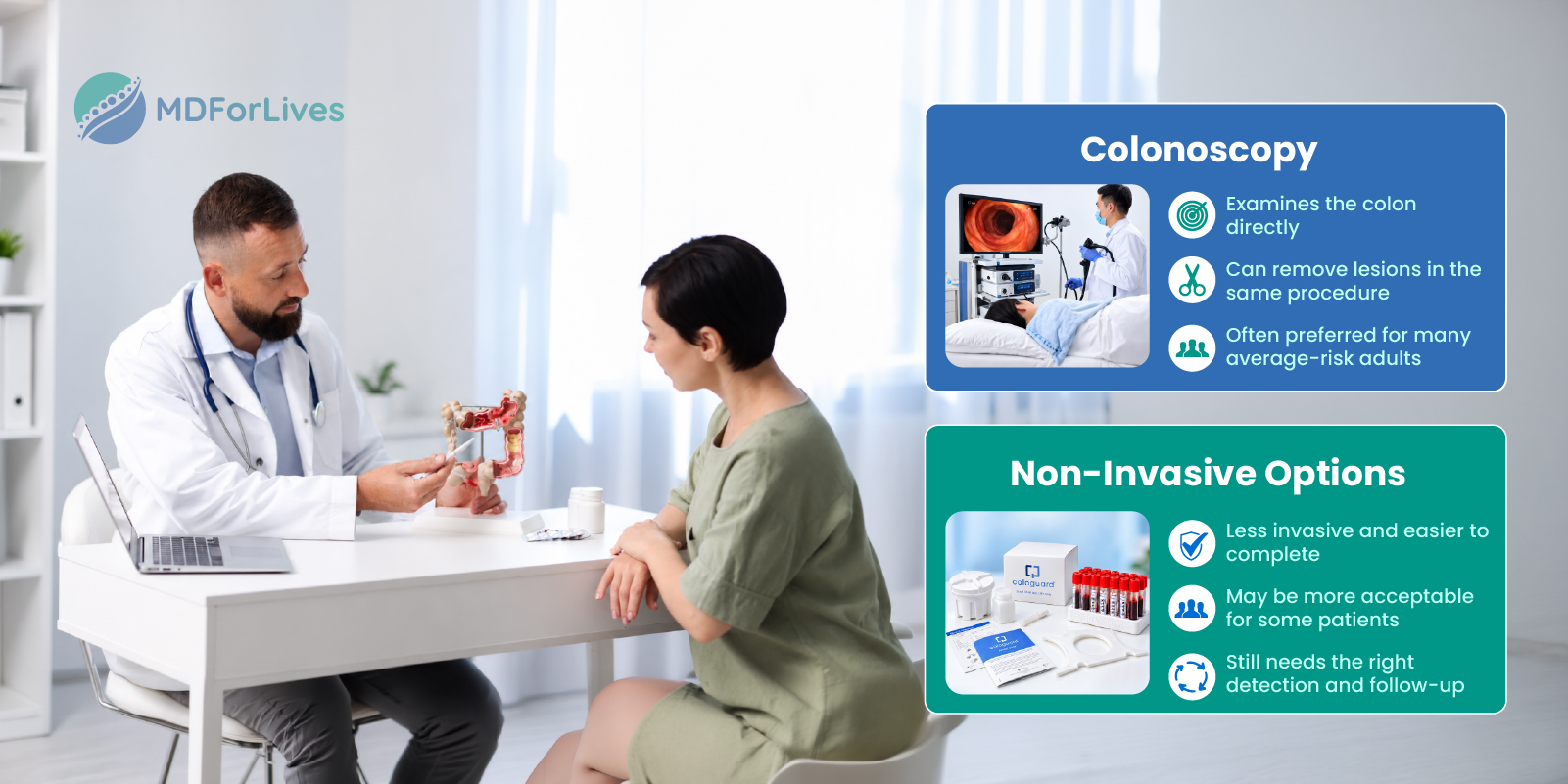
Each route differs: colonoscopy examines the colon and can remove lesions in the same procedure, while non-invasive testing reduces burden and may be a more acceptable entry point for those who would otherwise delay or decline screening. The comparison is not which test is superior: a test a patient repeatedly avoids may never deliver its benefit, while an easier test still needs the right performance and follow-up.
Endoscopic technology is also evolving, with artificial intelligence offering new possibilities for identifying abnormalities during clinical procedures. Explore how AI in endoscopy is improving detection while clinical trust remains important.
Easier only if detection holds
Non-invasive testing makes the first step easier, and for some patients avoiding bowel preparation, sedation or disruption decides whether screening happens at all. But convenience cannot be separated from performance.
In the survey, 57.1% of clinicians identified sensitivity for early colorectal cancer as the test characteristic that most influences screening choice. Clinicians judge options primarily by what they detect, not how easy they are, which matters more as alternatives multiply. A lower-burden test still needs the right balance of early-cancer detection, advanced-neoplasia pickup, false positives, false negatives, and evidence. Preference matters but should be informed: the discussion should cover not just which test a patient prefers, but what each detects, how often it repeats, and what happens if abnormal. Convenience improves entry; performance determines how much confidence to place in it.
Explain a positive result first
An important conversation happens before the test is ordered: FIT and stool DNA-FIT may reduce the need for colonoscopy as the initial step, but do not remove it from the pathway.
The strongest consensus appeared here: 88.1% of respondents selected diagnostic colonoscopy as the preferred next step after a positive non-invasive test. That makes many non-invasive approaches two-step pathways. The first test identifies who needs evaluation, and colonoscopy provides the diagnosis after an abnormal result. This should be clear from the start: a patient choosing a stool test to avoid colonoscopy should know an abnormal result may still lead to it, and that repeating a screening test instead of diagnostic evaluation delays resolution. A patient unwilling or unable to undergo follow-up colonoscopy may need a different discussion first; choose the first test with the second step in mind.
Quality is in the follow-up
The same applies at system level; expanding non-invasive screening helps more people participate, but every positive result needs diagnostic capacity.
In the research, 35.9% of clinicians identified follow-up colonoscopy capacity as the biggest barrier to routine implementation of non-invasive screening, shifting part of the decision from test selection to pathway design. Can abnormal results be tracked? Is diagnostic colonoscopy accessible and timely? Can the system absorb more demand if uptake rises? If the first step becomes easier but follow-up is delayed, the pathway may just move the bottleneck. Introducing new tests should therefore include planning downstream care, and success is measured not by how many complete the first test, but by whether abnormal results reach diagnostic evaluation.
Blood tests: another entry point
A blood test adds another entry point. A blood draw may be acceptable to people who skip stool testing and avoid colonoscopy. Respondents saw potential here, with 38.5% identifying highly sensitive blood-based tests as the development most likely to transform screening in three to five years.
But it should be evaluated by the same principles as any modality. How well it detects early-stage cancer and advanced lesions, which patients are candidates, what evidence supports it, and what happens after an abnormal result. Most importantly, it does not eliminate diagnostic colonoscopy after an abnormal result or replace surveillance for patients outside routine average-risk screening. The likely future is not one test replacing all others, but a broader range of entry points, with clinicians choosing which best matches individual risk, evidence, preference and the ability to complete the pathway.
Advances in colorectal cancer research are expanding the possibilities for earlier detection and more informed clinical decisions. Explore the latest breakthroughs in colorectal cancer research.
Choose the pathway, not the test
Comparisons often focus on colonoscopy, stool or blood-based tests, but practice requires a wider view. First, establish whether the patient belongs in routine screening or needs diagnostic or higher-risk surveillance. Then choose among validated options by clinical risk, local guidance, preference, and availability. Finally, ensure an abnormal result moves efficiently into diagnostic evaluation.
Colonoscopy remains central, both a primary screening strategy and the diagnostic endpoint after a positive non-invasive test. Non-invasive approaches broaden how eligible patients enter screening and reduce barriers for those who would otherwise stay unscreened. So, the most useful question is not simply colonoscopy or a non-invasive test. It is which pathway gives this patient an appropriate way to start and a reliable way to finish.