

For many people considering Botox, the goal is to look more refreshed while still looking like themselves. Too little change may disappoint, while too much reduction in facial movement can make an otherwise effective wrinkle treatment feel unnatural.
This is what people often mean by natural Botox or natural-looking Botox. It is not a different treatment. It describes an outcome in which selected wrinkles are softened while familiar facial expression is preserved.
MDForLives surveyed people considering, currently receiving, or previously receiving Botox treatment across the USA, UK, Canada, Italy, France and Germany. The detailed patient findings are available in the MDForLives Botox Treatment Expectations Insight Report. These patient-reported findings cover appearance, treatment choice, and repeat decisions.
For healthcare and aesthetic professionals, the practical question is how to translate a patient’s idea of “natural” into an appropriate treatment plan.
Natural Botox starts with what the patient wants to preserve
In the MDForLives survey, 38.6% of patients selected natural facial movement as the Botox treatment outcome that mattered most, ahead of noticeably fewer wrinkles.
A patient may want Botox for forehead wrinkles while still wanting the forehead and eyebrows to move naturally. Another may want to frown lines softened without losing a familiar expression.
The conversation needs to cover two goals: what should change and what should remain.
Asking what the patient wants to preserve can define the endpoint more clearly. Natural-looking improvement is visible change that still feels proportionate and familiar.
The right Botox result begins with identifying the right concern
Patients often arrive asking for a treatment before the underlying concern has been fully defined.
Botox temporarily reduces activity in selected muscles, making it relevant to dynamic wrinkles associated with facial movement. But not every facial change has the same cause.
Someone asking for Botox for forehead wrinkles may have a different concern from someone focused on volume, skin texture, or simply looking more refreshed.
For patients exploring alternatives based on their aesthetic goals, non-surgical aesthetic treatments may offer additional options depending on their concerns, suitability, and desired outcomes.
The findings reflect this range. Wrinkle reduction led the reasons for considering treatment, but looking more refreshed also mattered.
For professionals, this is why “where should Botox be injected?” cannot have one standard answer. Placement should follow anatomy, muscle activity, treatment goals, product guidance, and clinical assessment.
Natural Botox starts with treating the right concern, not automatically treating the requested area.
Natural-looking Botox is planned before the injection
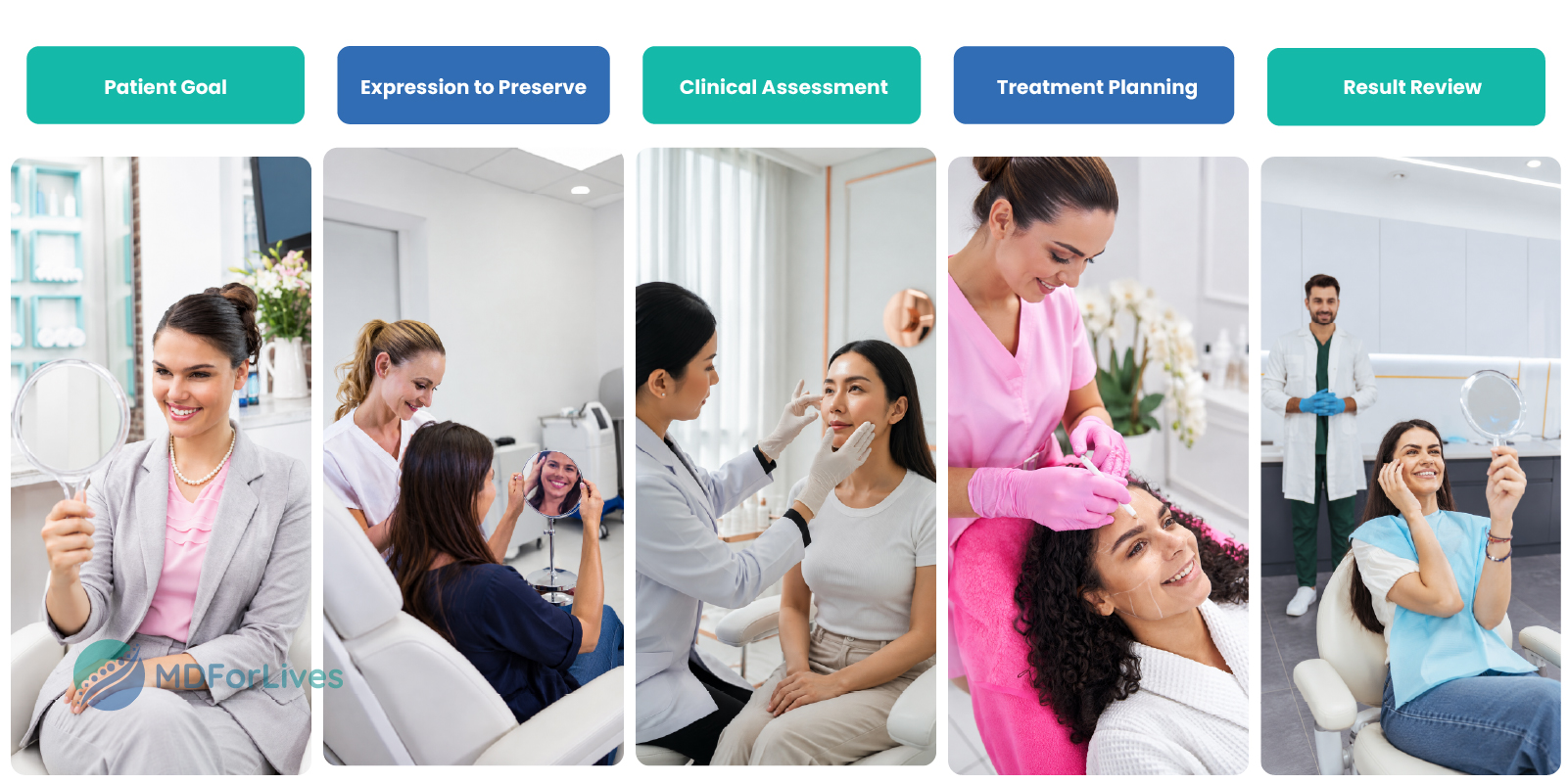
Patients commonly ask, “How much Botox should I get?”
There is no universal number of units that produces natural Botox. Dose and placement depend on anatomy, muscle strength, treatment area, previous response, product, and how much movement the patient wants to retain.
In the MDForLives survey, 40.0% of patients said expected treatment results most influenced their provider or treatment choice. Provider expertise and safety were also important.
Patients begin judging Botox results before treatment occurs because they already have an image of what “good” should look like. Does “natural” mean subtle softening, looking less tired, preserving movement, or avoiding a visibly treated look?
As digital healthcare evolves, AI in dermatology may help support the assessment of certain skin concerns, although treatment decisions still require appropriate clinical judgment.
Two patients asking for the same treatment may need different plans because they are describing different endpoints. The aim is an individualized plan for the agreed result.
Botox results need time before they should be judged
Even a well-planned treatment can create uncertainty if the patient expects the final Botox result immediately. Cosmetic botulinum toxin develops its visible effect over several days rather than producing its full result at the moment of injection.
Professionals can discuss when changes may begin, when the result should be assessed, how long Botox may last, and when to make contact.
Cosmetic effects commonly last around three to four months, although duration varies by individual, product, dose, treatment area, and other factors.
When the result feels wrong, follow-up becomes part of treatment
Careful planning cannot guarantee that every patient will feel satisfied with every treatment cycle. A result may feel too strong, too subtle, uneven, shorter-lived than expected, or different from what was discussed beforehand.
In the MDForLives survey, 42.9% said they would first request provider correction after an unsatisfactory result. That makes follow-up part of the treatment experience rather than something reserved for complications.
Patients should know when to contact the treating professional, what can reasonably be reassessed, and which Botox side effects require medical attention. They should not be encouraged to self-correct a cosmetic result.
For patients seeking professional guidance about skin-related concerns after treatment, an online dermatologist may help them understand their symptoms and determine whether further evaluation is needed.
The repeat decision reveals what patients really mean by a good result
Because Botox is temporary, treatment success is eventually tested by another question: would the patient choose to do it again?
In the MDForLives survey, 40.0% said natural-looking improvement would most influence their decision to repeat Botox treatment. Patients also identified longer-lasting effects as the future improvement that would influence them most.
The repeat decision goes beyond wrinkle reduction. Patients are judging whether the change was visible enough to matter, subtle enough to feel natural, predictable enough to trust, and durable enough to feel worthwhile.
For professionals, this shifts the focus from maximum correction to a result the patient can recognize as their own.
Closing perspective: natural Botox is a balance, not a formula
The question “can Botox look natural?” depends on several decisions made before and after treatment.
The patient needs to define what natural means to them. The clinician needs to identify the concern, assess the anatomy, determine whether Botox is appropriate, and plan dose and placement around the desired degree of movement and visible change.
Expectations also need to cover timing, duration, safety, and follow-up.
The MDForLives findings show why this balance matters. Natural facial movement leads the desired-outcome question, while natural-looking improvement leads the repeat-treatment decision.
The goal of natural Botox is not to make treatment invisible because nothing has changed. It is to soften the feature the patient wanted to treat while allowing the face to continue looking and moving like their own.