
A patient uploads a photograph of a rash, worsening acne, or a changing skin lesion and expects a diagnosis without entering a clinic. For the dermatologist, the harder question is whether the image and history contain enough information to support a safe decision.
That question sits at the center of modern online dermatologist services and asynchronous tele dermatology. Digital access can reduce travel and waiting time, but an image-based pathway still depends on clinical judgement.
MDForLives surveyed dermatologists across the USA, Italy, France, and Germany to understand where photo-based care works and where its limitations matter. The detailed findings and methodology are available in the MDForLives Direct-to-Consumer Dermatology Insight Report.
For clinicians, the practical issue is not simply whether an online dermatologist can assess a skin condition from a photograph. It is which cases can remain asynchronous, and which require escalation beyond the image.
A Photo Can Start the Assessment, but It May Not Finish It
Dermatology is inherently visual. Photographs can document erythema, scaling, pigmentation, lesion distribution, acne morphology, and other visible features. In selected lower-complexity cases, a high-quality image supported by an adequate history may provide useful information.
The MDForLives survey shows that diagnostic confidence is conditional. 40.0% of dermatologists said they were moderately confident in asynchronous photo-based assessments when it was conducted by a board-certified dermatologist. The broader finding is that confidence falls when a case requires physical examination, palpation, dermoscopy, severity grading, or a fuller differential diagnosis.
This broader assessment is particularly important in dermatometabolic care, where visible skin changes may sometimes warrant consideration of underlying metabolic conditions.
The clinical takeaway is that skin diagnosis online has a defined boundary. A photograph can show morphology, but it may not provide tactile information, dermoscopic detail, broader distribution, or enough evidence to exclude an important alternative diagnosis.
The Main Risk Is What the Image May Not Resolve
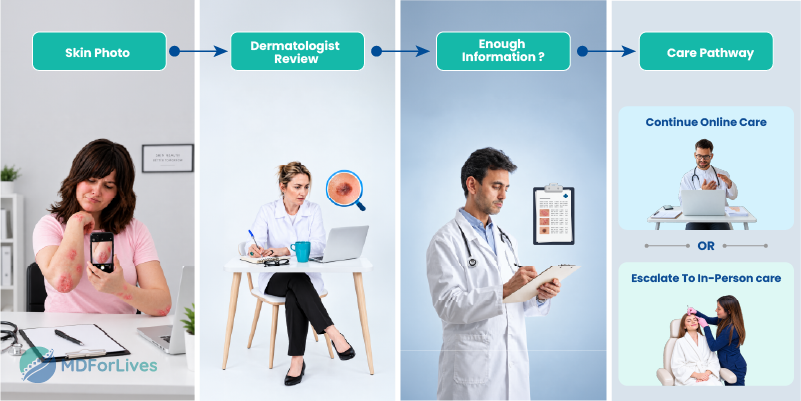
Image quality matters in tele dermatology, but the larger safety issue is unresolved diagnostic uncertainty.
In the MDForLives findings, 33.3% of surveyed dermatologists selected misdiagnosis or delayed diagnosis of a serious underlying condition as the greatest clinical risk of asynchronous DTC care.
A changing or suspicious lesion, rapidly worsening disease, uncertain morphology, treatment failure, or a condition requiring dermoscopy, palpation, biopsy, or broader examination may no longer be appropriate for photo-only assessment.
American Academy of Dermatology standards similarly emphasize dermatologist-directed teledermatology, adequate history and examination, access to records, and an in-person option when needed.
For an online dermatologist, the safest pathway is not one that keeps every case digital. It is one that recognizes when asynchronous assessment has reached its limit.
Who Reviews the Image Matters as Much as the Image
Digital care can make the patient journey look simple: upload, submit, and receive an answer. Clinically, another question matters just as much: who owns the diagnostic decision?
As AI in dermatology becomes more common, the role of the dermatologist remains important in interpreting AI-assisted findings and making the final clinical decision.
In the MDForLives survey, 58.6% of respondents selected strict requirements for consultations by board-certified dermatologists as the most urgently needed reform for DTC dermatology.
Credentialing is more than a trust signal. Specialist expertise influences case selection, differential diagnosis, prescribing, monitoring, and the decision to move from asynchronous to live or in-person assessment.
For dermatologist-led services, accountability should remain visible: who reviewed the case, what information was available, and what threshold would trigger escalation.
Online Treatment Still Needs Continuity of Care
A diagnosis or prescription issued online may be only the first part of the clinical episode.
In clinicians’ experience, dermatologists reported regularly seeing patients with adverse effects, treatment failures, or skin-barrier damage after prior DTC regimens. These observations do not establish that every event was caused by online care, but they reinforce the need for continuity, treatment history, and follow-up when patients move between digital and specialist settings.
The professional implication is that previous DTC exposure is becoming part of routine dermatologic history-taking. Online prescriptions, subscription skincare, compounded products, treatment duration, adverse effects, and response should increasingly be included in treatment reconciliation.
When records do not travel with the patient, the next dermatologist may have to reconstruct the diagnosis, formulation, concentrations, and treatment sequence after the problem has already evolved.
“Customized” Skincare Still Requires Traceability
Some digital dermatology platforms offer compounded multi-ingredient topical regimens. Dermatologists in the survey expressed mixed views, with concerns focusing on formulation stability, potency, irritation, treatment complexity, and treatment failure.
For dermatologists, the key issue is whether the formulation is clinically traceable.
That includes the active ingredients, concentrations, compounding source, labeling, duration of use, expected irritation, and follow-up plan. These details matter when assessing treatment failure, irritant reactions, possible allergic contact dermatitis, or barrier disruption.
In the United States, the FDA notes that compounded medicines are not FDA-approved before marketing; regulatory frameworks differ internationally. Regardless of jurisdiction, an online dermatology consultation should make formulation details and responsibility for follow-up clear.
Convenience Works Best When Escalation Is Built In
The access value of an online dermatologist is real. 51.7% of dermatologists identified greater convenience, including home delivery and avoiding travel, as the biggest advantage of DTC dermatology.
The survey therefore does not support a simple online-versus-in-person argument. A more clinically useful model is a connected pathway.
A suitable visual condition may begin with high-quality images and structured history. If diagnostic confidence is adequate, management may continue remotely. If morphology is uncertain, disease severity changes, treatment fails, or examination beyond the camera becomes necessary; care should move smoothly to live or in-person dermatology.
The strongest online dermatologist model is not the one that maximizes remote management. It is the one that makes the right level of care clear at each stage.
Closing Perspective: A Photo Should Open the Door to Care, Not Define Its Limits
Can an online dermatologist diagnose a skin condition from a photograph? In selected cases, yes.
But the more clinically meaningful question is whether the photograph, history, dermatologist expertise, and follow-up pathway together provide enough information to support the decision being made.
Online dermatology can improve access without reducing clinical standards. The strongest model preserves diagnostic accountability, appropriate examination, thoughtful prescribing, continuity of records, and a clear route to in-person care when the condition no longer fits the screen.
For the detailed dermatologist survey findings, methodology, and broader analysis of DTC care, explore the MDForLives Direct-to-Consumer Dermatology Insight Report.