A dermatology referral queue is full. Some lesions are benign. Some are urgent. Some images are unclear. Somewhere in that queue could be the case that should not wait.
This is where AI in dermatology becomes both promising and uncomfortable.
The promise is obvious: faster triage, better use of dermatologist time, smoother teledermatology workflows, and more efficient documentation. But the discomfort is just as real. If an AI tool misses a dangerous lesion, overflags low-risk cases, performs unevenly across skin tones, or creates uncertainty around liability, efficiency becomes only half the story.
The MDForLives dermatologist pulse captures this exact tension. Dermatologists are not rejecting AI. Many are already using it. But they are drawing a careful boundary between workflow support and clinical decision-making.
The clearest insight: AI in dermatology is improving how work is managed, but not yet resolving the risks attached to clinical judgment.
AI Is Already Present, but Selectively Trusted
The supplied MDForLives shows that adoption is no longer theoretical. About 62.5% of dermatologists are familiar with AI and using it selectively, while 25.0% are already actively using it.
That means most respondents are not observing AI from a distance. They are encountering it in practice, especially in lower-risk or operational areas.
But adoption does not equal readiness.
Half of respondents say documentation support is the only use case that feels truly ready today, while 25.0% say no use case feels clearly ready yet. This suggests a careful adoption pattern. Dermatologists are willing to use AI, but they are not ready to hand it clinical authority.
That distinction matters. AI in dermatology is being accepted where it saves time, organizes information, or supports workflow. Confidence becomes more guarded when the tool moves closer to diagnosis or risk stratification.
The Strongest Value Is Workflow, Not Diagnosis
It shows that 56.2% identify documentation and administrative support as AI’s primary value. This is telling because it places AI first as an efficiency tool, not a diagnostic one.
Dermatology is image-rich, high-volume, and increasingly shaped by referral pressure, teledermatology demand, and documentation burden. In that context, administrative relief is not minor. It can make clinics function better.
But it also reveals a boundary. If dermatologists see AI’s strongest value in documentation, they may still be cautious about relying on AI for lesion assessment or triage decisions.
The insight is not that AI lacks clinical promise. It is that dermatologists currently trust it more when the consequence of error is lower.
Efficiency Gains Do Not Remove Clinical Risk
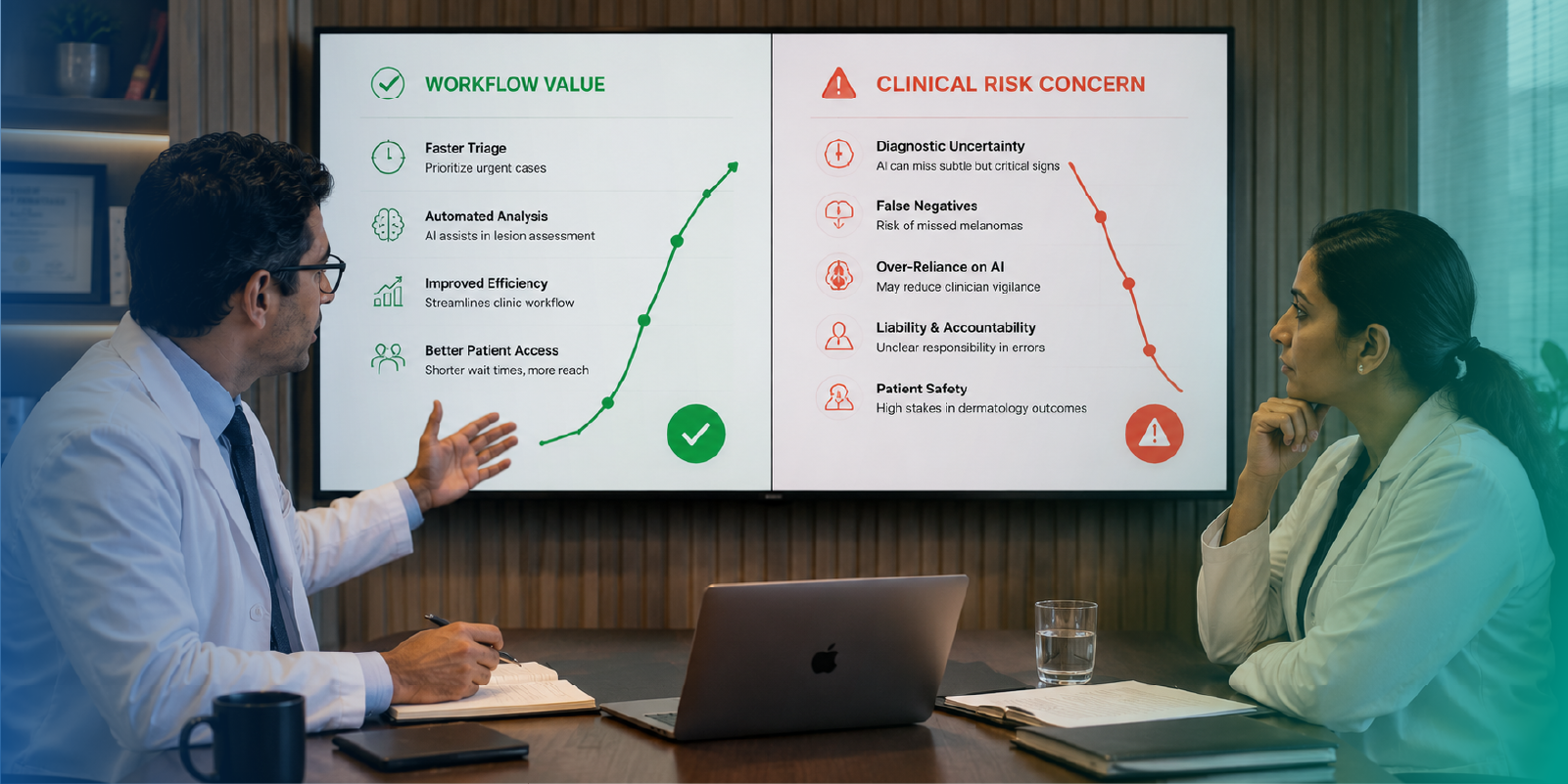
The central tension is clear: 50.0% say AI can improve efficiency, but clinical risk remains a major concern.
That is the core story of AI in dermatology.
Faster workflows can help. But faster workflows are only valuable if they do not compromise safety. In dermatology, risk is not abstract. It may mean missing melanoma, escalating too many benign cases, creating unnecessary biopsies, or reducing nuanced clinical reasoning to an image-level output.
This is why dermatologists appear to see AI as support, not authority. AI can prompt attention, organize cases, and make review more efficient. But the final clinical interpretation still needs dermatologist oversight.
A similar balance is emerging in AI in ophthalmology, where AI supports screening and clinical workflows while specialists continue to make the final diagnostic and treatment decisions
Access Is the Opportunity, but Risk Travels With Scale
AI may have its strongest near-term impact in access. , 56.2% believe AI can help by improving the use of dermatologist time in high-volume settings, while 18.8% see value in expanding teledermatology reach.
That matters because specialist access remains a real challenge in many regions. If AI can help filter benign cases, flag urgent referrals, and support teledermatology review, it may help patients reach the right level of care faster.
Similar questions around trust, workflow integration, and clinician oversight are also shaping the adoption of AI in Endoscopy, where AI is improving procedural efficiency while remaining dependent on specialist interpretation.
But access at scale also magnifies risk. A tool used across large referral volumes must perform consistently across image quality, lesion type, skin tone, age, clinical context, and practice setting.
This is where confidence stops. Dermatologists may support AI-enabled triage, but only if validation, oversight, and workflow fit are strong enough to protect patient safety.
The Concern Is Overreliance and Missed Lesions
The top concerns are highly clinical. Here, 43.8% are concerned about overreliance on AI, and 31.2% fear missing a dangerous lesion.
Those findings show that the risk is not only technical. It is behavioral.
If clinicians or patients trust AI too much, a low-risk output may falsely reassure. If AI generates too many high-risk flags, it may add workload and reduce efficiency. If the system performs inconsistently across different skin tones or atypical presentations, it may deepen disparities rather than reduce them.
The clinical risk is therefore both diagnostic and systemic.
AI in dermatology must prove that it can support better prioritization without weakening vigilance.
When AI and Dermatologist Judgment Differ
The survey QnR asks what dermatologists would do if an AI triage tool flags a lesion as high risk, but their initial impression is lower risk. It suggests clinicians are cautious: 31.2% use AI as a prompt to reassess, while 25.0% rely primarily on their own judgment.
That is exactly how many high-stakes tools enter medicine: not as replacement, but as a second signal.
This balance reflects the broader debate around AI vs human decision-making in healthcare, where the goal is to combine AI’s analytical support with the clinician’s expertise rather than replace professional judgment.
This is a healthy pattern. A dermatologist using AI as a prompt to reassess is not surrendering judgment. They are using the tool to reduce blind spots while preserving accountability.
The key question is whether AI improves the quality of reassessment, or simply adds another layer of doubt.
Trust Requires Validation, Accountability, and Fit
The leading barriers to broader confidence include limited trust in accuracy at 31.2%, unclear legal or ethical accountability at 25.0%, lack of validation across diverse skin tones, and limited training.
These are not superficial concerns.
Dermatology AI depends heavily on image datasets and model performance across real-world variability. If validation is narrow, confidence will remain narrow. If liability is unclear, clinicians will hesitate. If training is limited, AI will be used inconsistently. If workflow integration is weak, the tool may add steps rather than save time.
This makes the next phase of AI in dermatology less about capability and more about conditions of use.
The question is not only, “Can AI detect?”
It is, “Can AI be trusted, explained, governed, and safely integrated into dermatologist-led care?”
Closing Perspective
AI in dermatology is not being rejected. It is being contained.
The MDForLives data shows that dermatologists recognize AI’s value in documentation, workflow, access, and teledermatology efficiency. Adoption is already underway. But clinical confidence remains cautious, especially when AI approaches lesion risk, diagnostic interpretation, liability, and patient safety.
These themes mirror broader conversations around AI in mental health, where improving efficiency must be balanced with patient safety, clinician oversight, and ethical responsibility.
That is not resistance to innovation. It is clinical realism.
The future of AI in dermatology will likely be supportive rather than autonomous. Its strongest role may be helping dermatologists prioritize better, work more efficiently, and widen access while keeping final judgment firmly clinician-led.
Because in dermatology, faster triage matters.
But only if it does not make risk harder to see.