

A healthcare professional can finish a shift and still not be finished with work; notes to complete, messages to answer, decisions replaying, a difficult conversation that follows them home, or another shift already waiting.
Healthcare is built around caring for others. But what if those providing care have too little time, recovery or psychological space to look after themselves? That question sits at the center of healthcare worker burnout.
An MDForLives survey of physicians, nurses, allied healthcare professionals and other healthcare workers across the USA, UK, Canada, Italy, France and Germany points to a familiar pattern. Heavy workload, difficulty switching off, delayed help-seeking, and a desire for support that begins before wellbeing deteriorates. The findings reinforce a growing idea from occupational-health research; healthcare burnout cannot be solved by asking already stretched professionals simply to be more resilient.
Burnout is more than being tired after a difficult shift
The World Health Organization describes burnout as an occupational phenomenon resulting from chronic workplace stress that has not been successfully managed. It is marked by exhaustion, mental distance or cynicism toward work, and reduced professional efficacy; it is not classified as a medical condition.
That distinction matters. Mental health in healthcare workers extends beyond burnout. A clinician can be tired without being burned out, while persistent workplace pressure can coexist with anxiety, depression, sleep problems or other forms of distress that may require their own support. Burnout is best used as a warning about the relationship between a person and their working conditions, not a label for every difficult emotion in healthcare.
The pressures behind healthcare worker burnout
In the MDForLives survey, 54.5% identified heavy workloads or long shifts as an everyday pressure affecting mental wellness. Time pressure and lack of breaks followed at 45.4%, while the emotional demands of patient care and administrative burden were also frequently selected.
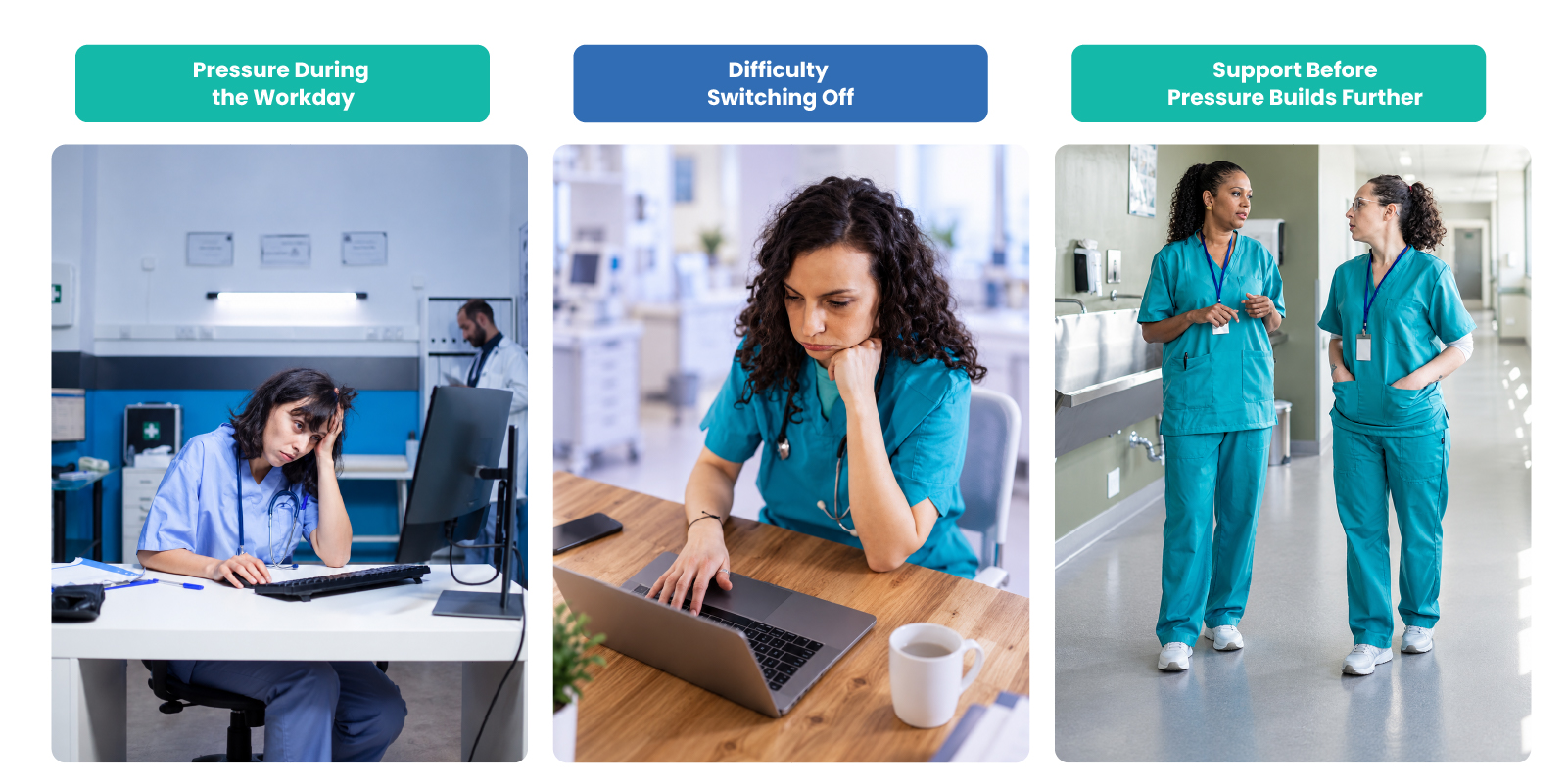
These pressures reinforce one another. A long shift is harder when staffing is tight; emotional work is harder without time to recover, and documentation grows heavier when it runs past scheduled hours. Even after leaving, work may continue digitally, and that stood out. Around 68.9% said being constantly contactable increases stress or makes it harder to switch off, and another 20% felt it disrupts sleep or rest between shifts.
Workforce pressure can make long shifts and recovery more difficult, particularly when staffing does not match the demands of care. Explore how the nursing shortage continues to affect healthcare workload and care delivery.
Although the populations and measures differ, a 2025 JAMA Network Open study of hospital-based physicians reported poor control over workload among 73.6% of the European sample and 64.3% of the US sample. The findings provide a broader context for the MDForLives results, reinforcing the role that working conditions can play in healthcare worker wellbeing.
Burnout remains a widespread workforce concern
There is no single global percentage; rates vary by profession, specialty, country and setting, though large studies consistently show high levels. The MDForLives survey measures perception, not prevalence, showing how professionals experience the pressures, warning signs and support gaps, and one finding stands out.
Healthcare professionals may keep going long after pressure starts to show
When asked how often healthcare professionals push through work pressure until it affects their wellbeing before seeking support, 73.5% of respondents selected “frequently.” It is one of the survey’s most revealing findings.
In healthcare, functioning under pressure can be seen as part of the job; patients need care, colleagues depend on one another, and the next handover still has to happen. But functioning is not the same as coping well.
Healthcare professionals can continue caring for others even when workload, fatigue and limited recovery begin to take a toll. Explore the pressures behind Still Caring, But Running Out.
Respondents most often identified persistent stress, exhaustion or low mood as signs that mental wellness may be declining. Open comments also highlighted heavy workload, insufficient breaks, emotional burden, difficulty switching off and the need for genuine recovery. The risk is that support begins only when strain is already hard to hide.
Speaking about mental health can still feel difficult
Knowing that support exists does not make it easy to use. Only 6.8% felt healthcare professionals were very comfortable discussing their own mental wellness, while 46.3% were rarely comfortable and 14.8% were not comfortable. Together, more than six in ten respondents felt healthcare professionals were rarely or not comfortable discussing their own mental wellness.
When asked what most often prevents healthcare professionals from seeking support early, 30.9% selected stigma or concern about professional judgment. Lack of time or access during work followed at 28.9%, while 28.3% pointed to professionals not recognizing their own need for support. Support therefore needs to be more than a telephone number on a portal; it has to feel accessible, reliable and safe to use.
Confidentiality matters, but prevention may matter even more
When asked what helps healthcare professionals remain engaged with support, 50.8% selected confidential and easy access, while 43.7% chose feeling heard and understood. But respondents also pointed further upstream: 49.4% identified preventing burnout before it affects work and wellbeing as the greatest unmet need.
That shifts the question from “Where can this person get help?” to “What about the work keeps creating the need for help?” WHO recommends organizational approaches to psychosocial risks at work, alongside manager training, worker education and individual support, including changes to workload, schedules, communication and teamwork. A 2024 systematic review of organisational mental health interventions for healthcare workers examined 22 studies. More than two-thirds reported improvement in at least one primary mental-health or wellbeing outcome, with the strongest evidence supporting job and task modifications.
Healthcare worker wellbeing needs more than one owner
MDForLives respondents did not place responsibility mainly on individuals. When asked who should take the most responsibility for improving mental-wellness support, 54.5% chose healthcare organizations and employers and 52.6% chose leadership and management, with individuals and peer-support networks chosen less often. That does not make individual wellbeing irrelevant. It means responsibility needs to be shared between healthcare professionals, teams, leaders, and the organizations in which they work.
A practical approach can include:
- manageable workloads, genuine breaks and protected time away from work
- confidential, accessible mental-health services
- managers who can recognize distress without becoming therapists
- teams where conversations about mental wellbeing are normal, not career-threatening
- follow-up that continues after someone first asks for help
Support should not require a professional to become visibly unwell before the system responds.
Closing perspective: caring for the people behind the care
Healthcare professionals often support people through some of life’s most difficult moments, including illness, uncertainty, pain and grief. That responsibility can also bring a strong sense of purpose and connection. The challenge is ensuring that the emotional demands of care do not build into chronic, unmanaged pressure.
The MDForLives findings show a clear pattern: healthcare professionals recognize the pressures affecting their wellbeing, from heavy workloads and limited recovery time to difficulty switching off and speaking openly about mental health. The answer is not simply to ask healthcare workers to become more resilient. It is to create working environments where support feels safe to access, recovery is protected, and wellbeing is addressed before pressure reaches a breaking point.
If healthcare systems depend on people being able to care for others, protecting the people who provide that care is not separate from healthcare. It is part of how healthcare continues to work.