

A nurse finishes one medication round and is already behind on the next. A patient needs reassurance. Documentation is waiting. A family has questions. The shift still has hours left, but recovery time has already disappeared.
This is the quiet reality behind nurse burnout today.
Burnout in nursing is often described as too much work. But that is no longer enough to explain what many nurses are experiencing. The pressure is not only heavier. It is more continuous. It stretches across physical workload, emotional intensity, administrative tasks, staffing gaps, patient expectations, and the difficult question many nurses are now asking themselves: can I keep doing bedside care this way?
Global and national workforce bodies continue to frame nursing shortages, retention, working conditions, and well-being as central healthcare challenges. The World Health Organization’s 2025 nursing workforce report shows that the global nursing workforce has grown, but major gaps and inequities remain across regions. In the United States, recent workforce research continues to show that burnout and staffing challenges remain closely tied to nurses’ intent to leave.
The MDForLives nurse-centered pulse reflects the same tension. Nurses are still committed to care. But many are reassessing how long bedside care remains sustainable when demand keeps rising faster than support.
Workload Is Rising Beyond Patient Volume

The supplied MDForLives draft shows 70% reporting increased workload. On the surface, that may sound familiar. Healthcare workload has been rising for years.
But the deeper issue is how that workload is changing.
For nurses, increased workload does not only mean more patients. It can mean more complex patients, more coordination, more documentation, more emotional management, more handoffs, and more decisions compressed into the same shift. The work expands in scope, while time does not expand with it.
This is why workload now feels different. It is not only a volume problem. It is a compression problem.
The nurse is expected to keep pace clinically, emotionally, and administratively, often without enough recovery between high-intensity moments.
Staffing Shortages Remove the Buffer
The same draft shows 65% reporting staffing shortages. That number matters because staffing shortages do more than add tasks to a shift. They remove the margin that makes care sustainable.
When there are not enough nurses, breaks become inconsistent. Handoffs become more fragile. Senior nurses absorb more supervision. Newer nurses carry risk earlier. Small delays become larger pressures because there are fewer people available to absorb them.
This is where burnout becomes structural.
A nurse may be willing to work hard. Nursing has always required that. But sustained short staffing changes the emotional contract of the job. It asks nurses not only to care, but to repeatedly compensate for system gaps.
That is not resilience. That is overextension.
Burnout Is Becoming Continuous Strain
The draft indicates that 60% report emotional exhaustion. For nurses, emotional exhaustion often sits alongside physical fatigue and cognitive overload. It is the feeling of being required to remain alert, compassionate, accurate, and responsive without enough space to reset.
This is why burnout is no longer defined only by long hours.
A long shift can be survivable when support is strong, breaks are protected, and the workload has rhythm. A shorter shift can still be exhausting when everything is urgent, everyone is stretched, and no task feels safely complete.
The MDForLives insight points to a key shift: nurse burnout is becoming less about occasional overload and more about sustained intensity.
This growing pattern also highlights the importance of managing work-related stress and anxiety before prolonged pressure affects both well-being and long-term career satisfaction.
That matters for retention. Nurses can recover from difficult days. It is much harder to recover from a work environment where intensity becomes the baseline.
Leaving Bedside Care Is Not Always Leaving Nursing
The nurse-centered QnR asks whether nurses are working bedside full-time, planning to transition, already transitioned, working travel or contract roles, or moving into telehealth or virtual nursing. That question is important because it recognizes a more nuanced reality.
Many nurses are not rejecting the profession. They are rethinking the setting.
Bedside care remains deeply meaningful, but it can also carry the highest concentration of physical demand, emotional intensity, staffing exposure, and scheduling pressure. When nurses consider transition, they may be looking for telehealth, outpatient care, travel nursing, informatics, advanced practice, or roles that offer more control over workload and recovery.
The draft suggests that approximately 50% of healthcare professionals are considering a role change or exit. In a nurse-centered context, this should not be read only as dissatisfaction. It may reflect a search for sustainability.
Many nurses are also exploring passive income opportunities to build greater financial stability alongside their clinical careers.
The question is no longer simply, “Are nurses leaving?”
It is, “What part of bedside work is making nurses feel they cannot stay?”
Technology Helps, but It Does Not Solve Recovery
The survey also asks how helpful technology has been in reducing daily workload and how comfortable nurses are using AI or digital tools for documentation or care coordination.
That inclusion is important. Technology is often positioned as a solution to workforce pressure. In practice, nurses may experience it in mixed ways.
Digital tools can reduce friction when they simplify documentation, improve coordination, or reduce duplication. But they can also add burden when systems are poorly integrated, alerts multiply, or documentation becomes another layer of work.
For nurses, the test is practical: does technology give time back, or does it move the burden into another screen?
If the core problem is staffing, workload, emotional exhaustion, and lack of recovery, technology can support the solution. It cannot replace the solution.
Understanding the broader role of technology in nursing can help healthcare leaders and nurses identify where digital tools improve workflows while recognizing the limits of technology in addressing burnout.
Sustainability Depends on Work Design
The survey asks what would make nursing more sustainable long-term: better staffing and ratios, flexible scheduling, mental health support, higher compensation, career mobility, or reduced administrative load.
That list is the real heart of the issue.
Nursing sustainability is not built through one intervention. Higher compensation matters, but pay alone may not solve exhaustion. Mental health support matters, but it cannot compensate for unsafe staffing. Technology matters, but it must reduce work rather than create new tasks. Career mobility matters, but it should not become the only way to escape burnout.
The pattern is clear: nurses need work environments designed for recovery, flexibility, support, and professional growth.
When those elements are missing, burnout becomes a career decision.
The Burnout Loop Is a Retention Risk
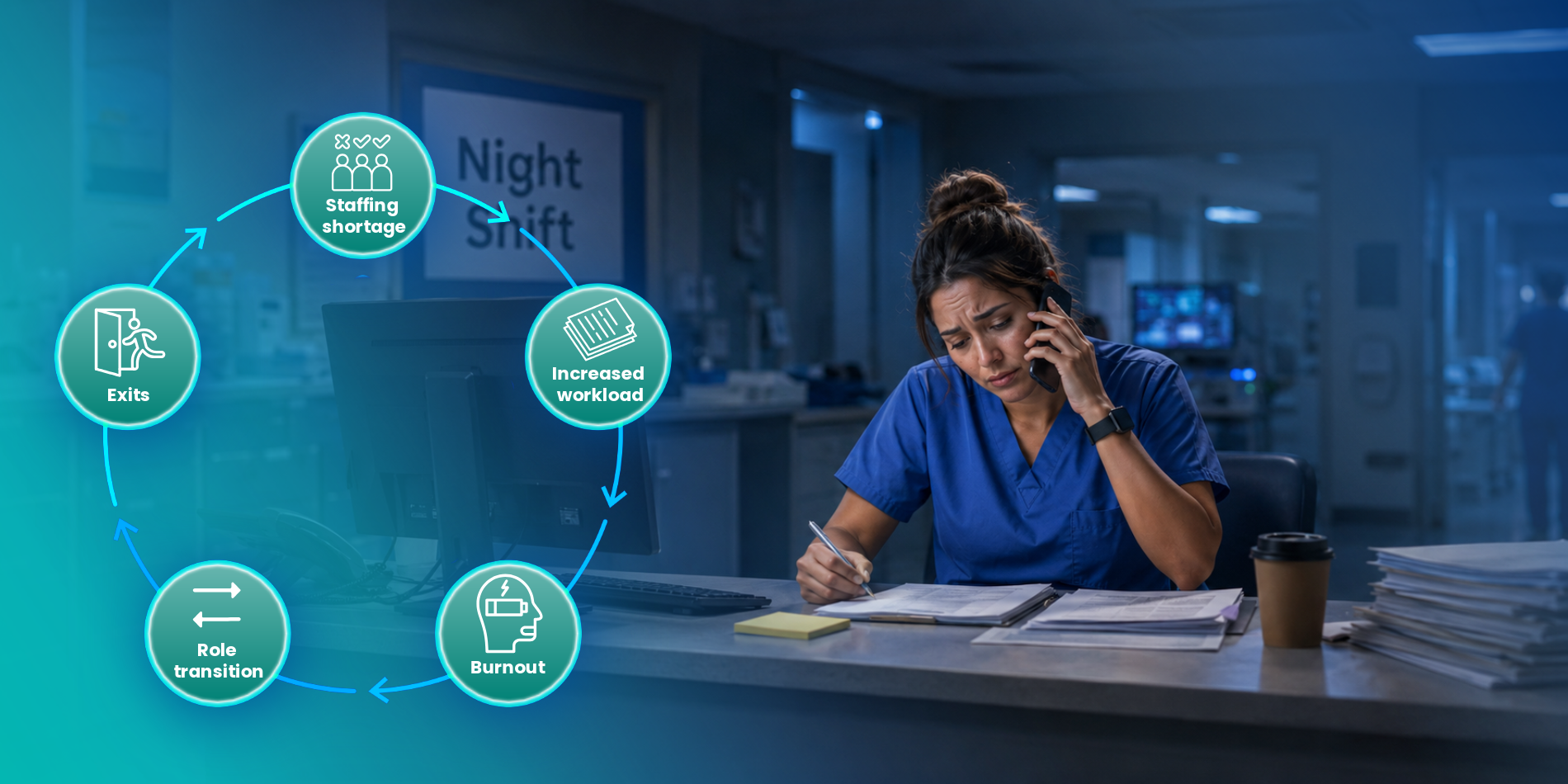
The draft describes a self-reinforcing cycle: staff shortage, increased workload, burnout, exit, and deeper shortage.
This loop is one of the most important insights for healthcare leaders.
Burnout is not just an outcome of workforce strain. It becomes a driver of future workforce strain. Each nurse who leaves bedside care increases pressure on those who remain. Each overloaded shift makes the next retention conversation harder. Each missed break or unsupported day quietly teaches nurses what the system will expect them to absorb.
This also highlights why hospital burnout continues even when staffing levels improve, as systemic issues often place sustained pressure on healthcare teams.
This is why burnout cannot be treated only as an individual well-being issue. It is a workforce planning issue, a care quality issue, and a system sustainability issue.
Closing Perspective
Nurses are still caring. That is not the question.
The question is whether healthcare systems are giving nurses enough support to keep caring without losing themselves in the process.
The MDForLives findings suggest that nurses burnout is no longer just about workload. It is about the gap between demand and capacity, between commitment and recovery, between bedside purpose and bedside sustainability.
If nurses are rethinking bedside care, leaders should not hear that as a lack of dedication.
They should hear it as a signal.
The future of nursing will depend not only on recruiting more nurses, but on redesigning the conditions that make nurses want to stay.