

A chemistry analyzer throws a flag. The middleware queue stalls. A critical sample sits in limbo, not because the test is difficult, but because the system has decided it needs human judgment.
This is the quiet pivot inside many modern laboratories.
Automation has changed the lab, but not in the simple way many expected. It has reduced some repetitive steps, improved turnaround time, and helped laboratories manage rising test volumes. But it has also moved technicians closer to a new responsibility: watching the system, interpreting exceptions, troubleshooting failures, validating outputs, and deciding when automation needs human correction.
The technician is not disappearing from the center of quality. In many labs, the technician is becoming the person who keeps automated work safe.
Automation Is Real, but Not Uniform
The MDForLives pulse shows that automation has become part of the default lab experience. Around 80% of technicians work in labs that are at least partially automated, and about one-third describe their environment as highly automated.
That headline matters, but it hides a split reality.
Two technicians may both say they work in an automated lab, while their daily experience looks very different. One may still spend much of the shift handling manual routines. Another may spend the day managing flags, queues, interfaces, quality checks, and instrument exceptions.
This suggests that automation is not a single destination. It is a maturity curve. The more automated the lab becomes, the more the technician’s role shifts from performing steps to supervising flow.
The First Change Is Workflow, Not Identity
When technicians were asked which task changed most because of automation, the strongest signal was sample handling at 28%, followed by data entry and reporting at 24%, and quality control checks at 21%.
This is important because it shows where automation is felt first: not in a dramatic replacement of expertise, but in the flow of work.
Samples move differently. Data moves faster. Reports are generated with fewer manual touches. Quality checks become embedded into systems. But the technician does not step away. Instead, the technician becomes responsible for ensuring that flow does not break.
Automation may stabilize throughput, but technicians remain the human layer that notices when stability is only surface-level.
The same principle applies to AI in endoscopy, where AI enhances procedural accuracy but clinicians remain responsible for interpreting findings and making treatment decisions.
Repetition Falls, but Oversight Rises
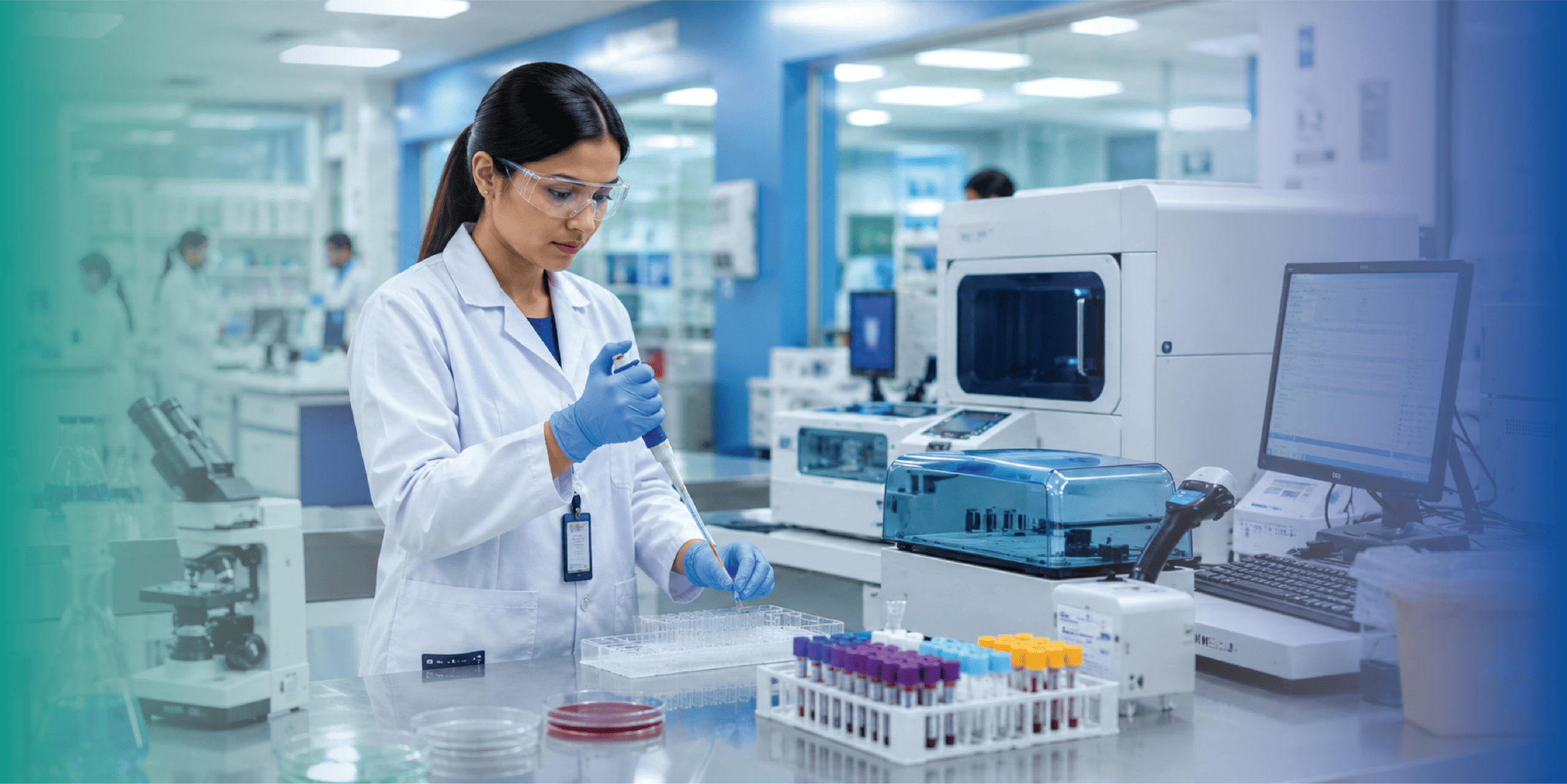
One of the clearest findings is the trade-off between reduced repetition and increased oversight. In the MDForLives pulse, 62% said automation reduced repetitive workload significantly or somewhat. That confirms part of automation’s promise.
But 28% said automation increased oversight workload. That means technicians are now spending more time monitoring queues, validating system outputs, chasing instrument flags, and managing downtime.
This is the hidden workload shift.
The task may no longer be manual, but accountability remains human. If an analyzer flags a result, if an interface misroutes data, or if a validation queue stalls, the technician becomes the stabilizer.
This reinforces the ongoing AI vs human discussion in healthcare, where automation supports decision-making, but trained professionals remain responsible for the final outcome.
That explains another key finding: 76% said their responsibilities have become more complex. The work has moved from doing the step to owning the outcome when the step fails.
The New Skill Gap Is System Confidence
A lab can implement automation and still leave its technicians underprepared.
Only 10% of respondents said they feel very confident managing automated or AI-integrated systems. The largest share, 45%, said they feel somewhat confident, while another 45% combined reported being not fully confident or underprepared.
That is not a small training issue. It is a performance risk.
When technicians were asked which new skill has become most important, the leading answers were troubleshooting automated systems at 27% and data literacy at 23%. Workflow optimization, molecular diagnostics knowledge, and cybersecurity awareness followed.
This tells us that the future-ready lab technician is not defined only by bench technique. The role now requires system judgment: understanding data flow, recognizing errors, troubleshooting instruments, interpreting flags, and knowing when to escalate.
A similar evolution is taking place with technology in nursing, where digital tools are expanding clinical responsibilities while reinforcing the need for human expertise and oversight.
The lab is not only adding tools. It is adding decision moments.
Staffing Shortages Are Accelerating Automation
The MDForLives findings also show that automation is not being adopted only for efficiency. It is being adopted for continuity.
A full 80% of respondents said staffing shortages have strongly or somewhat accelerated automation adoption in their labs.
This is a critical insight. Automation is often presented as innovation, but inside many laboratories it functions as a response to workforce pressure. When labs struggle to hire, retain, or cover shifts, automation becomes a way to absorb demand.
But this also changes the technician’s role. Technicians become the stability layer between rising volume and limited capacity. They are expected to keep automated systems moving, even when staffing remains thin.
The Biggest Risk Is Failure, Not Automation Itself
When technicians described the biggest risk of increasing automation, system failures led at 30%. Data security vulnerabilities followed at 24%, reduced human oversight at 21%, and loss of hands-on expertise at 19%.
This is a grounded pattern. Technicians are not simply worried about technology taking over. They are worried about what happens when technology fails and responsibility returns to them.
System failure in a lab is rarely abstract. It can mean delayed results, reruns, quality checks, manual workarounds, interrupted workflows, and added pressure during already stretched shifts.
Loss of hands-on expertise also matters. It is not nostalgia for manual work. It is a practical concern: if automation dominates for months, what happens when manual skill is suddenly needed again?
Turnaround Time Improves, but Fragility Remains
Automation appears to be delivering measurable operational value. In the pulse, 68% said automation has significantly or moderately improved turnaround time.
But technicians judge efficiency differently from dashboards.
A dashboard may show improved turnaround time. A technician sees the fragility underneath: queues that back up, systems that need intervention, interfaces that do not speak cleanly, and instruments that throw inconsistent flags.
This is why efficiency and workload can move in opposite directions. The lab may become faster overall while technicians carry more responsibility for exception handling.
Integration Is the Quiet Limiter
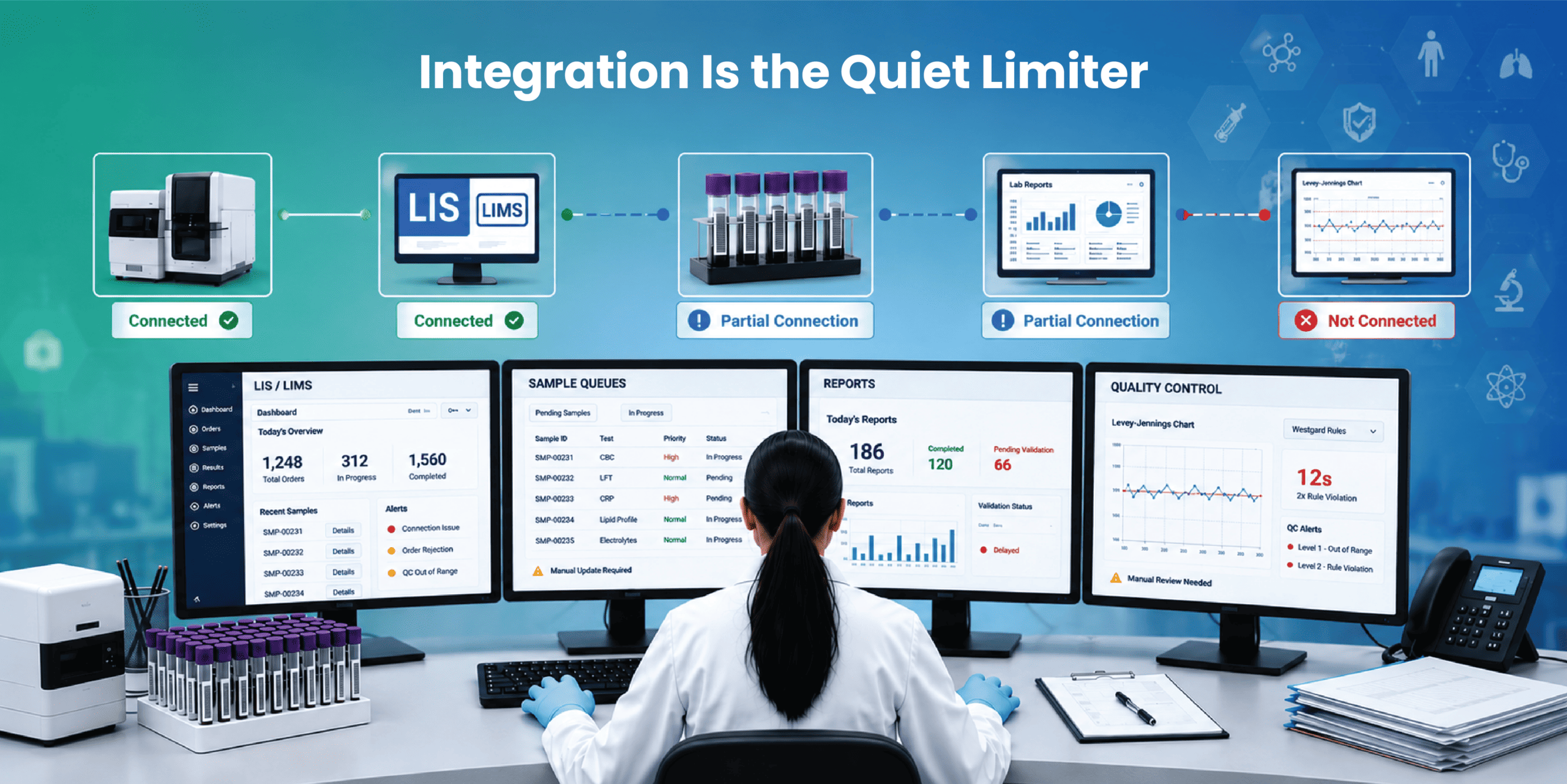
Only 18% of respondents described LIS or LIMS integration with automated instruments as fully integrated. The largest share, 46%, said systems are partially integrated, while 36% reported fragmented or poorly integrated systems.
This is where automation becomes lived experience.
Poor or partial integration creates duplicate entry, manual checks, mismatched fields, delayed validation, and workaround culture. On paper, the lab may be advanced. In practice, technicians may still be bridging system gaps manually.
Integration looks like an IT issue. But in the daily lab, it becomes a technician issue.
The Identity Shift Is Already Here
Perhaps the most direct signal is this: 75% agreed strongly or somewhat that their role is shifting from bench technician to system manager.
That does not mean technicians want to become IT staff. It means the lab is asking them to own system outcomes, reliability, workflow continuity, and decision thresholds, while scientific quality remains their responsibility.
The role is not becoming less important. It is becoming more accountable.
The evolving demands on technicians and laboratory staff are reflected in broader healthcare participation channels such as paid surveys for allied healthcare professionals, where professionals share insights from daily practice.
Closing Perspective
Automation did not remove the technician from the center of the lab. It moved the technician closer to the moment where quality can fail.
Repetition is dropping. Turnaround time is improving. But oversight, troubleshooting, system confidence, and integration gaps are rising.
The modern lab technician is no longer defined only by bench work. Increasingly, they are the person who keeps automated work safe when the system hesitates, breaks, or behaves unpredictably.
The real question is not whether lab technicians are becoming automation managers.
In many labs, they already are.