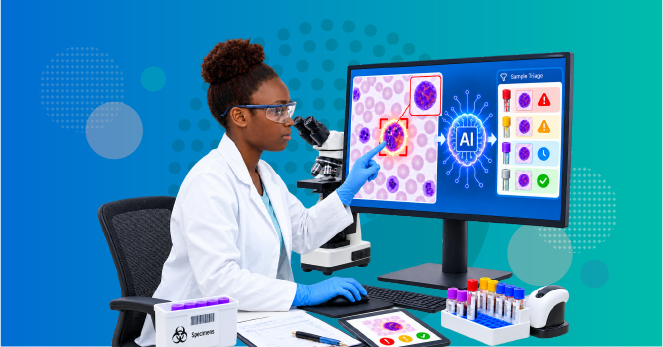
It is 7:40 a.m. in the lab.
A STAT sample is waiting. A validation batch is ready. Turnaround time is already under pressure. Then the system flags an exception and suggests the next step.
Not as a passive tool. More like a partner expecting the lab team to follow.
That is the shift now emerging in clinical laboratories. AI is no longer being discussed only as automation that makes tasks faster. It is beginning to influence priorities, diagnostic confidence, workload balancing, and operational decisions.
The broader laboratory environment is ready for this conversation. Clinical laboratories generate structured, high-volume, high-stakes data every day. AI and machine learning are increasingly being explored for diagnostics, image analysis, anomaly detection, quality control, turnaround time optimization, and workflow support. At the same time, regulatory bodies and professional organizations continue to emphasize life-cycle management, validation, local verification, transparency, and safe implementation.
An MDForLives pulse among lab managers, supervisors, and directors across North America and Western Europe reflects this tension clearly. Labs are not rejecting AI. They are asking what AI can safely own.
AI Adoption Is Moving, but Not Evenly
In the MDForLives findings, the most common position is “evaluated but not implemented,” selected by 36.4% of lab leaders. At the same time, 27.3% say AI is actively deployed across workflows, and another 27.3% say it is being piloted in select areas. Only 9.1% say AI is not currently being considered.
This does not suggest that labs are slow. It suggests they are cautious in a highly appropriate way.
Clinical labs are not adopting a consumer technology. They are evaluating tools that may influence diagnostic interpretation, reporting, workload prioritization, and patient-impacting decisions. In that setting, evaluation is not hesitation. It is governance in motion.
The insight is clear: AI adoption in labs is no longer a simple yes-or-no question. It is a maturity curve.
Healthcare professionals interested in contributing similar perspectives can participate in MDForLives paid surveys for allied healthcare professionals supporting research while earning compensation for their expertise.
The First Value Signal Is Both Diagnostic and Operational
When lab leaders identify where AI adds the greatest immediate value, image analysis and diagnostics lead at 36.4%. But the next strongest signal, scheduling and workload balancing at 27.3%, is operational. Sample triage and prioritization, along with reporting and result validation, follow at 18.2% each.
That pattern matters.
Lab leaders are not seeing AI only as a diagnostic engine. They are also seeing it as a workflow stabilizer. They want AI where interpretation can become more consistent, and where throughput can become more manageable.
This growing role of AI in diagnostic interpretation is also evident in specialties such as AI in ophthalmology , where image-based analysis is helping clinicians improve screening accuracy and support earlier intervention.
This dual expectation is important for the future of lab AI in clinical laboratories. The strongest use cases may not be purely diagnostic or purely administrative. They may sit at the intersection of diagnostic confidence and operational resilience.
Adoption Is Limited by Accountability More Than Curiosity
When asked what most limits broader adoption, regulatory or compliance concerns lead sharply at 45.5%. Data quality and standardization, along with staff readiness and trust, follow at 18.2% each. Cost and ROI uncertainty, and integration with existing systems, sit lower at 9.1% each.
This is the core of the lab AI challenge in clinical laboratories.
Value is visible, but value alone does not scale. Once AI begins touching workflows that can be audited, questioned, or challenged, the lab has to answer a different set of questions.
Can the output be explained? Can it be validated locally? Can its performance be monitored? Can it be traced through the LIS? Can responsibility be clearly assigned if the AI suggestion is wrong?
For clinical labs, AI does not only need to work. It needs to be governable.
Moderate Confidence Still Means Human Oversight
Confidence in AI-assisted diagnostic outputs is present, but not absolute. In the MDForLives pulse, 72.7% of lab leaders report moderate confidence, while 27.3% report limited confidence.
That is a meaningful signal, but it should not be over-read as full trust.
Moderate confidence often means AI is acceptable as support, but not as the final word. It may help flag, prioritize, compare, or suggest. But when the decision touches interpretation, validation, grading, or reporting, human oversight remains central.
This aligns with the practical reality of laboratory medicine. Even when AI performs well, diagnostic responsibility remains embedded in clinical governance, quality systems, and accountable review.
In short, labs may trust AI enough to listen. They do not yet trust it enough to hand over the call.
This evolving balance between technology and clinical expertise reflects the broader debate around AI vs human decision-making in healthcare, where collaboration often delivers better outcomes than complete automation.
Variability Reduction Is Still Uneven
One of AI’s strongest promises is reducing subjectivity or variability in diagnostic interpretation. The MDForLives data shows that this promise is not yet consistently realized.
Responses were mixed: 27.3% report minimal reduction, 27.3% say not applicable, 18.2% report significant reduction, 18.2% report moderate reduction, and 9.1% say not at all.
This tells us something important. AI may be present in clinical laboratories, but not always positioned where interpretation variability is truly decided. Some labs may be using AI in operational workflows rather than diagnostic interpretation. Others may not have enough implementation experience to credit AI with measurable variability reduction.
The gap between confidence and measurable impact is still open.
Operational AI May Scale Before Diagnostic Delegation
When asked which operational area would benefit most from AI-driven decision-making, turnaround time optimization leads at 27.3%. Staffing and scheduling, quality control and error reduction, throughput and capacity planning, and cost and resource management each cluster at 18.2%.
This distribution suggests a practical path forward.
Lab leaders may be more willing to let AI support operational decisions before they delegate high-stakes diagnostic decisions. Turnaround time optimization, triage, capacity planning, and workload balancing offer useful entry points because they can improve flow without directly replacing clinical interpretation.
The future of lab AI may not arrive as one large autonomous system. It may arrive through smaller, safer decision engines that remove friction one workflow at a time.
LIS Readiness Is the Quiet Limiter
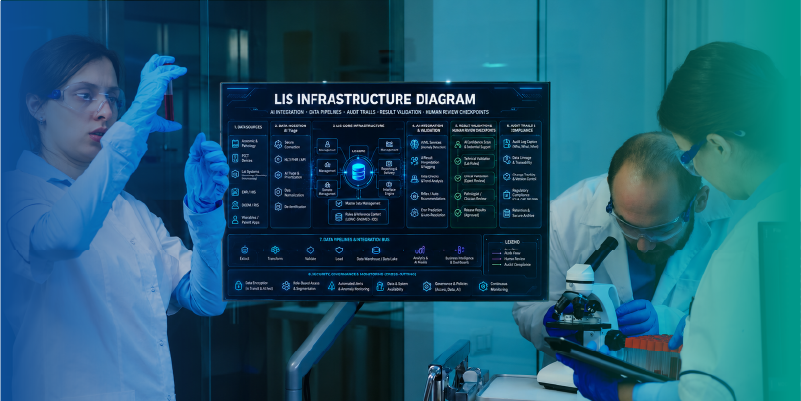
Advanced AI needs infrastructure. In the MDForLives pulse, 63.6% describe their laboratory information system as partially adaptable, while 36.4% say it requires significant upgrades.
That finding may be one of the most important in the article.
A strong AI model can still fail operationally if the LIS cannot support clean integration, audit trails, data flow, human review, and reliable handoffs. In a lab, integration is not a technical convenience. It is part of accountability.
This is where many AI strategies may slow down quietly. Not because the model is weak, but because the system cannot carry the weight of deployment.
Governance and Security Define the Boundary
Data governance and security concerns are not minor in this dataset. A full 72.7% call them a major limiting factor, while 27.3% describe them as a moderate concern.
That means every respondent sees governance and security as at least a meaningful issue.
This is not fear of innovation. It is fear of losing control over data, traceability, and responsibility. Once AI influences lab decisions, leaders must know where the data goes, how outputs are produced, who can review them, and how performance is monitored over time.
In lab medicine, trust is not built through novelty. It is built through control.
Selective Expansion Is the Realistic Future
Looking ahead, 81.8% of lab leaders expect AI to expand selectively over the next two to three years. Smaller shares expect it to remain niche or are uncertain.
This is not a lack of ambition. It is how high-reliability environments adopt tools responsibly.
Selective expansion allows labs to validate AI use case by use case, protect decision quality, build staff trust, and define accountability before scaling.
The final boundary is clear. When asked which decision they remain hesitant to hand over to AI, the leading theme is diagnostic interpretation and grading at 27.3%, followed by data governance and transparency, result validation and reporting, and uncertainty.
The closer AI gets to sign-out, the more it becomes responsibility rather than technology.
As AI expands across healthcare workflows, fields like AI in endoscopy demonstrate how real-time clinical AI can enhance—but not replace—human expertise.
Closing Perspective
AI in clinical laboratories is moving beyond automation. It is beginning to influence diagnostic support, workflow management, and operational decision-making.
But the MDForLives findings show that labs are not rushing toward autonomy. They are moving toward governed partnership.
The next phase will not be defined by whether AI can generate outputs. It will be defined by whether labs can validate, integrate, monitor, explain, and own those outputs.
AI may become an active partner in the clinical lab. But before it can own more decisions, lab leaders need to answer one question with confidence:
When AI suggests the next step, who owns the call?