

Menopause is one of the most universal health transitions in a woman’s life. So why do so many women only recognize it after it has already started disrupting sleep, mood, focus, work, and confidence?
That question sits at the center of this MDForLives insight pulse.
For many women, menopause does not begin with a clear signal. It begins with small changes that are easy to explain away. A few restless nights. More irritability than usual. A missed cycle. Less focus at work. Sudden heat at night. A body that feels familiar, but not fully predictable.
By the time these changes are recognized as menopause symptoms, many women have already spent months adjusting their routines without fully understanding what is happening.
MDForLives insights from a global community of over 3,500 women across multiple markets reveal a clear pattern: menopause is experienced early, but understood late.
Menopause Begins Subtly, but Recognition Often Comes Late
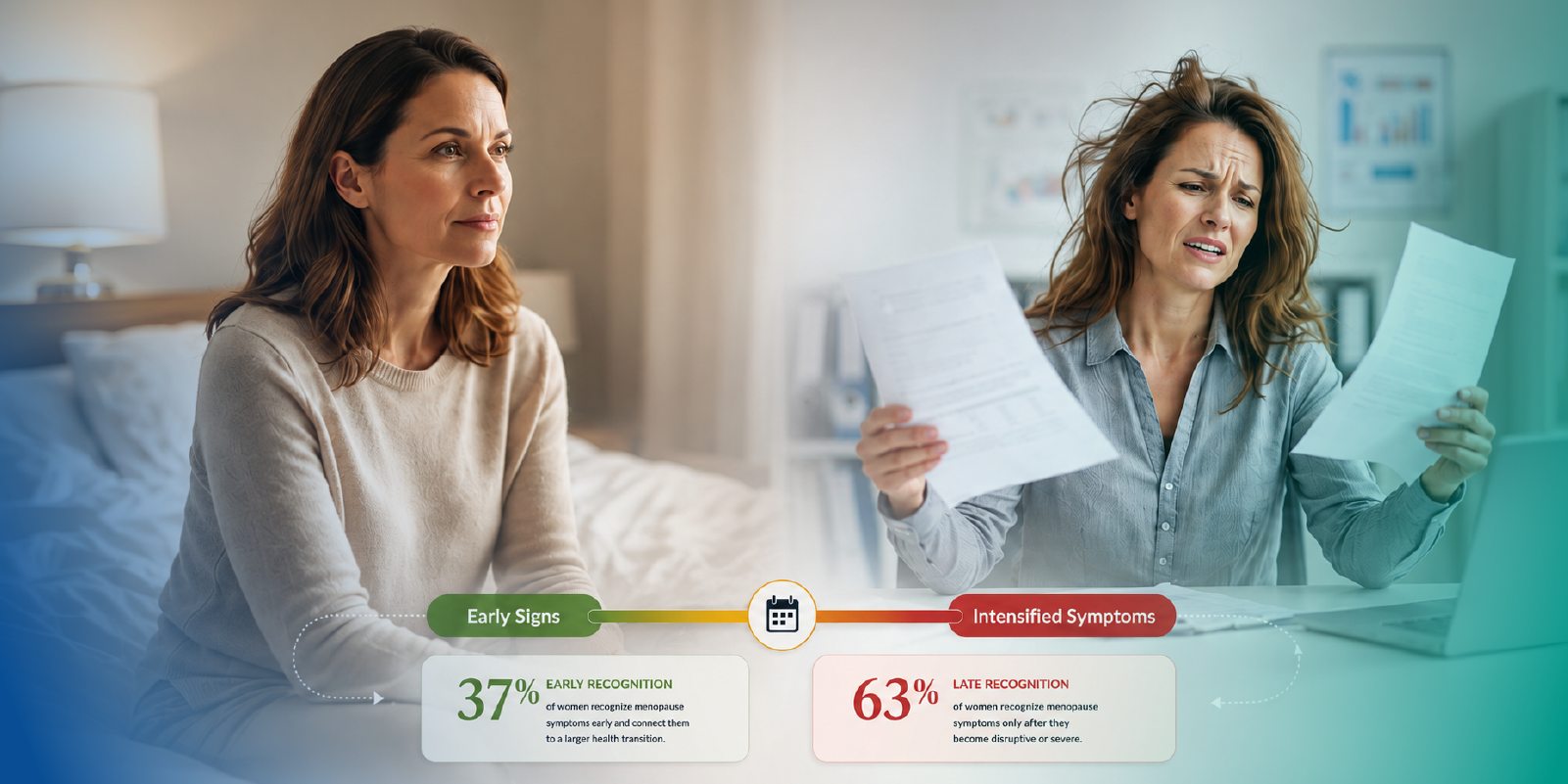
The strongest finding is the recognition gap. In MDForLives, 63% of women recognized menopause only after symptoms intensified, while just 37% identified early signs.
This matters because late recognition changes the whole experience. When early symptoms are not connected to menopause, women may treat them as stress, aging, work pressure, poor sleep hygiene, or temporary mood changes. Each symptom appears manageable on its own. Together, they form a pattern.
But that pattern is often missed.
This is why menopause awareness cannot only focus on hot flashes. Women need earlier language for the broader transition, including sleep changes, mood changes, cognitive shifts, cycle irregularity, body changes, and emotional disruption.
The insight is clear: menopause is not recognized late because women are not paying attention. It is recognized late because early signals are often normalized too quickly.
Symptoms Are Common. Interpretation Is Uneven.
The data shows that many experiences are widely shared: 68% report sleep disturbances, 64% report mood changes, and 59% report hot flashes.
These are not rare signals. Yet the same menopause symptoms can be interpreted very differently depending on age, culture, family conversations, workplace openness, healthcare access, and what women have been taught to expect.
One woman may connect poor sleep and hot flashes to perimenopause. Another may assume she is simply stressed. Someone else may notice mood changes but hesitate to raise them because they feel personal, not medical.
That difference in interpretation is powerful. When women do not know what the symptom means, they may delay support, understate the impact, or rely on trial-and-error coping.
This is the real education gap: not symptom awareness alone, but symptom meaning.
Awareness Is Also Shaped by Culture and Conversation
Study shows that 52% of women in developed markets recognize early signs, compared with 29% in emerging markets.
This does not necessarily mean women in one region experience menopause more clearly than another. It suggests that recognition is shaped by how openly menopause is discussed, how accessible information feels, and whether women are encouraged to treat midlife health changes as valid and worth discussing.
In some settings, menopause remains private. In others, it is discussed more openly through healthcare systems, workplaces, online communities, or peer groups.
The result is an awareness gap that is partly medical, but also social.
If women do not hear menopause discussed in practical, everyday language, they may not recognize it when it begins.
Why Self-Management Dominates

One of the most important findings is how women manage the transition. It shows that 71% rely primarily on lifestyle changes and home remedies, while 34% use medical treatments.
This should not be read as a rejection of healthcare. It is more likely a sign of uncertainty.
Women may self-manage because they are unsure whether symptoms are “serious enough” to raise with a doctor. They may worry about side effects. They may receive unclear guidance. They may prefer familiar approaches first. Or they may feel that medical care does not fully address the emotional and day-to-day reality of menopause.
This makes menopause management feel experimental. Women try sleep routines, diet changes, exercise, supplements, cooling methods, peer advice, and online suggestions. Some of it helps. Some does not. But the overall pattern is clear: women are actively managing, often without enough structured guidance.
Menopause care is not simply underused. It is often under-translated into everyday support.
Support Exists, but It Is Decentralized
MDForLives shows that 58% rely on friends, family, or peer networks, 46% frequently use online sources, and 41% primarily depend on doctors.
This does not mean doctors are unimportant. It means clinical care is only one part of the support ecosystem.
Improving menopause care also depends on insights from Allied Healthcare Professionals, whose experiences help shape patient education, support strategies, and future healthcare research.
Women often need more than a diagnosis or treatment recommendation. They need reassurance, context, lived-experience interpretation, and practical advice for days when symptoms affect sleep, patience, concentration, relationships, or work.
This is why peer support matters so much. Friends and online communities can provide validation that formal care may not always have time to offer.
But decentralized support has limits. Online information varies in quality. Family advice may be incomplete. Peer experience may not match individual health needs.
The strongest menopause support should combine medical clarity with lived-experience understanding.
Menopause Is Also a Workplace and Identity Issue
Menopause symptoms do not stay at home. They can affect focus, confidence, energy, communication, and productivity. Sleep disruption can change the next workday. Mood changes can affect relationships. Brain fog can make routine tasks feel unusually demanding.
This is why menopause at work needs more attention. For many women, symptoms are invisible, but the effort required to manage them is not.
The data also shows how menopause changes health perception. Nearly 49% view menopause as a life transition toward more proactive health management. At the same time, 33% associate it with uncertainty, and 18% report a sense of loss of control.
A more proactive approach to health also encourages women to stay informed about conditions that require ongoing awareness, including breast cancer recurrence, reinforcing the importance of long-term monitoring and follow-up care.
That contrast matters. Menopause can be empowering when women understand what is happening and feel supported. It can feel destabilizing when changes arrive without explanation.
The same biological transition can become very different lived experiences depending on recognition, guidance, and validation.
What Women Wish They Knew Earlier
The survey QnR asks what women wish had been explained earlier: emotional changes, sleep disruption, cognitive effects, body changes, and relationship impact.
That question is the heart of the topic.
Many women are not asking for menopause to be made dramatic. They are asking for it to be made clear.
They want to know that sleep can change before periods stop. That mood changes may feel unfamiliar. That brain fog is not imagined. That body changes can affect confidence. That libido, intimacy, skin, weight, joints, and emotional well-being may all become part of the same transition.
For women experiencing menopause-related weight changes, learning about evidence-based approaches to obesity treatment can provide helpful guidance for managing long-term health alongside lifestyle changes.
Most importantly, they want to know early enough to respond with confidence rather than confusion.
Closing Perspective
Menopause does not need to be treated as a mystery women discover only after symptoms intensify.
The MDForLives findings point to a clear pattern: symptoms appear early, recognition often happens late, self-management dominates, peer networks fill support gaps, and many women are still translating their own experience in real time.
The opportunity is not just to increase awareness. It is to move understanding earlier.
Because menopause symptoms do not only affect the body. They affect how women sleep, work, think, relate, and feel about themselves.
Menopause is universal.
Understanding it should be too.