Weight loss can change a number on the scale.
But for many people living with obesity, the harder question comes after the number changes: what happens next?
That question now sits at the center of obesity care. Newer oral and injectable treatments are helping many people achieve weight loss that may have felt out of reach before. Yet the lived experience is more complex than “treatment works.” People are also thinking about cost, side effects, muscle loss, long-term use, weight regain after stopping, and whether they will be supported once the first phase of weight loss is over.
This MDForLives patient-focused obesity pulse reflects that shift clearly. The findings suggest that weight management is no longer being viewed as a short-term effort to lose weight. It is becoming a long-term question about how to live with the outcome.
Effort Is High, but Confidence Is Not

The supplied MDForLives draft shows that 86.3% of respondents are actively trying to manage their weight. This is an important starting point because it challenges a common misconception: people living with obesity are not ignoring the issue. They are already engaged.
But high effort does not mean high confidence.
Nearly 44.2% say their biggest concern after stopping treatment is rapid weight regain. Another 25.0% fear losing control of appetite or cravings. This creates the central tension of the article: progress is real, but stability is not guaranteed.
The challenge is no longer only starting the weight-management journey. For many, it is maintaining the progress without feeling that every improvement is temporary.
Weight Loss Is Becoming a Health Goal, Not an Appearance Goal
The motivations behind treatment also show a shift away from appearance-led thinking. In the draft, 33.2% are motivated by health concerns, followed by 21.4% who struggle to maintain weight loss.
This matters because it reframes obesity care.
Patients are not only asking, “How much weight can I lose?” They are asking whether treatment can help them move better, feel less tired, improve blood sugar or metabolic health, support heart health, protect liver health, and feel more in control of daily life.
The outcomes people value most reinforce this change. Energy and daily function lead at 31.1%, followed by metabolic health improvements at 26.2%. The scale still matters, but it is no longer the only way people judge success.
For many patients, the real win is not simply weighing less. It is having more stamina, less physical strain, better mobility, and a life that feels less limited.
Newer Treatments Are Expanding Options, but Adoption Remains Uneven
The survey asks about lifestyle changes, injectable medications, oral weight-loss medications, medication plus lifestyle, and non-invasive procedures. This mix reflects how obesity treatment is becoming more layered.
For some people, bariatric surgery for weight loss may also become part of the conversation when lifestyle changes and medical therapies alone do not provide sustainable results.
Yet the draft shows that 57.6% still rely on lifestyle changes alone, while only 22.5% combine medication with lifestyle interventions. This suggests that even as medical options expand, many people remain in largely self-managed pathways.
There may be many reasons for this: access, affordability, familiarity, comfort with injections versus oral options, provider guidance, or uncertainty about long-term use. The point is not that everyone should use medication. The point is that treatment choice is often shaped by what feels reachable, explainable, and sustainable.
That makes patient support essential. Without guidance, newer options can feel available in theory but hard to navigate in practice.
The Fear of Regain Is Not Irrational
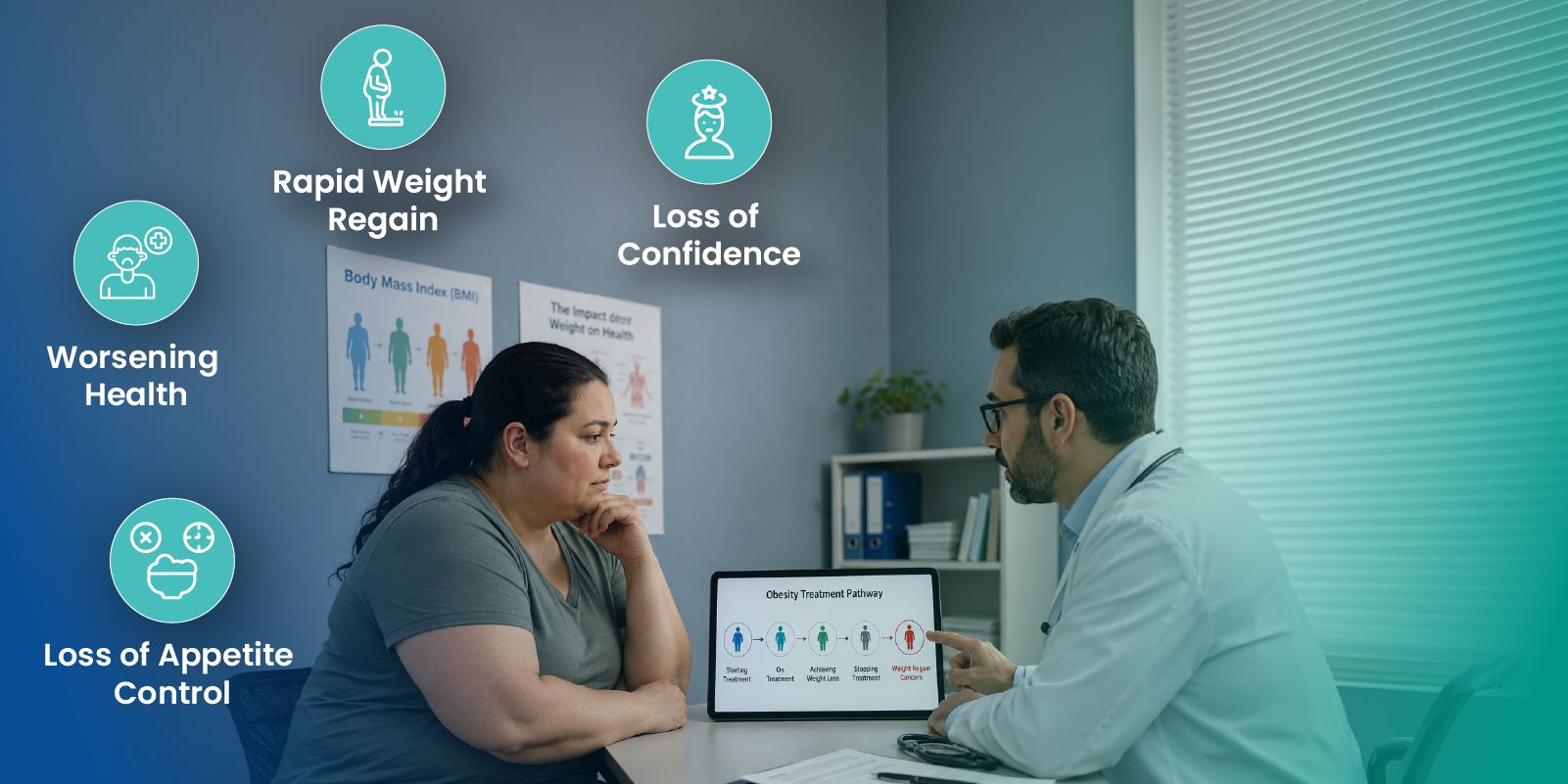
Weight regain after stopping treatment is one of the strongest concerns in the draft, and it deserves careful interpretation. For people living with obesity, regain is often treated socially as a personal failure. Clinically, it is better understood as part of the chronic and biological nature of weight regulation.
This is why the survey’s question about stopping or pausing medication is so important. Patients are not only worried about the return of weight. They are worried about losing progress, confidence, appetite control, and health gains.
That fear can affect how people start treatment, continue treatment, and think about their future. If a person believes weight loss will disappear as soon as treatment stops, every milestone can feel fragile.
The insight is clear: people do not only need help losing weight. They need a plan for what happens after weight loss begins.
A similar shift is taking place in migraine care, where new migraine treatments are helping many patients, but long-term confidence still depends on consistent, predictable results in everyday life.
Muscle Health Is Becoming Part of the Conversation
The Questionnaire includes an important question about muscle loss or weakness during weight loss. This is a meaningful addition because patients increasingly understand that not all weight loss feels the same.
People may want to lose fat while preserving strength, mobility, balance, and daily function. For older adults, people with joint discomfort, or those with limited physical activity, muscle concerns may be especially important.
This again moves the conversation beyond the scale. A lower weight is not the only outcome that matters. People want to feel capable in their bodies. They want energy, stamina, and strength, not only reduced weight.
Reducing the risk of physical inactivity is equally important, as regular movement supports muscle strength, mobility, metabolic health, and long-term weight management.
Long-term obesity care should therefore include support around nutrition, physical activity, resistance training where appropriate, and monitoring that looks beyond weight alone.
Support Systems Are Not Keeping Up
Only 21.1% of respondents feel very supported in long-term weight planning, while the majority report partial or limited support. This may be the most important system-level signal in the draft.
People are making the effort. Treatments are evolving. Health goals are becoming more sophisticated. But support after weight loss remains uneven.
That gap can leave patients feeling like they are expected to manage a chronic condition with short-term tools.
Long-term support should include realistic expectation setting, maintenance planning, discussion of what happens if medication is stopped or paused, attention to muscle health, affordability conversations, and follow-up that does not end once weight loss begins.
This is why GLP-1 therapy in obesity care is increasingly viewed as part of an ongoing treatment strategy rather than a short-term solution for weight loss.
Without that, the treatment journey can feel like a cliff: intense focus during weight loss, then uncertainty after it.
Obesity Is Being Reframed, but the Shift Is Not Complete
The survey asks how people view obesity today: as a chronic condition needing ongoing care, a condition manageable with the right tools, something still difficult to understand, or something they feel blamed for.
That question matters because it captures the emotional and social reality of obesity.
Even as medicine increasingly frames obesity as chronic and treatable, many people still carry stigma. Some may feel hopeful. Others may feel blamed. Some may understand the biology better than before but still be uncertain about what long-term care should look like.
The future of obesity care will depend not only on medications, but on whether patients feel supported, respected, and guided through a long-term condition without shame.
Closing Perspective
Weight loss is happening. But weight loss alone is no longer the full story.
The MDForLives findings show a deeper transition: people living with obesity are moving from asking how to lose weight to asking how to sustain health, confidence, and function after weight loss begins.
They want more energy. Better metabolic health. Less fear of regain. More clarity around long-term treatment. Better support if medication is stopped or paused. Protection of strength and mobility. Fewer assumptions and less blame.
The future of obesity care will not be defined only by how much weight people lose.
It will be defined by whether they can live well with the outcome.