

If your eyes water when they are “dry,” it can feel like your body is arguing with itself.
You blink. You squint. You rub your lids. You add drops. You take a screen break. You return to work, reading, driving, or scrolling, and the discomfort comes back again.
That cycle is what many people living with dry eye or digital eye strain know too well. The problem is not always severe enough to feel like an emergency. But it is persistent enough to reshape the day.
Dry eye is not simply “not enough tears.” It is now understood as a multifactorial ocular surface condition, involving tear-film instability, inflammation, environmental triggers, and symptoms that can include discomfort and visual disturbance. Digital eye strain adds another layer, especially as screen-heavy routines reduce blinking, increase visual demand, and make discomfort more noticeable.
The MDForLives pulse, conducted among 518 panelists who reported dry eye or frequent eye discomfort in the past 30 days across India, the United Arab Emirates, the United Kingdom, Saudi Arabia, the United States, and other markets, shows a clear patient pattern: symptoms are common, triggers are built into daily life, and relief often feels temporary.
Many People Live With Symptoms Before They Have a Diagnosis
The diagnosis gap is one of the strongest signals in the data. About half of respondents reported being diagnosed or told by an eye doctor that dry eye is likely: 52.3%, or 271 out of 518. Nearly as many, 47.7%, reported frequent symptoms without a diagnosis.
This matters because dry eye often starts as a comfort issue before it becomes a care issue. People may try drops, change screens, avoid air conditioning, adjust lighting, or simply tolerate the symptoms until daily routines begin to suffer.
The market contrast also tells a story. In the United States, 68% reported a diagnosis, while in the United Kingdom that figure was 44.7%. This suggests that symptoms may be similar, but the pathway to clarity can vary.
The insight is simple: people are not always ignoring care. Many are living with eye discomfort before they have language, diagnosis, or a clear plan for it.
“Manageable” Does Not Always Mean Minor
Most respondents did not describe their symptoms as catastrophic. The most common weekly impact was “noticeable but manageable,” selected by 36.9%.
But that is only half the story. Another 33.3% said symptoms were frequently distracting, and 12.8% said symptoms severely limited daily activity. Combined, 46.1% were dealing with symptoms that actively interfered with life.
This is where dry eye and digital eye strain can be underestimated. People adapt. They lower screen brightness. They pause reading. They blink harder. They keep drops nearby. They avoid certain rooms, lenses, or late-night screen use.
Over time, that adaptation can get mislabeled as “manageable.” The condition may not stop life completely, but it quietly changes how people work, read, focus, and rest.
Screens Matter, but So Does the Environment Around Them
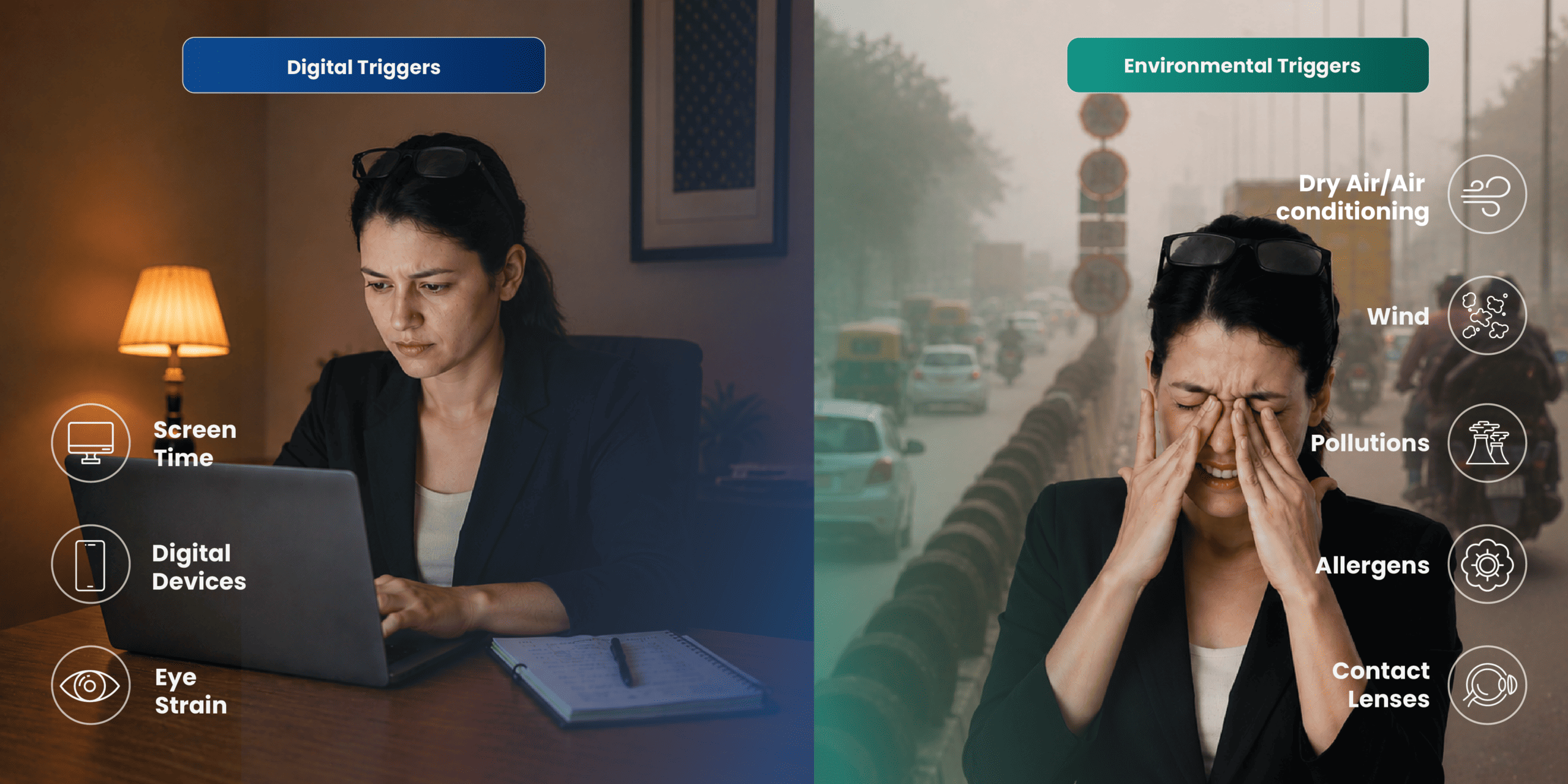
Screen time was the leading trigger, cited by 40.3% of respondents. But it was not the only one. Air conditioning or dry air followed at 21.4%, and wind, pollution, or allergens at 17.6%.
This is important because dry eye relief is often framed around screen breaks alone. The data suggests the trigger pattern is broader. Many people are not just using screens too much. They are working in dry air, living around dust or pollution, wearing contact lenses, or spending long hours in environments that keep irritating the ocular surface.
Regional differences make this even clearer. In India, screen time dominated as the trigger at 52.9%. In the UAE, dry air and air conditioning led at 48.3%, and Saudi Arabia showed a similar pattern at 39.0%.
The patient insight is practical: if the trigger is the room, the air, the lens, or the workday, a single screen habit may not be enough.
Watery Eyes Can Still Be Dry Eyes
The most bothersome symptom was watery eyes, reported by 22.8%, closely followed by burning or stinging at 21.8%. Redness followed at 18.7%, and fluctuating or blurry vision at 15.6%.
The watery-eye finding is especially meaningful because it can confuse patients. Many assume watery eyes mean the eyes cannot be dry. But watery eyes may be part of irritation or tear instability, not necessarily comfort.
This is why patient education matters. When symptoms feel contradictory, people can delay care, use products inconsistently, or assume they are treating the wrong problem.
For many respondents, dry eye is not only irritation. It is unreliability. The eyes do not feel the same from morning to evening, from one room to another, or from one screen session to the next.
Drops Dominate, but They Do Not Always Create Stability
When asked what they tried first, responses were fairly spread out: artificial tears at 23.9%, screen breaks or blue-light changes at 23.0%, warm compresses or lid hygiene at 16.6%, and prescription drops at 15.4%.
But when asked what helped most so far, one answer dominated: drops, selected by 49.6%.
That does not mean drops are the full solution. It means drops often become the center of the coping routine because they are accessible, familiar, and immediate.
As symptoms persist, many people also explore newer dry eye treatments that combine medications, procedures, and personalized care strategies to achieve longer-lasting relief.
The frustration begins when drops help, but only briefly. If screen behavior, dry air, contact lenses, inflammation, or lid-related issues remain unaddressed, relief can feel like refilling a bucket with a slow leak.
Relief Is Often a Window, Not a State
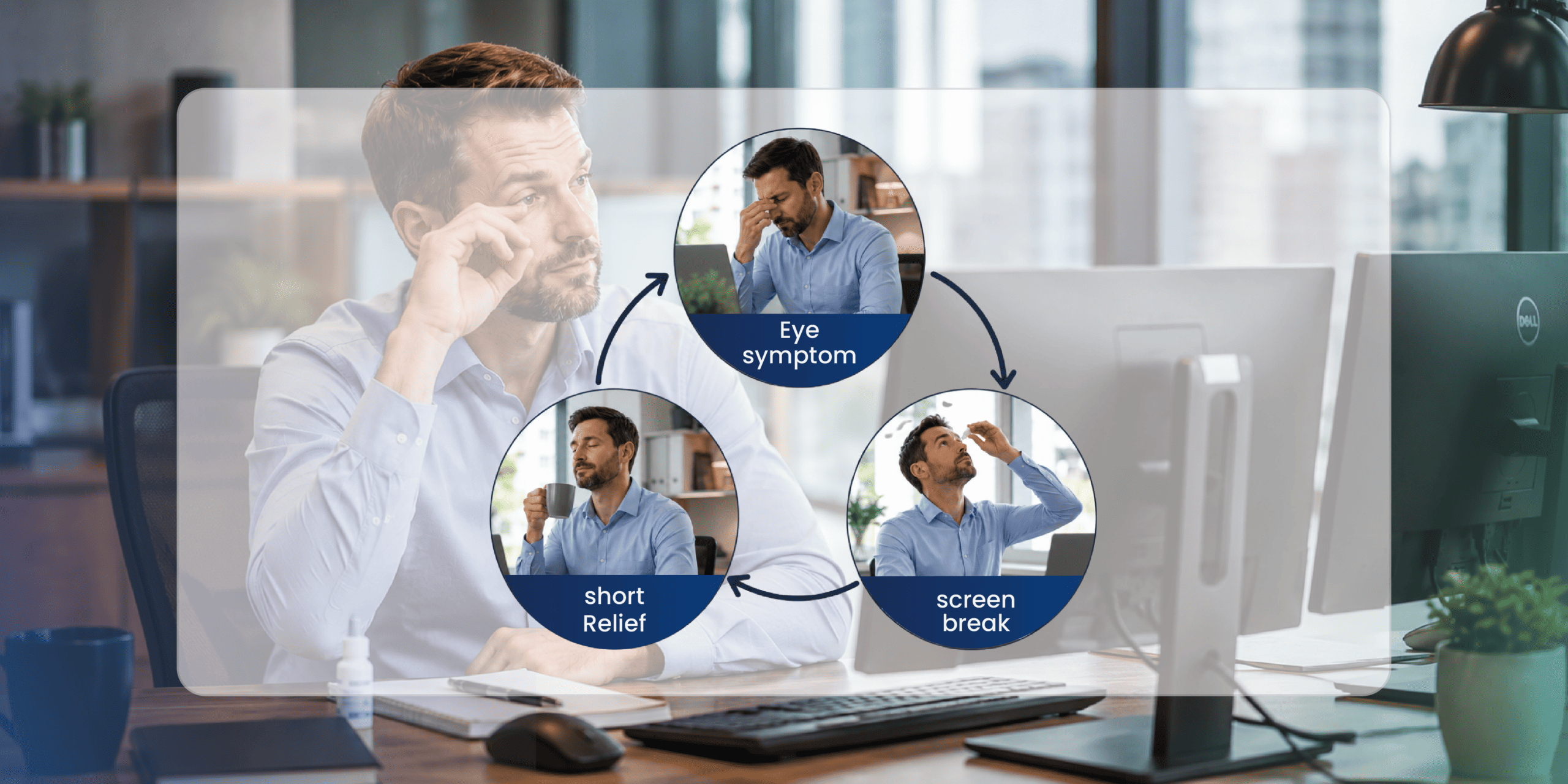
Only 30.3% said relief was consistent and lasting. The rest described instability: 35.1% said relief works only sometimes, 24.3% said it works but symptoms return often, and 10.2% said it rarely works.
This may be the most important finding in the pulse.
Patients are not simply looking for another tip. They are looking for predictability. They want to know whether relief will last through a workday, a drive, a book, a meeting, or sleep.
When relief is temporary, dry eye becomes more than discomfort. It becomes planning uncertainty.
Screen Use Becomes a Behavior Change
Symptoms also reshape screen life. In the survey, 44.8% said symptoms affect screen use or reading somewhat, 31.1% said a lot, and 11.0% said they regularly avoid screens due to symptoms.
Avoidance is easy to overlook, but it is the clearest sign that dry eye has moved from symptom to constraint. For people whose work, learning, communication, and entertainment depend on screens, avoiding screens is not a small adjustment. It can affect productivity, focus, and daily confidence.
The broader conversation around mental health in the digital age also reflects how constant digital engagement can affect emotional well-being alongside physical symptoms such as eye strain.
A Doctor Visit Does Not Always Resolve Uncertainty
Nearly half, 44.8%, said they had discussed symptoms with an eye doctor and had a treatment plan. But 20.3% had spoken to a doctor and still felt uncertain. Another 35.0% had not meaningfully engaged clinically, either because they had not discussed it yet or did not plan to.
This shows that access to a visit is not always the same as clarity. Patients may still wonder what is causing the symptoms, whether the treatment is enough, how long it should take, and what to do when symptoms return.
Many people living with migraine ask similar questions as they explore new migraine treatments and look for options that provide more reliable long-term symptom control.
Closing Perspective
People are not asking for the perfect drop. They are asking for a plan that holds up on a normal day.
The MDForLives data shows a consistent pattern: symptoms are frequent, triggers are embedded in daily environments, first-line relief is often reasonable, drops become central, but relief remains inconsistent for many.
Dry eye and digital eye strain are not just comfort complaints. For many patients, they become repeat interruptions that affect reading, work, driving, sleep, and focus.
Temporary relief changes how people manage the day.
Predictable relief changes how they live it.
Medical note: This article summarizes patient-reported patterns from an MDForLives survey. It is not medical advice. If symptoms are persistent, worsening, or affecting vision, consider speaking with an eye-care professional.