AI in nursing was supposed to give time back.
Less documentation. Less repetitive charting. Faster review. Better prioritization. More time with patients.
But for many nurses, the early reality feels more complicated. The task may move from writing to reviewing, from searching to verifying, from doing the work to supervising the tool that claims to reduce it.
That is the central question emerging from the MDForLives nurse pulse: is AI in nursing reducing workload, or simply changing where the burden shows up?
The answer is not anti-technology. Nurses do see value. They are clear about where AI could help most. But they are also clear that workload relief has not yet matched the promise.
The Promise Is Clear: Reduce Documentation Burden
The strongest expectation around AI in nursing is practical, not futuristic. Nurses are not asking for technology to replace clinical judgment or redefine care. They are asking for relief from repetitive administrative work.
In the MDForLives survey data, 54.2% identify documentation reduction as AI’s biggest potential value. Even more directly, 62.6% say they want AI to take repetitive documentation off their plate.
That concentration matters. It shows that the main demand is not broad automation. It is targeted relief.
Documentation remains one of the most visible sources of daily friction in nursing. It can stretch beyond the shift, interrupt patient-facing time, and create a sense that nurses are documenting care almost as much as delivering it.
So when AI enters nursing workflows, the expectation is simple: reduce charting burden and return attention to patients.
The Reality Is More Limited
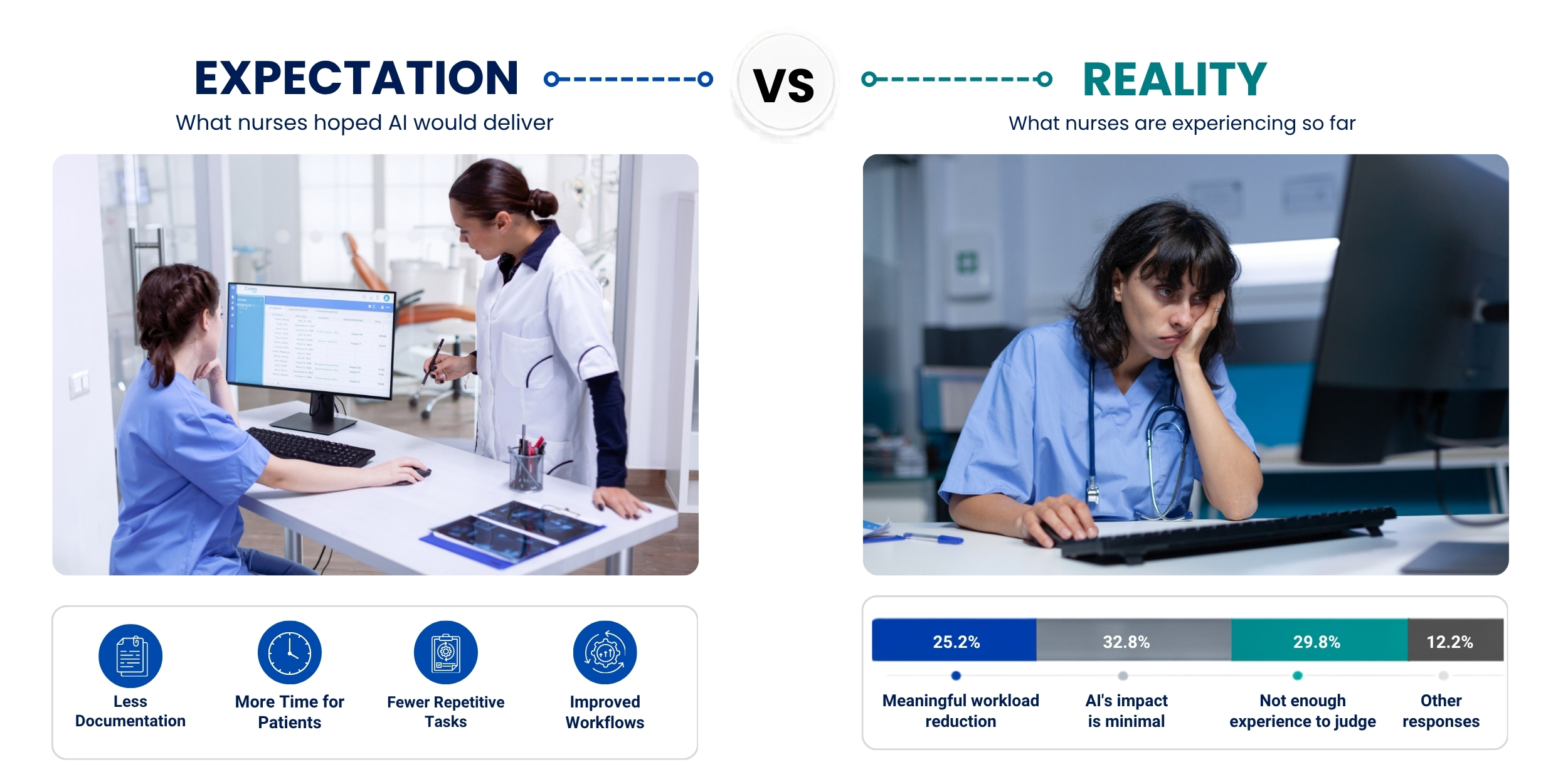
The experience so far is more modest. Only 25.2% report meaningful workload reduction. Another 32.8% say AI’s impact is minimal, while 29.8% have not seen enough to judge.
That gap is the story.
Nurses see where AI should help, but many are not yet feeling the benefit in daily work. This suggests that AI in nursing has crossed the awareness stage, but not the reliability stage.
The issue is not that nurses do not understand the value proposition. They do. The issue is that the tools have not consistently converted potential into time saved.
Work Is Being Shifted, Not Removed
One of the most important insights is that AI can introduce new work even while reducing old tasks.
In the MDForLives survey data, 26.7% report more time spent reviewing and correcting AI outputs. Another 21.4% point to learning and adapting to new systems, while 16.8% feel increased pressure to work faster.
This is where workload becomes harder to define.
If an AI tool drafts documentation, but the nurse must check, correct, validate, and remain accountable for it, the burden has not disappeared. It has changed form. If a system generates prompts but nurses need to interpret whether they fit the real clinical context, then the work has shifted from execution to oversight.
AI in nursing may reduce manual effort in one place while adding cognitive effort in another.
Trust Is Still Measured
Trust remains a key limiter. The MDForLives survey data shows that 39.7% somewhat trust AI, but only 13.0% strongly trust it.
That difference matters because nursing work is high-stakes and context-rich. A recommendation, summary, or prompt that looks efficient but does not fit the patient’s real condition can create risk. Nurses cannot simply accept output because it is fast.
If AI requires constant verification, it may still be useful. But its efficiency gains become partial.
This is why trust is not just an attitude. It is an operational requirement. The more nurses need to double-check, the less workload reduction they feel.
Accuracy and Autonomy Are the Core Concerns
The biggest concerns in the survey data are closely matched: 32.8% worry about inaccurate or unsafe recommendations, while 32.1% worry about loss of clinical judgment or autonomy.
These concerns are not resistance to innovation. They reflect the nature of nursing work.
Nurses combine observation, context, relationship, clinical experience, and judgment in real time. If AI tools do not respect that complexity, they may feel less like support and more like interference.
This is especially important because accountability does not disappear when AI enters the workflow. If something is wrong, the nurse is still expected to notice, correct, escalate, and protect the patient.
This balance between technology and professional expertise reflects the broader conversation around Ai vs Human-in-Healthcare in healthcare, where the goal is to augment clinical decision-making rather than replace the human judgment that underpins safe patient care.
AI in nursing must support judgment without quietly shifting responsibility onto nurses for system-generated errors.
The Barrier Is Workflow Fit
The survey data points to structural barriers as well: lack of training, low trust in accuracy, manual verification, and poor workflow fit.
This suggests that the AI challenge is not only technological. It is implementation-led.
A tool can be technically impressive and still fail nurses if it does not fit shift realities, documentation systems, handoff processes, staffing patterns, patient complexity, or the pace of bedside care.
More broadly, AI is just one component of the evolving landscape of Technology in Nursing, where successful adoption depends as much on workflow integration and usability as on the technology itself.
For AI in nursing to be genuinely helpful, it must be designed around nursing workflow, not imposed on top of it.
Training also matters. Nurses need to know when to use AI, when not to use it, how to interpret outputs, how accountability works, and what to do when the recommendation does not match clinical judgment.
Who Benefits Most?
The data shows an important perception gap. More respondents believe physicians and administrative teams benefit from current AI tools than bedside nurses. Only 7.6% identify bedside nurses as the group benefiting most.
That finding should make healthcare leaders pause.
If AI is introduced as a workforce solution, but the people closest to the workload do not feel the benefit, adoption will remain fragile. Nurses are not simply end users. They are the workflow experts.
The next phase of AI in nursing should be judged not only by system efficiency, but by whether nurses experience real time back, less documentation strain, and better patient-facing support.
Closing Perspective
AI in nursing is not failing. But it is not yet fulfilling its primary promise.
The MDForLives findings show a clear expectation-reality gap. Nurses see documentation as the strongest use case. They want repetitive tasks reduced. But only a minority report meaningful workload relief today.
The deeper insight is that AI does not automatically remove work. In many settings, it redistributes it into oversight, correction, learning, verification, and accountability.
For nurses, the future test is practical: does AI give back real time with patients, or does it become another layer to manage?
If AI eventually delivers genuine time savings, some nurses may also explore opportunities to use that extra time to build Passive Income for Nurses, creating additional financial flexibility beyond their clinical shifts.
Until that question is answered in daily workflow, AI in nursing will remain useful, but not fully trusted as workload relief.