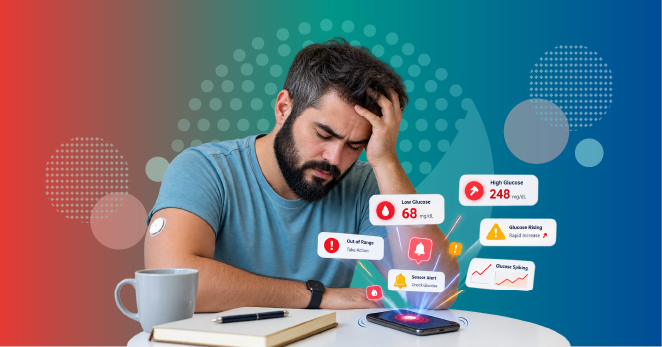
Nothing went wrong today.
No severe low. No frightening spike. No emergency correction. No middle-of-the-night panic.
And yet, by the end of the day, you still feel tired.
Not because of one crisis, but because of all the small decisions that never stopped: checking trends, interpreting arrows, responding to alerts, planning meals, thinking about exercise, wondering whether to correct now or wait.
That is the contradiction in modern diabetes care. Tools have improved. Visibility has improved. Control has improved. But for many people living with diabetes, the mental load has not disappeared.
This MDForLives pulse survey, conducted among people living with diabetes across North America with additional Western Europe responses, shows the next challenge in diabetes technology. Continuous glucose monitoring is helping people see more, fear less, and feel more in control. But seeing more can also mean thinking more.
Diabetes Management Has Moved From Checking to Supervising
For years, glucose management was often built around specific moments: fingerstick testing, meal timing, insulin decisions, symptoms, and follow-up visits. Continuous glucose monitoring changed that rhythm. Instead of isolated readings, people can now see glucose patterns, trends, and alerts across the day and night.
In the MDForLives draft, most respondents use CGM-based setups. 63.6% use continuous glucose monitoring with insulin therapy, while only 12.1% rely on fingerstick testing alone.
For many people, combining an Insulin Pump and CGM offers a more connected approach to diabetes management by pairing continuous glucose insights with automated insulin delivery, reducing manual intervention while improving day-to-day control.
That shift reduces blind spots. But it also changes the lived experience. Diabetes becomes less about occasional checking and more about continuous supervision.
The person is no longer simply asking, “What is my number?”
They are asking, “Where is it going, why is it moving, and what should I do next?”
CGM Reduces Fear, but Not Responsibility
The strongest benefit in the survey is real. 57.6% say CGM significantly reduced effort and stress, and 30.3% say it was somewhat helpful. That means most respondents experience meaningful relief.
But the type of relief matters.
The biggest reduced challenge is fear of sudden highs or lows, reported by 33.3%, followed by night-time monitoring at 24.2%. This suggests that continuous glucose monitoring is most powerful where it reduces uncertainty and improves safety confidence.
That is an important patient insight. CGM often removes surprise, but it does not fully remove responsibility.
The device may alert. The person still interprets. The device may show a trend. The person still decides. The device may reduce fear overnight. But during the day, meals, activity, work, stress, and correction decisions still require attention.
Accuracy Matters Because Trust Saves Thinking
When respondents were asked what CGM feature matters most, accuracy and reliability led at 39.4%. Real-time alerts followed at 24.2%, and ease of use at 18.2%.
This says something deeper than feature preference.
Accuracy matters because it determines whether data feels calming or exhausting. A trustworthy reading helps someone act with confidence. An uncertain reading can trigger second-guessing: should I correct, wait, recheck, trust the sensor, or trust how I feel?
In diabetes care, second-guessing is not a minor inconvenience. It is part of the mental workload.
Continuous glucose monitoring can reduce anxiety when the data feels reliable. But when accuracy is questioned, technology may add another decision layer instead of removing one.
This reflects the broader role of Wearable Health Technology, where continuous access to health data can improve awareness while also reshaping how people manage chronic conditions.
Automation Helps, but Not All Tools Offload Decisions
The survey also explored automation and smart tools. 42.4% use automated insulin delivery, 30.3% use prediction or insight apps, and 21.2% use none.
This is where the story becomes more nuanced.
Automation can reduce decisions when it truly takes action, such as adjusting insulin delivery based on CGM-informed algorithms. But predictive insights or AI-based apps may work differently. They may add prompts, forecasts, or suggestions that still require human supervision.
The same principle underpins lab automation, where technology is designed to reduce repetitive tasks, improve efficiency, and support more consistent clinical workflows while keeping healthcare professionals central to decision-making.
That means some tools reduce thinking. Others organize thinking. A few may unintentionally create more of it.
For patients, the key question is practical: does the technology take work off my plate, or does it make me manage a smarter system?
Predictive Alerts Can Be Helpful and Tiring
Predictive alerts are rated positively. 60.6% say they are very helpful, and 30.3% say they are somewhat helpful in preventing glucose spikes or drops.
But helpfulness is not the same as rest.
An alert can prevent a high or low while still interrupting a meeting, meal, commute, workout, or night’s sleep. It can create peace of mind, but also noise. It can reduce danger, but still demand attention.
This is the trade-off many people recognize but rarely name: technology can make diabetes safer while keeping it mentally present.
The next generation of diabetes tools will need to do more than alert earlier. It will need to alert better, with fewer unnecessary interruptions and clearer next steps.
More Control Does Not Always Mean Less Work
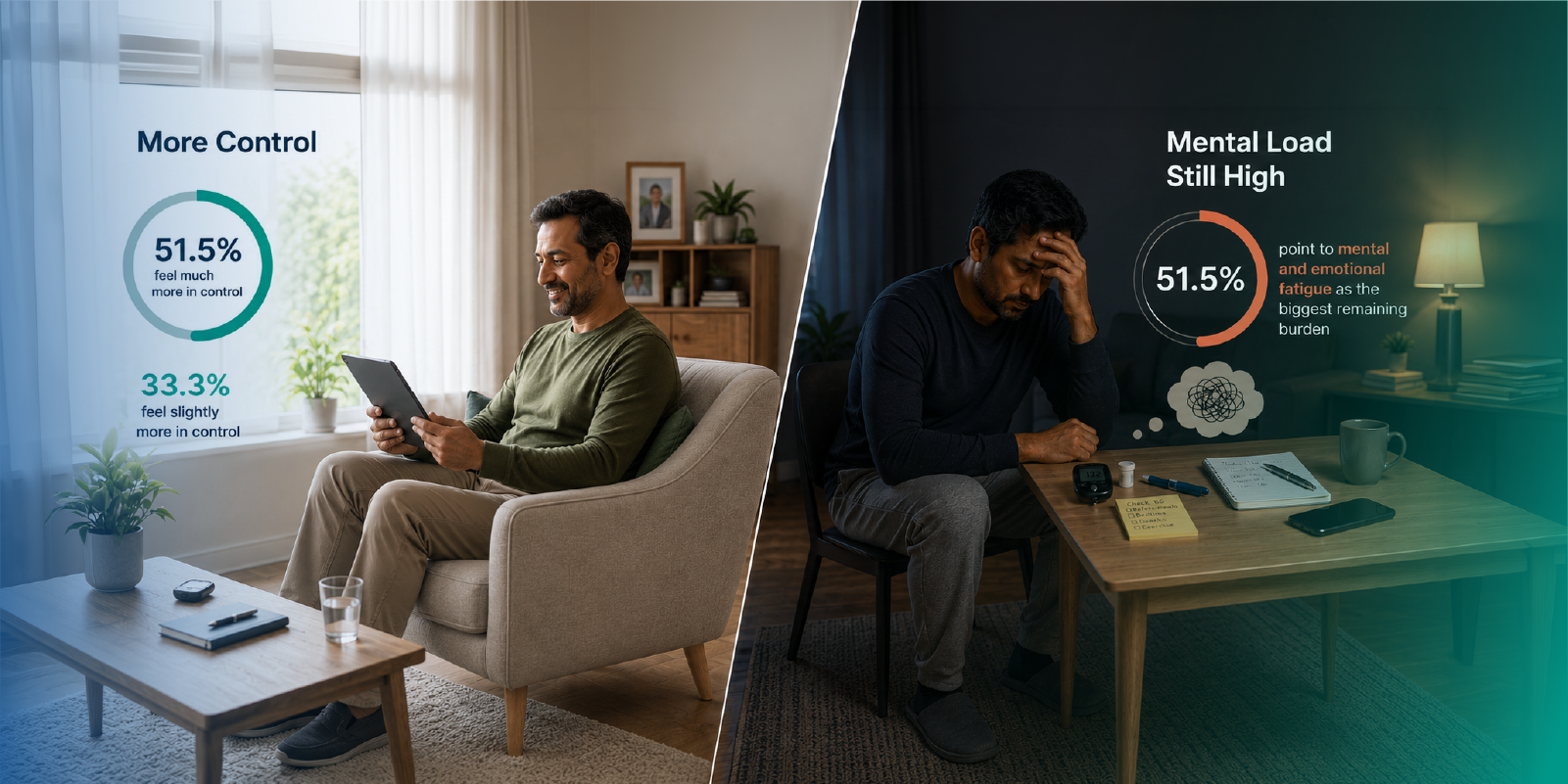
One of the most important tensions in the survey is this: 51.5% feel much more in control of their diabetes today, and 33.3% feel slightly more in control. Yet 51.5% also point to mental and emotional fatigue as the biggest remaining burden.
These two truths are not contradictory. They explain each other.
For many people, better control is being earned through attention. It comes from watching trends, responding early, planning better, using alerts, and making repeated micro-decisions. That can improve outcomes and confidence, but it can still be tiring.
The data suggests a clear insight: control has improved faster than cognitive relief.
That is why diabetes technology should not only be evaluated by glucose metrics. It should also be evaluated by how much decision weight it removes from daily life.
A similar patient-centered approach is shaping obesity treatment, where long-term success depends not only on clinical outcomes but also on reducing the everyday burden of managing a chronic condition.
Food and Personalization Still Require Effort
Meal sequencing and personalized nutrition show promise in the survey. 33.3% say these approaches helped clearly, and 42.4% say they helped somewhat. But 21.2% have not tried them.
Again, the pattern fits the larger story. Personalized strategies may improve glucose control, but they can also add planning. A person may learn which meals work better, but then has to remember, prepare, adjust, and repeat those choices across real life.
Personalization helps most when it simplifies decisions. If it creates another layer of tracking, it may improve numbers without fully reducing fatigue.
Closing Perspective
The most important insight is not that diabetes technology works. It often does.
Continuous glucose monitoring, predictive alerts, automation, and digital tools are helping many people reduce uncertainty, improve safety, and feel more in control. But diabetes is not only a numbers condition. It is a decision condition.
When the condition never pauses, decision fatigue becomes part of the burden.
The next phase of diabetes technology will not be defined only by better measurement. It will be defined by reliable decision offload: fewer interruptions, clearer guidance, trustworthy data, and tools that reduce the need to think about diabetes all day.
Because the goal is not just to see more.
It is to carry less.