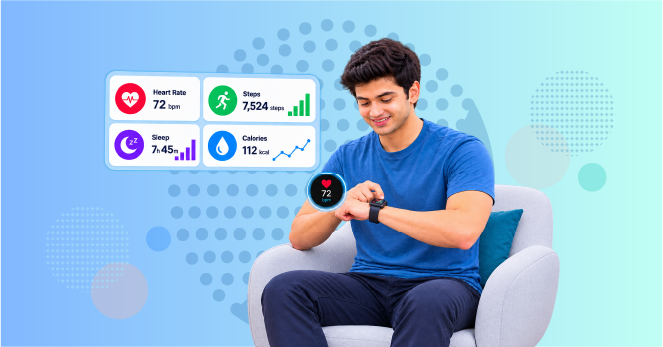
A patient walks into the consultation room with a symptom, a concern, and a graph from their smartwatch. For many clinicians, this is no longer unusual. Heart rhythm alerts, sleep scores, glucose trends, blood pressure logs, recovery metrics, and step counts are increasingly becoming part of the clinical conversation. The consultation no longer starts only with what the patient feels. It often starts with what the device has recorded. That shift is changing healthcare in a subtle but important way.
Wearable health technology is expanding the visibility of patient behavior between appointments. Remote patient monitoring and mobile health tools are already recognized as part of broader telehealth models for chronic disease management. The CDC notes that remote patient monitoring can involve patients recording health data for providers to evaluate later, while digital tools can support medication adherence, self-management, and clinical outcomes. At the same time, the FDA’s growing body of digital health guidance reflects how rapidly software, sensors, mobile applications, and clinical decision support tools are becoming part of healthcare oversight. But visibility is not the same as clarity.
The FDA’s growing body of digital health guidance reflects how rapidly software, sensors, mobile applications, and clinical decision support tools are becoming part of healthcare oversight, highlighting the latest advances in medical technology.
An MDForLives clinician survey among FPGPs and HCPs across specialties suggests that wearable data has moved from novelty to routine clinical friction. Clinicians are no longer asking only whether patients are tracking health metrics. They are asking which signals deserve action, which create anxiety, and whether current workflows are ready for continuous patient-generated data.
Wearable Data Is Now a Regular Part of Clinical Encounters
In the MDForLives findings, only 14.2% of clinicians said patients rarely present wearable or self-tracked health data. By contrast, 28.7% encounter it daily, 25.1% weekly, and 32.0% occasionally.
That means wearable data is not sitting outside clinical care anymore. It is entering the consultation, whether systems are prepared for it or not.
This matters because patient-generated data changes the starting point of clinical reasoning. A symptom description may now arrive with a trend line, an alert, or a device-generated interpretation. In some cases, that can improve the conversation. In others, it may create a new layer of explanation before clinical assessment even begins.
The core insight is simple: wearable data is no longer just personal health tracking. It is becoming consultation material.
The Problem Is Not Data Access. It Is Signal Quality.
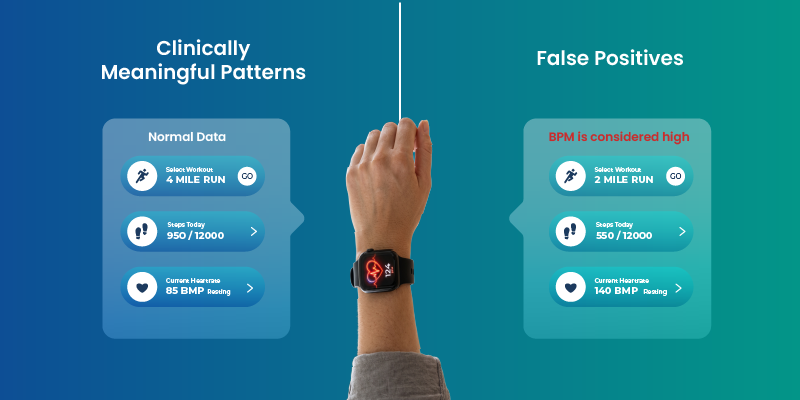
Clinicians in the MDForLives survey appear cautious about the clinical meaning of wearable alerts. The largest share, 39.5%, described alerts as false positives, while 31.6% saw them as a mix of useful and noisy signals. Only 20.3% considered them clinically meaningful, and 8.6% described them as mostly noise.
This pattern reflects a broader tension in wearable medicine. The American College of Cardiology notes that clinicians will increasingly encounter heart rhythm data from consumer-grade devices. It also highlights that while some smartwatch tools show strong performance for atrial fibrillation detection, specificity can be poor for certain rhythm patterns, and monitoring people with low pretest probability may increase false-positive rates.
For clinicians, that distinction matters. A wearable alert may be helpful when it identifies a meaningful pattern in the right context. But when alerts are frequent, ambiguous, or poorly understood, they can shift the clinical encounter from interpretation to correction.
The real challenge is not whether wearable devices can collect data. It is whether they can produce data that clinicians can trust, explain, and act on without creating unnecessary cascades.
Wearables May Be Lowering the Threshold for Testing
One of the more important findings is how wearable data affects diagnostic behavior. In the MDForLives survey, 20.9% of clinicians said wearable data often lowers their threshold for ordering diagnostic tests, while 45.8% said it sometimes does. Only 6.2% said it never changes their testing threshold.
This suggests that wearable data can influence clinical action even when its significance is uncertain.
That is where the risk of over-testing begins. When a patient arrives with an alert, clinicians may feel pressure to rule out risk, reassure the patient, or validate the concern. This does not mean the test is always unnecessary. It means wearable data may introduce a defensive or precautionary layer into decision-making.
The survey reinforces this point. When asked about the biggest risks, 33.1% of clinicians identified overtesting, followed by false reassurance at 25.3%, anxiety at 24.2%, and time diversion at 17.3%.
Wearables are designed to create awareness. In practice, awareness can sometimes become escalation.
Patient Engagement and Anxiety Are Rising Together
Wearable data can make patients more engaged in their health. It can also make them more anxious about every fluctuation.
This dual effect is one of the strongest insight angles in the survey. Wearables may help patients describe symptoms more precisely, monitor chronic conditions, and notice patterns earlier. But they may also turn normal variation into concern.
For clinicians, the psychology of the consultation changes. The patient may not simply ask, “Is this symptom serious?” They may ask, “Why did my device show this?”
As digital tools become increasingly integrated into clinical workflows, the role of technology in nursing and patient care coordination continues to expand.
That difference matters. It shifts part of the consultation toward data interpretation, reassurance, and expectation-setting. In digital health, the patient is not only reporting lived experience. They are interpreting a dashboard.
This is why wearable literacy may become as important as wearable adoption. Patients need to understand what a device can measure, what it cannot diagnose, and when clinical evaluation is still necessary.
Clinician Confidence Has Not Fully Caught Up
The MDForLives data shows a clear confidence gap. Only 17.9% of clinicians said they feel very confident interpreting wearable data without formal guidelines. Another 40.9% reported moderate confidence, while 29.8% were somewhat uncertain and 11.3% were not confident.
This is not resistance to technology. It is a signal that clinical workflows, training, and guidance are still catching up.
Wearable data sits in a grey zone between consumer wellness and clinical evidence. Some devices and use cases are clinically validated. Others are directional, behavioral, or wellness-oriented. The WHO has cautioned that digital health interventions are not a substitute for functioning health systems and must be evaluated through benefits, harms, feasibility, resource use, and equity considerations.
That perspective is highly relevant here. Wearables may support better care, but only if clinicians have clear standards for interpretation, documentation, escalation, and responsibility.
The Clearest Value Is Long-Term Monitoring
Despite the concerns, clinicians do see meaningful value. In the MDForLives survey, 35.1% identified chronic disease monitoring as the clearest value area for wearables. Early deterioration detection followed at 24.2%, engagement and adherence at 22.4%, and triage or prioritization at 18.3%.
For chronic disease management, recovery monitoring, glucose tracking, cardiovascular rhythm awareness, and lifestyle change, longitudinal data can add context that a single appointment cannot capture.
This suggests that wearables may be most valuable when they are used to understand patterns over time, not isolated alerts.
That distinction is important. A single abnormal reading may raise uncertainty. A consistent trend may support better clinical reasoning. For chronic disease management, recovery monitoring, glucose tracking, cardiovascular rhythm awareness, and lifestyle change, longitudinal data can add context that a single appointment cannot capture.
The future value of wearables may depend less on individual alerts and more on clinically usable patterns.
Emerging innovations such as digital twins in healthcare may further enhance the ability to analyze longitudinal patient data and predict health outcomes.
The Next Challenge Is Workflow Capacity
Wearable data is also increasing workload. In the survey, 28.1% of clinicians said wearable data often increases consultation time, while 44.6% said it sometimes does. That means nearly three-quarters experience at least some time burden.
This is where wearable health technology becomes a system issue.
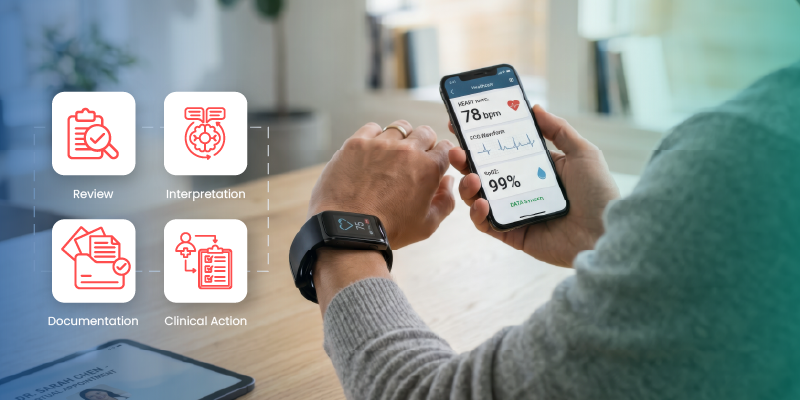
If patients generate more data, someone must review it, interpret it, contextualize it, document it, and decide what action is needed. Without structured pathways, wearable data can create invisible work for clinicians.
The future outlook reflects this tension. While 35.9% of clinicians expect wearables to be integrated into standard care, 28.5% see them as an adjunct tool, 21.6% expect earlier intervention with more noise, and 14.0% believe they may fade because of weak validation.
Clinicians are not rejecting wearables. They are asking for the infrastructure to use them responsibly.
Closing Perspective
Wearable health technology is changing the clinical conversation. It gives patients more visibility into their health and gives clinicians more information about what happens between appointments.
But the MDForLives findings suggest that more data does not automatically mean better care.
Wearables are strengthening care when they support chronic disease monitoring, early pattern recognition, and patient engagement. They are complicating care when alerts are ambiguous, false positives trigger testing, anxiety increases, or consultation time expands without clear interpretation pathways.
The next phase of wearable health technology will not be defined by device adoption alone. It will be defined by clinical integration.
The question is not whether patients will bring wearable data into care. They already are.
The real question is whether healthcare systems can turn that data into meaningful clinical insight without turning every alert into additional burden.