
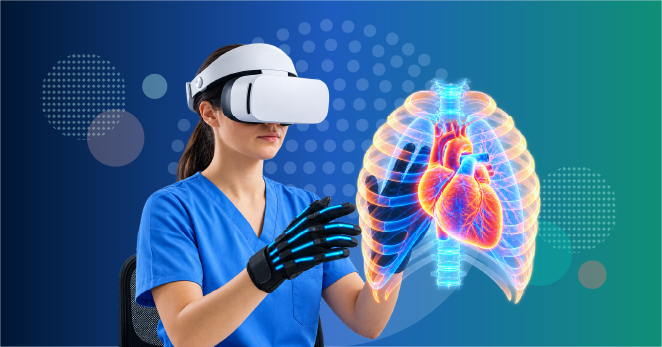
VR in medical training is reshaping how healthcare professionals learn, practice, and prepare for increasingly complex clinical environments. As healthcare systems face rising procedural complexity, workforce shortages, patient safety pressures, and growing demand for simulation-based education, virtual reality is becoming an increasingly important part of modern healthcare training infrastructure.
Across medical schools, hospitals, nursing programs, and surgical training centers, healthcare organizations are integrating immersive VR technologies into education models designed to improve procedural confidence, decision-making, technical precision, and interdisciplinary collaboration. Unlike traditional learning methods that rely heavily on observation or limited hands-on exposure, VR training environments allow healthcare professionals to repeatedly practice realistic clinical scenarios within controlled and risk-free settings.
The growing adoption of VR in healthcare education also reflects a broader shift toward technology-supported, data-informed, and competency-based medical learning systems. As medicine becomes more technologically advanced, healthcare training itself is evolving to mirror the complexity of real-world clinical practice.
Virtual reality is no longer viewed only as an experimental educational tool. It is increasingly becoming part of the future infrastructure of healthcare workforce development.
What Is VR in Medical Training?
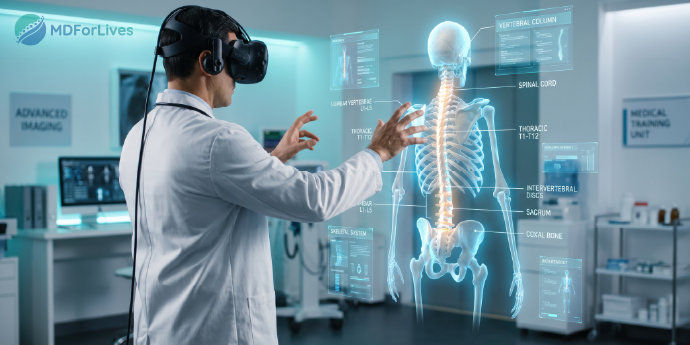
VR in medical training refers to the use of immersive virtual reality technologies to simulate healthcare environments, medical procedures, patient interactions, and clinical decision-making scenarios.
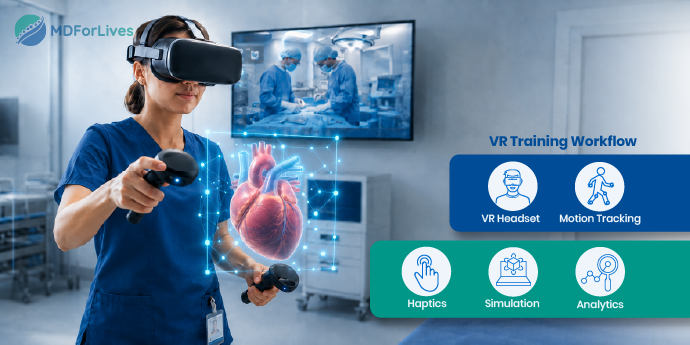
Using VR headsets, motion tracking systems, haptic feedback tools, and simulation software, healthcare professionals can interact with highly realistic digital environments designed to replicate clinical situations. These systems are increasingly being used across surgical education, emergency medicine, nursing training, anatomy learning, rehabilitation, critical care, and allied healthcare education.
Unlike passive educational tools, VR environments allow learners to actively participate in simulated clinical experiences while receiving real-time feedback and performance analysis.
How VR Medical Training Works
VR medical education systems combine immersive software environments with motion-sensitive hardware capable of tracking user interaction and procedural movement. Healthcare learners enter simulated clinical scenarios where they perform surgeries, assess patients, respond to emergencies, practice communication, and complete technical procedures within realistic healthcare settings.
The system records user performance and provides analytics related to procedural accuracy, timing, instrument handling, and clinical decision-making. Some advanced systems also integrate AI-supported performance analysis and biometric monitoring.
VR training transforms healthcare education from observation-based learning into interactive clinical participation.
Why VR is Becoming Essential in Medical Education
Healthcare education is becoming increasingly complex as procedures grow more specialized and patient safety expectations continue rising.
Traditional medical education often relies heavily on classroom instruction, cadaver labs, observation-based learning, and limited real-world procedural exposure. However, clinical opportunities can vary significantly between institutions and learners, creating inconsistencies in hands-on experience.
One of the strongest advantages of VR in healthcare training is the ability to practice repeatedly without placing real patients at risk. Healthcare professionals can refine technical skills, emergency response protocols, and procedural decision-making in fully simulated environments before entering live clinical situations.
At the same time, modern healthcare increasingly involves robotic systems, minimally invasive procedures, AI-supported diagnostics, and advanced imaging technologies. VR allows healthcare professionals to train within environments that more closely reflect modern clinical workflows and technology-integrated care delivery.
Healthcare workforce shortages are also contributing to the growth of simulation-based education. Many institutions are exploring VR platforms as scalable learning systems capable of supporting standardized training experiences across larger healthcare populations.
Read also about Healthcare Workforce Burnout
Benefits of VR in Medical Training
VR medical education offers several important advantages across healthcare learning environments. The technology supports immersive experiential learning, procedural repetition, standardized exposure, and stronger technical confidence before real-world clinical application.
Many healthcare institutions report that simulation-based learning improves learner engagement, procedural familiarity, and knowledge retention. Because scenarios can be repeated multiple times, healthcare professionals are able to practice complex procedures more consistently than traditional opportunistic learning models often allow.
VR training also supports a shift from passive observation toward active, competency-based healthcare education.
Another major advantage is patient safety. Simulation environments allow mistakes, delays, and workflow challenges to occur virtually rather than during real patient care situations. This creates opportunities for safer skill development while reducing pressure during early-stage training.
VR systems may also reduce dependence on limited cadaver access and expand remote healthcare education capabilities, particularly for geographically distributed learning environments.
Applications of VR in Medical Training
VR applications in healthcare education continue expanding rapidly across multiple specialties and professional roles.
Current use cases include anatomy education, procedural simulation, ICU management, rehabilitation therapy, emergency response training, patient communication exercises, and interdisciplinary teamwork simulations. Healthcare organizations are increasingly using VR not only for technical skill development, but also for cognitive training, empathy development, and behavioral healthcare education.
VR in Surgical Training
Surgical education remains one of the most advanced applications of VR in healthcare. Virtual surgical simulations allow trainees to practice minimally invasive procedures, laparoscopic surgery, robotic workflows, and emergency surgical responses within controlled simulation environments.
These systems may help improve hand-eye coordination, spatial awareness, procedural sequencing, and surgical confidence. Some advanced platforms also integrate haptic feedback systems that simulate tissue resistance and instrument interaction.
VR surgical training is increasingly viewed as a supplement to traditional operative exposure rather than a replacement for supervised clinical experience.
VR in Nursing Education
VR in nursing education is increasingly used to simulate bedside care, medication administration, critical care scenarios, emergency response, and patient communication.
Nursing students can repeatedly practice high-pressure situations such as code blue response, ICU deterioration management, infection control procedures, and triage decision-making. VR also supports interdisciplinary communication training within realistic healthcare environments.
VR for Allied Health Professionals
Allied health professionals are also increasingly using VR systems for physiotherapy simulation, rehabilitation planning, radiology workflows, respiratory care training, and occupational therapy education.
These immersive systems help strengthen procedural familiarity while supporting collaborative healthcare learning.
How VR Improves Patient Safety
Patient safety remains one of the strongest drivers behind healthcare simulation adoption.
VR training helps healthcare professionals practice high-risk procedures, identify workflow errors, improve emergency coordination, and strengthen technical competency before direct patient interaction occurs. Simulation-based learning environments allow clinical errors to occur virtually rather than in real healthcare settings.
VR may also improve communication and crisis management during high-acuity scenarios involving multidisciplinary healthcare teams.
Simulation-based healthcare education supports safer learning pathways while strengthening clinical preparedness.
Read also about doctor patient communication
AI and VR in Medical Training
Artificial intelligence is increasingly integrated into VR healthcare training systems.
AI-supported platforms can adapt training difficulty, personalize educational pathways, analyze performance patterns, and generate predictive feedback based on learner behavior. Some systems evaluate procedural timing, communication behavior, technical accuracy, and decision-making consistency.
AI integration is gradually transforming VR from static simulation into adaptive healthcare intelligence platforms capable of continuously optimizing medical education experiences.
VR vs Traditional Medical Simulation
Traditional simulation methods such as mannequins and cadaver labs remain important components of healthcare education. However, VR offers several advantages including scalability, remote accessibility, repeated procedural exposure, and highly customizable clinical environments.
At the same time, VR still has limitations related to tactile realism and physical procedural feedback. Because of this, most healthcare educators increasingly view VR as a complementary tool integrated alongside traditional clinical and simulation training models rather than a complete replacement.
Challenges and Limitations of VR in Medical Training
Despite growing adoption, VR healthcare training still faces important operational and educational challenges.
Implementation costs can be significant depending on hardware complexity, software licensing, infrastructure requirements, and simulation fidelity. Institutions must also invest in faculty training, technical support systems, and curriculum integration frameworks.
Some learners may experience motion sickness, visual fatigue, or reduced immersion during prolonged sessions. In addition, healthcare organizations must carefully evaluate long-term educational outcomes, clinical validation standards, cybersecurity risks, and data privacy requirements.
The long-term success of VR in healthcare education depends not only on technology adoption, but on meaningful clinical integration and measurable learning outcomes.
Future of VR in Healthcare Education
Future VR medical education systems will likely become more immersive, AI-driven, cloud-connected, and personalized. Emerging technologies such as mixed reality, biometric tracking, digital twin simulation, and adaptive AI-generated learning scenarios are expected to further expand simulation capabilities.
Medical schools and healthcare institutions increasingly recognize that future healthcare professionals will train within digitally integrated learning environments where immersive simulation becomes part of standard educational infrastructure.
As healthcare systems continue evolving, VR is expected to play a growing role in anatomy learning, procedural competency development, interdisciplinary teamwork training, and continuing medical education.
The future of VR in healthcare will not be defined solely by technological sophistication, but by how effectively these systems improve clinical readiness, healthcare collaboration, and patient outcomes.
Read also about Advances in Healthcare Technologies
Conclusion
VR in medical training is transforming healthcare education by creating immersive, scalable, and increasingly personalized learning environments. From surgical simulation and nursing education to AI-supported analytics and interdisciplinary crisis response training, VR technologies are reshaping how healthcare professionals develop procedural competency and clinical confidence.
At the same time, successful implementation requires careful integration, faculty support, infrastructure investment, and ongoing validation. As healthcare systems become more technologically advanced and clinically complex, simulation-based education is becoming increasingly important for workforce preparedness and patient safety.
Virtual reality is increasingly moving from experimental innovation toward a core component of modern healthcare education infrastructure.