
A patient hears that their biologic is being switched to a biosimilar. The pharmacist explains that it is highly similar to the reference medicine, approved through a regulated pathway, and used to improve access. The patient pauses and asks the question that often sits beneath every biosimilar conversation:
“Will it work the same for me?”
That moment captures the real-world challenge of biosimilars today.
Biosimilars are no longer unfamiliar in modern healthcare. They are used across oncology, immunology, inflammatory bowel disease, rheumatology, endocrinology, and other therapy areas where biologics have become central to care. Their value is clear: they can support affordability, improve access, increase competition, and help healthcare systems manage the rising cost of biologic therapy.
But adoption is not the same as trust.
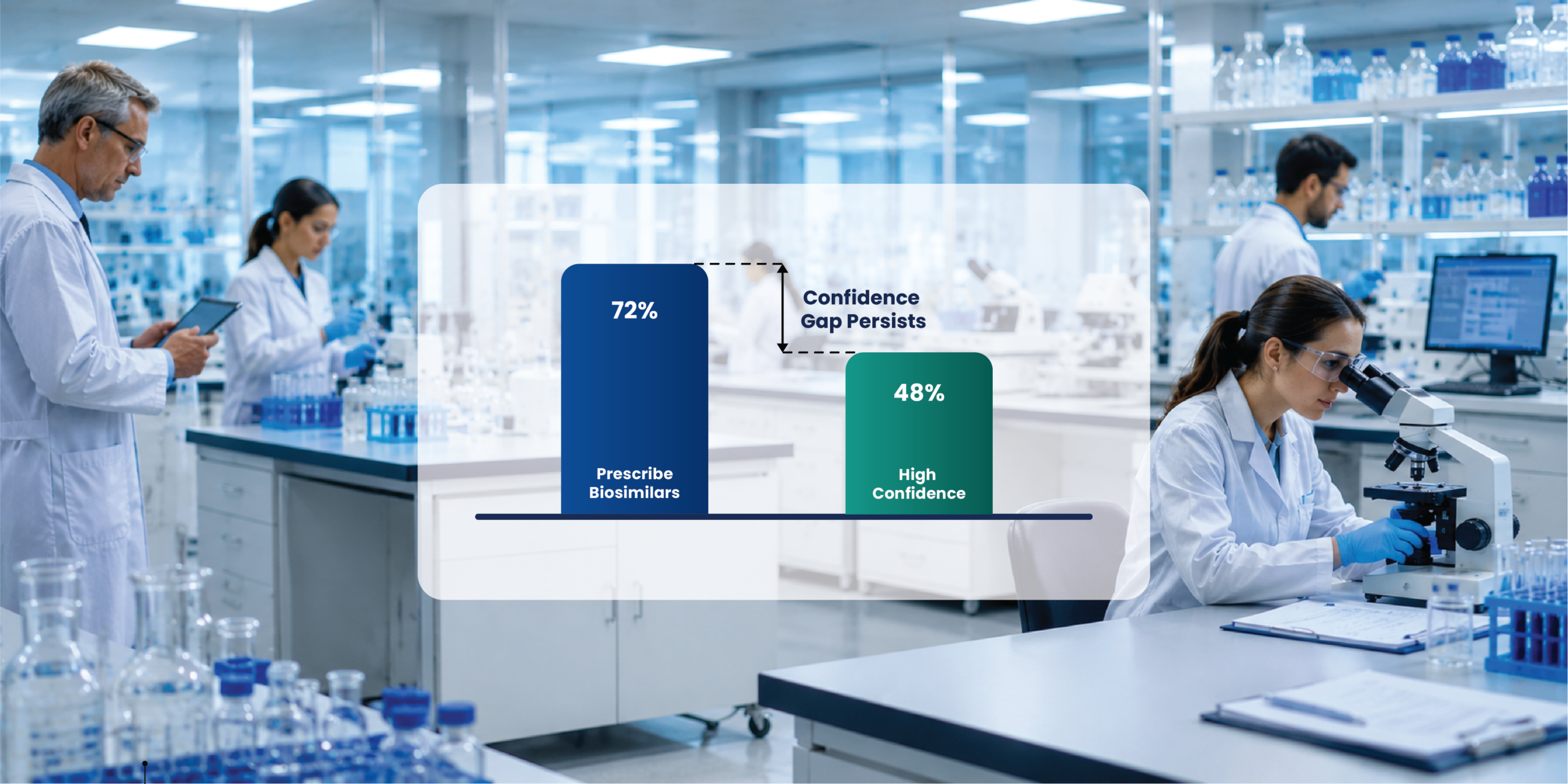
The MDForLives draft insight shows that biosimilar use is already established. Across a global community of over 2,500 healthcare professionals, 72% report prescribing biosimilars, while only 48% report high confidence in their use. That gap is the story. Biosimilars are being used, but they are still being evaluated case by case.
For pharmacists, this gap matters because they often sit closest to the practical realities of biosimilar use: patient reassurance, substitution rules, prescriber coordination, adherence monitoring, documentation, and safety follow-up.
Biosimilars Have Crossed the Adoption Threshold
The first insight is clear: biosimilars have moved from concept to practice.
When 72% of clinicians report prescribing biosimilars, the question is no longer whether biosimilars belong in healthcare. They already do. They are part of real treatment pathways, payer decisions, institutional protocols, and pharmacy workflows.
But the confidence figure changes the interpretation. Only 48% reporting high confidence suggests that adoption is running ahead of complete reassurance.
This is not resistance. It is conditional acceptance.
Clinicians and pharmacists may accept the regulatory and clinical basis for biosimilars, yet still approach specific switches, patient groups, or therapy areas with caution. In practice, confidence is shaped not only by approval standards, but by what happens after patients start or switch therapy.
Why Pharmacists Are Central to the Trust Gap

The pharmacist’s role in biosimilars is not limited to dispensing. The survey QnR correctly places pharmacists at the center of patient education, managing substitutions, coordinating with prescribers, monitoring safety and adherence, and explaining interchangeability.
That is where trust becomes operational.
As patients become more engaged in their care, wearable health technology is also changing how clinicians interpret patient-generated data during consultations while balancing meaningful insights with clinical judgment.
A prescriber may initiate the treatment decision. A payer or institutional protocol may shape product selection. But the pharmacist often becomes the professional who explains what the change means for the patient, why the biosimilar is being used, what to monitor, and when to escalate concerns.
This is especially important because patient concern can influence adherence. Even when clinical evidence is strong, a patient who feels uncertain about a switch may interpret normal symptoms, side effects, or disease fluctuation through the lens of distrust.
In biosimilar practice, education is not a soft add-on. It is part of therapy continuity.
Cost Drives Use, but Trust Sustains It
The supplied draft shows that 68% cite cost-effectiveness as a key driver of biosimilar use, followed by institutional protocols at 54% and patient access at 47%.
This pattern is important because it shows biosimilar adoption is often system-driven. Cost pressures, formulary decisions, payer dynamics, hospital protocols, and access goals may all push biosimilars into practice.
That does not make the decision less clinical. It makes it more layered.
A pharmacist may support biosimilar use because it improves access and affordability, while still needing to manage patient concerns, prescriber alignment, and therapy monitoring. In other words, the system may initiate the switch, but trust must be built at the patient and care-team level.
This is why biosimilars cannot be treated only as a cost-saving mechanism. If the conversation begins and ends with cost, patients may hear “cheaper” rather than “clinically appropriate.” Pharmacists can help reframe the discussion around access, evidence, monitoring, and continuity.
The Confidence Barriers Are Not About Availability
The draft identifies three major confidence concerns: 61% question long-term outcomes, 49% express concerns around interchangeability, and 42% cite lack of clarity in real-world evidence.
These are not barriers of availability. They are barriers of interpretation.
Biosimilars may be approved, stocked, prescribed, and reimbursed, but healthcare professionals still want confidence that outcomes remain predictable across patients, settings, switches, and therapy histories. This is especially relevant in chronic diseases where patients may be stable on a reference biologic and anxious about change.
Interchangeability adds another layer. In some systems, substitution can be shaped by legal, regulatory, and pharmacy-level requirements. For pharmacists, this creates a practical need for clarity: when substitution is permitted, what documentation is required, how prescribers should be notified, and how patients should be counseled.
Confidence grows when the process is not only clinically valid, but also operationally clear.
The same balance applies to AI in endoscopy, where better detection capabilities must be supported by clinician confidence, transparent workflows, and clear accountability.
Biosimilars Are Used Strategically, Not Uniformly
The supplied draft suggests biosimilars are more commonly used in switching scenarios and cost-driven cases, while they are less commonly used in treatment-naïve patients or complex, high-risk cases.
That pattern should not be read as inconsistency. It reflects risk-managed adoption.
Clinicians and pharmacists may feel more comfortable when the pathway is familiar, the patient is stable, and monitoring expectations are clear. Caution rises when treatment decisions are more complex, when the patient has a high-risk history, or when the clinical consequences of disruption feel greater.
For pharmacists, this means biosimilar counseling cannot be one-size-fits-all. A patient starting therapy for the first time may need a different conversation from a patient being switched after years on a reference product. A patient with prior treatment failures may require more reassurance and closer follow-up than someone with a straightforward pathway.
Trust Is Accumulated Through Experience
One of the strongest insights from the draft is that confidence develops through repeated patient outcomes, peer validation, and institutional reinforcement.
This is a useful way to understand biosimilar trust.
Regulatory approval creates permission. Clinical evidence creates rationale. But real-world experience creates comfort.
Pharmacists contribute to that comfort by documenting product use, monitoring adherence, reporting adverse events, supporting patient education, and keeping communication clear between patients and prescribers.
These stewardship practices also play an important role in preventing antimicrobial resistance by supporting the appropriate and responsible use of medicines across healthcare settings.
Over time, these everyday practices can turn biosimilars from “accepted in principle” into “trusted in routine care.”
What Would Improve Biosimilar Adoption?
The QnR points to the right improvement areas: better patient education, clearer interchangeability guidance, prescriber-pharmacist alignment, improved tracking and data, and policy or reimbursement clarity.
Among these, pharmacist involvement is most visible in three places.
First, patient education. Patients need clear, non-technical explanations that biosimilars are not simply “cheaper substitutes,” but regulated biologic medicines intended to match the reference product in quality, safety, and efficacy.
Second, prescriber alignment. Pharmacists need smooth communication pathways so substitution or switching does not create uncertainty between care-team members.
Third, tracking and monitoring. Because biologics and biosimilars may have product-specific identifiers, accurate documentation supports pharmacovigilance, safety review, and continuity.
The next phase of biosimilar adoption will likely depend less on awareness and more on trust infrastructure.
A similar balance is emerging with AI in clinical laboratories, where successful adoption depends on combining automation with clinical oversight, transparency, and professional accountability.
Closing Perspective
Biosimilars are no longer emerging. They are established in real-world practice.
But establishment is not the same as confidence.
The MDForLives data shows a clear gap: biosimilars are widely prescribed, yet not fully trusted across every patient scenario. Cost and access are driving use, but long-term outcomes, interchangeability, and real-world evidence still shape caution.
For pharmacists, this is a defining moment. They are not just dispensing biosimilars. They are translating evidence into patient trust, helping prescribers operationalize switching, and supporting the real-world monitoring that makes confidence sustainable.
The future of biosimilars will not be decided only by whether they are available.
It will be decided by whether patients, pharmacists, and prescribers can trust the pathway around them.