

For a child born with congenital heart disease, successful surgery is not always the end of the treatment journey. The heart grows. The child grows. A replacement heart valve usually does not.
That mismatch has long challenged pediatric heart surgery: a valve that fits a young child can become too small, requiring another intervention or open-heart operation.
In October 2026, the U.S. Food and Drug Administration approved the Autus Size-Adjustable Valve, a surgically implanted pulmonary valve for selected pediatric patients with congenital pulmonary valve disease. What makes it different is what can happen after surgery: it can later be enlarged through a catheter-based procedure as the child grows.
For pediatric cardiology and congenital heart surgery teams, that shifts the question from “What valve fits this child today?” to “How can today’s valve accommodate the child they will become?”
Why growth changes the valve problem
Congenital heart defects are structural abnormalities of the heart or major blood vessels present from birth, affecting about 1 in every 100 births in the United States. Some of these defects affect the pulmonary valve or the pathway carrying blood from the right side of the heart to the lungs. Pulmonary valve stenosis is a narrowed valve; pulmonary atresia is a valve that does not form normally. According to the FDA, these two conditions together affect approximately 4,200 babies in the United States each year.
Treatment can improve blood flow, but some children later develop pulmonary regurgitation, where blood leaks backward through the valve and over time can enlarge or weaken the right ventricle, creating a need for heart valve replacement.
Growth complicates that decision. With conventional heart valve replacement, surgeons choose a valve that fits the child at that time, yet the body may still have years of growth ahead, which raises a question for tomorrow: what happens when the child outgrows the valve?
It does not grow. It expands.
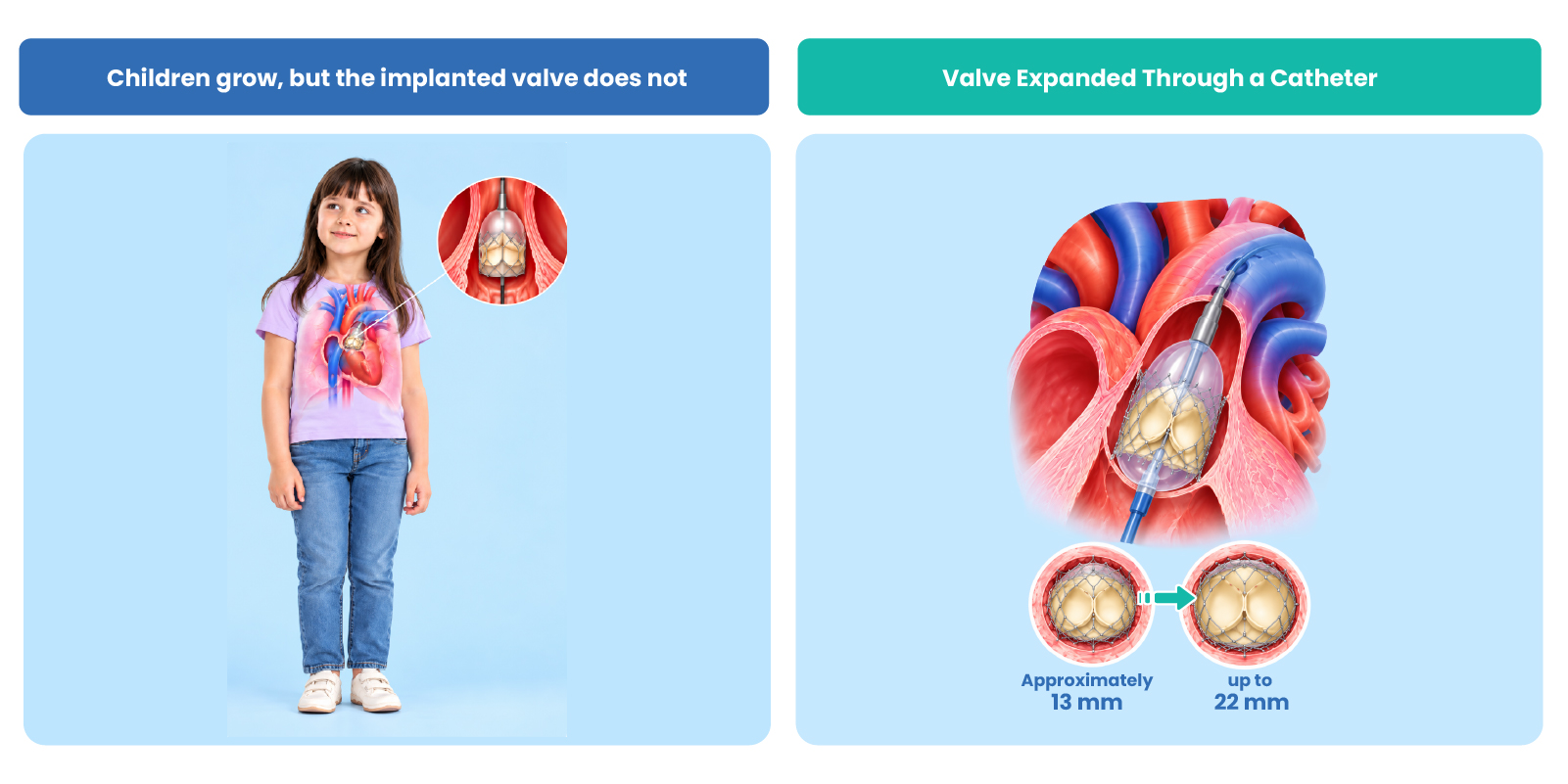
The phrase “a heart valve that grows with a child” makes the concept easy to grasp, but clinically the distinction matters. The Autus valve does not biologically grow. It is size-adjustable: implanted at approximately 13 millimeters in diameter and later widened with a balloon catheter, ultimately reaching approximately 22 millimeters, comparable with an adult-sized pulmonary valve.
With a fixed-size pediatric valve, becoming too small may eventually contribute to another surgical replacement. With an expandable valve, some growth may instead be managed through catheter-based enlargement. This does not eliminate future procedures, but it may change the type and timing of intervention required.
The FDA indication is specific: the valve is approved for selected pediatric patients weighing at least 10 kg who require surgical pulmonary valve replacement for defined dysfunction of the native or previously repaired right ventricular outflow tract. It is not intended for every child with congenital heart disease or every valve condition, and approval and availability may differ outside the United States.
The material is different too
Expansion is only part of the technology. The Autus valve is also the first U.S.-approved heart valve to use polymeric material for its leaflets, the flexible components that open and close with each heartbeat. Traditional biological valves use animal-derived tissue, which can deteriorate or calcify over time, an important consideration in younger patients who may need the valve to work for many years. The synthetic design offers a different approach, and early follow-up has been encouraging, though durability still needs to be established over longer periods. Such a valve must solve two problems, size and durability, since expandability matters only if it keeps working reliably before and after expansion.
Medical innovation increasingly depends on developing new ways to modify, replace, or support biological functions. Explore gene therapy, its mechanisms, uses, and what to expect.
What the clinical study showed
The approval was supported by a study of 62 pediatric patients across 12 U.S. sites. At six months, the first 60 patients evaluated showed acceptable blood-flow performance through the right side of the heart, with pulmonary valve leakage no more than mild. All patients underwent successful implantation, and the FDA reported no deaths, strokes, blood clots requiring additional treatment, or other clot-related complications.
The findings are encouraging, but they show why monitoring matters: three patients experienced fractures in the valve frame and two had reduced movement of one leaflet, though at the time reported these had not caused symptoms.
The strongest early evidence for the growth concept came from two children who began to outgrow their valves. Rather than another open surgical replacement, both had their valves successfully enlarged through balloon-catheter expansion. That shows the concept can work, but two expansions are early evidence, not proof of long-term performance.
The real goal is fewer repeat surgeries
For families, repeat pediatric heart surgery can mean another hospitalization, anesthesia, recovery, time away from school, and disruption to everyday life. Repeat operations can also be technically more complex because of previous surgery, scar tissue, changing anatomy, and the underlying defect.
An expandable valve does not remove all future valve problems. Some children may still need catheter interventions, valve repair, another replacement, or surgery for other aspects of congenital heart disease. The potential advantage is narrower: physical growth may not always have to trigger an open-heart operation simply because the valve has become too small. If catheter-based expansion safely extends the valve’s useful life, it could change the sequence of procedures across childhood rather than improving one operation.
Pediatric treatment decisions often depend on the child’s anatomy, condition, timing, and expected needs over time. Explore how precision medicine can improve treatment and care.
Long-term evidence will be critical
The Autus clinical programme includes continued follow-up after implantation and after expansion. For pediatric cardiology teams, key questions remain: Can the valve be expanded more than once? How does the frame perform over time? Do the polymeric leaflets keep moving normally? Does narrowing or leakage develop after expansion? And most importantly, does the technology reduce repeat open-heart operations over childhood?
FDA approval establishes that the device can be used within its indication. It does not mean every long-term question has been answered, and for a technology built around childhood growth, the most important evidence will come from years rather than months.
Other approaches are also being explored: a 2025 JAMA case series described 19 children who underwent partial heart transplantation, where living donor valve tissue showed the potential to grow with the patient rather than being mechanically expanded
Closing perspective: beyond the next surgery
The phrase “a heart valve that can grow with a child” captures attention because the problem is easy to understand; children grow, conventional valve implants do not. The Autus Size-Adjustable Valve does not literally grow, but it adds something new to approved pediatric valve care, a pulmonary valve that can be implanted and later enlarged as the child becomes bigger.
The early results are promising but still limited. Implantation worked in the patients studied, early valve performance was acceptable, and two children have already had their valves expanded as they grew. That said, important questions remain. Some patients had frame fractures or reduced movement in a leaflet; only a handful of expansions have been done so far, and how long the valve lasts are still unknown and under study.
Ultimately, this technology will be measured not by how the valve performs just after surgery, but by what happens as the child grows. If expandable valves can safely postpone some repeat open-heart operations, they could change part of the lifelong treatment journey for selected children with congenital heart disease.