

When a patient says their dry eye treatment is not working, the obvious next question seems to be what to try instead. But persistent dryness, burning, fluctuating vision or ocular discomfort does not always mean the current treatment has failed. Dry eye disease is multifactorial, and the mechanism driving symptoms often becomes clearer as treatment progresses. A patient who first appeared to need more tear support may also have meibomian gland dysfunction (MGD), persistent ocular-surface inflammation, adherence challenges, environmental triggers, or symptoms not fully explained by visible ocular-surface findings. That makes persistent symptoms a reassessment point, not automatically a reason to move to the next therapy.
An MDForLives survey of ophthalmology and eye-care professionals across the USA, UK, Canada, Italy, France and Germany explored how clinicians approach dry eye disease management when symptoms continue beyond first-line treatment. For the detailed clinician findings and methodology, explore the MDForLives Dry Eye Disease Management: When Symptoms Persist Beyond First-Line Treatment Insight Report.
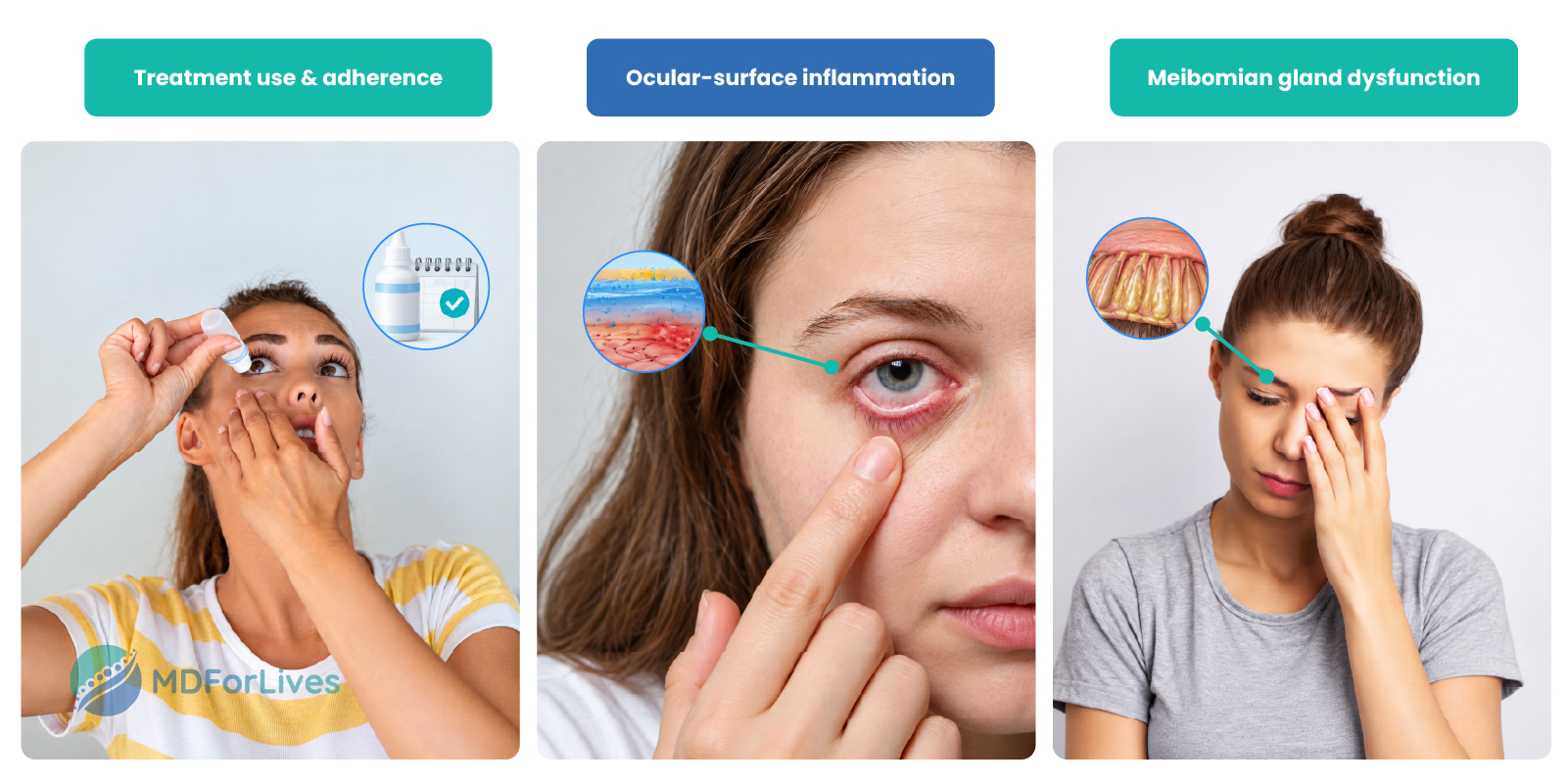
Check whether the problem is treatment or treatment use
Treatment failure and treatment non-use are not the same thing. In the survey, 49.1% of eye-care professionals identified poor adherence as the most common explanation for initial treatment failure.
So before changing therapy, it helps to ask whether the treatment is being used as intended, whether enough time has passed to judge response, whether administration or discomfort is discouraging use, and whether cost or availability is making it hard to continue. This matters most in chronic dry eye, where improvement takes time and burden builds. Clarifying treatment use first separates a therapy that has genuinely failed from one that has not had a fair chance to work.
Does the diagnosis still fit?
Even when treatment has been used appropriately, the next question is whether the original disease model still fits. TFOS DEWS III describes dry eye as a multifactorial, symptomatic disease involving loss of tear-film and/or ocular-surface homeostasis, so several drivers may coexist rather than follow one pathway. That appeared in the research, where 58.5% of surveyed professionals said mixed-mechanism dry eye most often drives their approach, such as aqueous deficiency, evaporation, MGD, inflammation, eyelid abnormalities and medication effects overlap.
When symptoms persist, intensifying the same treatment may not answer the real question. Reassessment can include symptom pattern, tear-film stability, ocular-surface staining, eyelid and gland findings, medication exposure, environmental factors and systemic disease. The aim is not to reconfirm dry eye, but to identify which mechanisms are active now and whether the current treatment targets them. That is where management shifts from a treatment ladder toward matching treatment to phenotype and disease drivers.
When inflammation is the issue not lubrication
Lubrication remains important, but tear support cannot address every cause of persistent disease. If ocular-surface inflammation remains active, more lubricant alone may give incomplete control, and the question becomes whether inflammation has become an important target. This does not mean every patient with continuing symptoms needs anti-inflammatory therapy; the point is to ask whether the current treatment and the active mechanism still match. If not, increasing the same therapy may add burden without addressing the reason for non-response. Clear counseling on what the treatment targets and how long it takes also supports adherence.
How MGD redirects the pathway
MGD is another reason tear-focused treatment may give only partial relief. The meibomian glands contribute lipids that stabilize the tear film and reduce evaporation, so impaired gland function can leave fluctuating vision, irritation or dryness despite regular lubricant use.
The survey shows how this changes decisions: when symptoms persisted, 32.1% of respondents said they would intensify MGD-directed treatment, while another 32.1% would escalate topical anti-inflammatory therapy. The value is not that one should precede the other, but that persistent symptoms can represent different problems. One patient may need more attention to gland function, another continuing inflammation, and another, a review of triggers or the diagnosis. The next step depends on what the reassessment reveals.
When symptoms and signs diverge
Sometimes symptoms remain substantial despite limited objective findings, or visible signs improve while discomfort continues. That mismatch deserves investigation: environmental exposure, medications, autoimmune disease, eyelid disorders, contact-lens use and other surface conditions may need review, and in selected patients neuropathic ocular pain may contribute to symptoms disproportionate to visible disease.
Dry eye symptoms can persist even when patients have tried different ways to find relief. Explore why dry eyes and screen-related discomfort can make relief feel temporary.
The research also identified refractory MGD and autoimmune-associated dry eye among the subgroups most likely to alter strategy. The takeaway is simple: refractory dry eye is not always asking for a stronger drop. Sometimes the dominant driver, an associated condition or the source of discomfort has not yet been identified and recognizing this avoids cycling through similar therapies.
Better matching solution, not more treatment
Advanced dry eye treatment options can suggest a simple progression from mild therapies to stronger ones, but practice is rarely that linear. Inflammatory disease, refractory MGD, severe aqueous deficiency, autoimmune-associated dry eye and neuropathic symptoms can each need different approaches.
Dry eye management involves understanding the underlying causes and choosing treatments that address individual symptoms and disease mechanisms. Explore dry eye treatments, their uses and the latest developments.
Comprehensive care therefore extends beyond choosing another medication, and may involve tear support, eyelid and gland management, medication review, inflammation control, adherence support and specialized interventions. The goal is not to use every treatment, but to find the one, or combination, that best matches the active drivers while remaining practical to continue. Escalation should mean greater precision, not greater intensity.
Toward personalized care
The future of dry eye care may depend less on one superior treatment and more on matching patients, phenotypes and therapy. That was reflected in the survey, where 45.3% identified personalized DED treatment algorithms as the development most likely to transform care in the coming years.
Personalization does not replace clinical judgement; it helps organize it: which mechanisms are active, which have been addressed, whether the patient can follow the plan, whether symptoms and findings are changing together, and whether another condition or barrier has become more important. These questions help separate genuine treatment failure from incomplete treatment exposure, an untreated driver, or a diagnosis that needs reconsideration. For clinicians managing persistent dry eye, the takeaway is this: when treatment is not working, the next step is not automatically a new treatment but understanding why the current one has not worked.