
A patient has been stable on treatment. The prescription is appropriate. The next dose is due. Then the usual medicine is unavailable. That moment turns a supply problem into a clinical one.
Drug shortages can interrupt treatment, delay administration, and force changes in therapy. For pharmacists and other allied healthcare professionals, the challenge is not simply finding stock. It is protecting treatment continuity without creating a new medication-safety risk.
To understand how pharmacy professionals manage that balance, MDForLives surveyed pharmacists across the USA, UK, Canada, Italy, France and Germany. The detailed findings and methodology are available in the MDForLives Medication Shortages: How Pharmacists Protect Treatment Continuity and Safety Insight Report.
In such situations the practical question is not only, “What can replace the missing medicine?” But it is: “How can treatment continue safely while the usual option is unavailable?”
A shortage becomes a treatment problem before the shelf is empty
A medicine shortage may first appear as a stock alert, delayed delivery or reduced supply. But the clinical risk begins before inventory reaches zero.
The questions are already changing. Which patients depend on uninterrupted treatment? Is a clinically appropriate alternative available? Will a different product change prescribing, preparation, dispensing or administration?
In the MDForLives survey, 80.7% of pharmacists selected continuity of clinically appropriate therapy as an outcome that best demonstrates effective shortage management.
Pharmacy teams should begin assessing the clinical impact as soon as medicine supply becomes uncertain, rather than waiting until the product is completely unavailable. Early review gives teams more time to identify affected patients, consider suitable alternatives and prepare for any necessary treatment changes.
Effective shortage management is therefore not just about finding available stock. The real goal is to keep patients on safe and clinically appropriate treatment with as little disruption as possible.
Limited supply turns inventory into a clinical decision
When supply cannot meet demand, inventory decisions become patient-care decisions.
Teams may need to determine who can safely wait, who can switch, and who may face greater harm from interruption. In the MDForLives survey, 43.0% of pharmacists said clinical urgency most determines medication allocation during a shortage.
No single factor determines how limited medicine supply should be allocated. Clinical urgency, patient risk, continuity of treatment, available alternatives and remaining stock all need to be considered together.
When antimicrobial treatment options are limited, selecting an appropriate medicine remains essential. Understand antimicrobial resistance and why responsible antimicrobial use matters in healthcare.
For pharmacists, the key is to have a clear and transparent process in place before the shortage becomes critical. This includes knowing how limited stock will be assessed, which patients may need priority or escalation, and which members of the care team should be involved.
When supply is limited, decisions should be based on clinical need rather than simply on who receives the medicine first.
A substitute can restore treatment and still create new risk
An alternative product may protect continuity. It may also introduce unfamiliarity into a medication-use system built around the usual medicine.
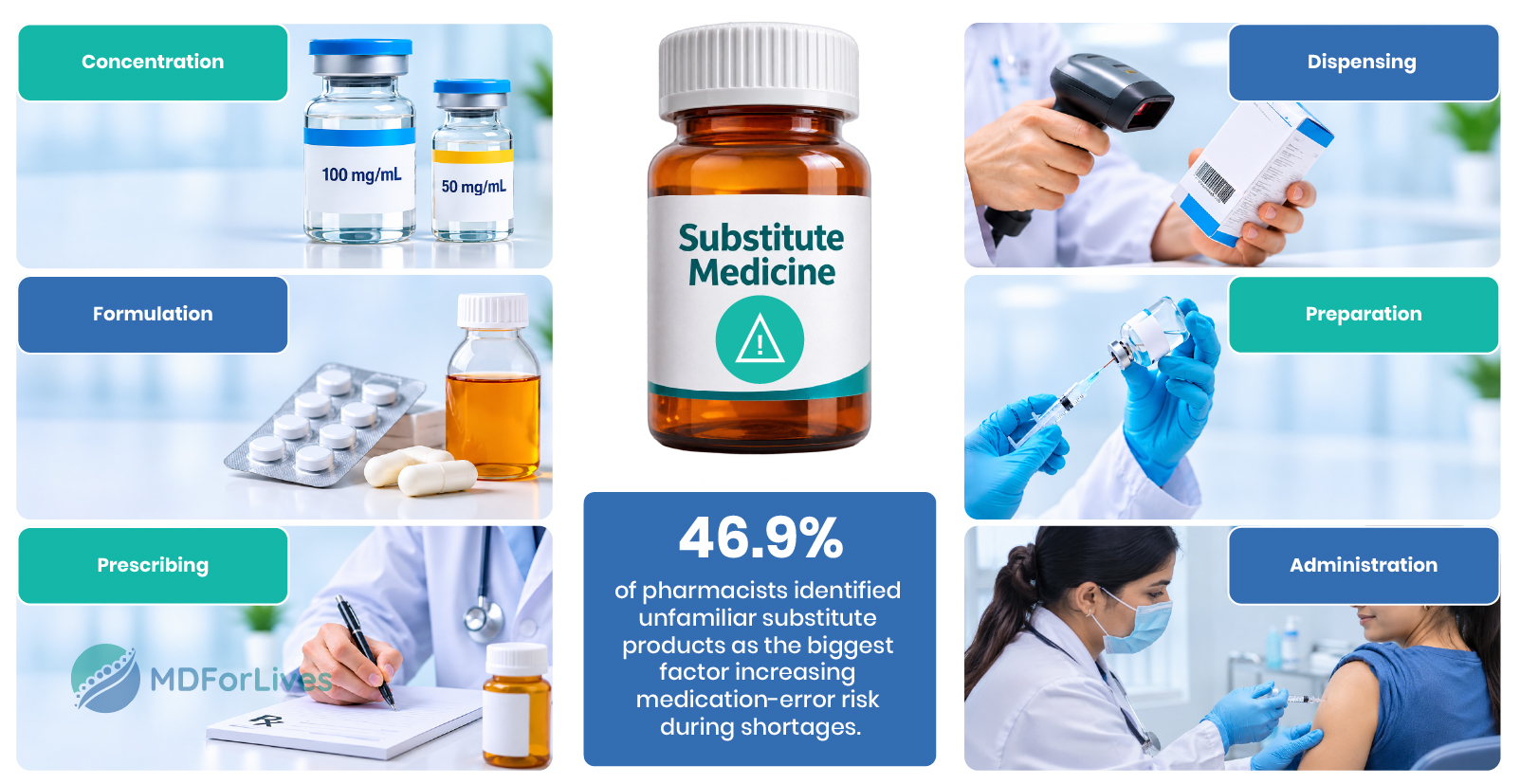
A different manufacturer, strength, concentration, formulation or route can change how treatment is prescribed, dispensed, prepared or administered.
In the MDForLives research, 46.9% of pharmacists identified unfamiliar substitute products as the biggest factor increasing medication-error risk during shortages.
Choosing a substitute during a shortage is not only about finding an available product. It also means making sure the alternative can be introduced safely into the existing medication-use process.
Therapeutic suitability remains the first consideration. In the MDForLives survey, 53.2% of pharmacists said therapeutic equivalence was the factor that most influenced substitute selection.
Choosing an alternative medicine requires more than confirming availability. Clinical suitability, treatment effectiveness and safe use all matter. Explore how biosimilars are used in clinical practice and the considerations involved in their adoption.
Once an alternative is chosen, pharmacists may also need to review prescribing systems, labels, storage requirements, preparation instructions, and administration guidance. In hospitals, clear communication with nursing and other clinical teams may also be necessary.
When medication products or prescribing details change, verification becomes especially important. Discover how AI in pharmacy could make prescription verification safer and support medication safety.
The right substitute is therefore not simply one that is available. It is one that is clinically appropriate and can be used safely across the care pathway.
Supply recovery and treatment planning should happen together
When a shortage appears, two questions need attention at the same time: Can more of the usual medicine be obtained, and what happens if it cannot?
The MDForLives findings show that contacting alternative suppliers and identifying therapeutic alternatives were almost equally common in first responses; reinforcing that procurement and clinical planning cannot always happen sequentially.
Waiting until every sourcing route has failed before reviewing alternatives may lose valuable time. Changing treatment too early, however, may create avoidable disruption.
A stronger response to prescription drug shortages therefore runs both workstreams in parallel.
Procurement teams can explore alternative suppliers while pharmacists identify affected patients, review substitute options, and flag workflow changes that may be required.
The objective is not to change therapy sooner. It is to avoid making clinical decisions too late.
Drug shortages in hospitals reveal limits outside pharmacy
Not every shortage risk can be solved inside the pharmacy. Teams can improve inventory rules, communication, escalation, and substitution planning. They cannot fully control manufacturer output, distribution disruptions or supplier availability.
In the MDForLives research, 46.4% of pharmacists identified unreliable supplier availability as the main factor limiting effective shortage management.
That finding shifts the focus from perfect forecasting to usable lead time.
Drug shortage mitigation needs options, not just warnings
Earlier warning helps only if the organization has something useful to do with it.
When pharmacists were asked which future development could most strengthen medication-supply resilience, 35.6% selected multi-source procurement networks.
The broader principle for drug shortage mitigation is that resilience depends on options: alternative suppliers, clinically reviewed substitutes, appropriate inventory strategies, escalation pathways, and multidisciplinary communication.
Technology and forecasting may identify emerging pressure sooner, but a warning cannot restore treatment itself. Teams still need another sourcing route or an agreed clinical contingency.
The strongest shortage plans connect information with action: detect the problem, identify who may be affected, review alternatives, prepare the medication-use system, and escalate when patient risk increases.
Closing perspective: continuity without creating new risk
Drug shortages begin with unavailable supply, but their consequences quickly move into patient care.
A missing medicine can trigger allocation decisions, substitutions and new workflows across the care team. Each response may solve one problem while creating another risk.
Pharmacists play a central role in maintaining treatment continuity during shortages, while other healthcare professionals help ensure that any necessary changes are implemented safely. The MDForLives findings suggest that effective shortage management is ultimately about more than obtaining stock. It is about keeping patients on clinically appropriate treatment without introducing additional safety risks.
For pharmacists and other AHPs, the key question is therefore not simply, “Did we obtain the medicine?” but “Did the patient continue receiving appropriate treatment safely?”
That is where drug shortage management becomes an important part of medication safety and continuity of care.