

For decades, the blue inhaler for asthma has represented something simple: symptoms appear, the patient takes a few puffs, the airways relax, and breathing becomes easier.
That rapid relief still matters.
What has changed is the understanding of what happens alongside bronchoconstriction, the tightening of the muscles around the airways.
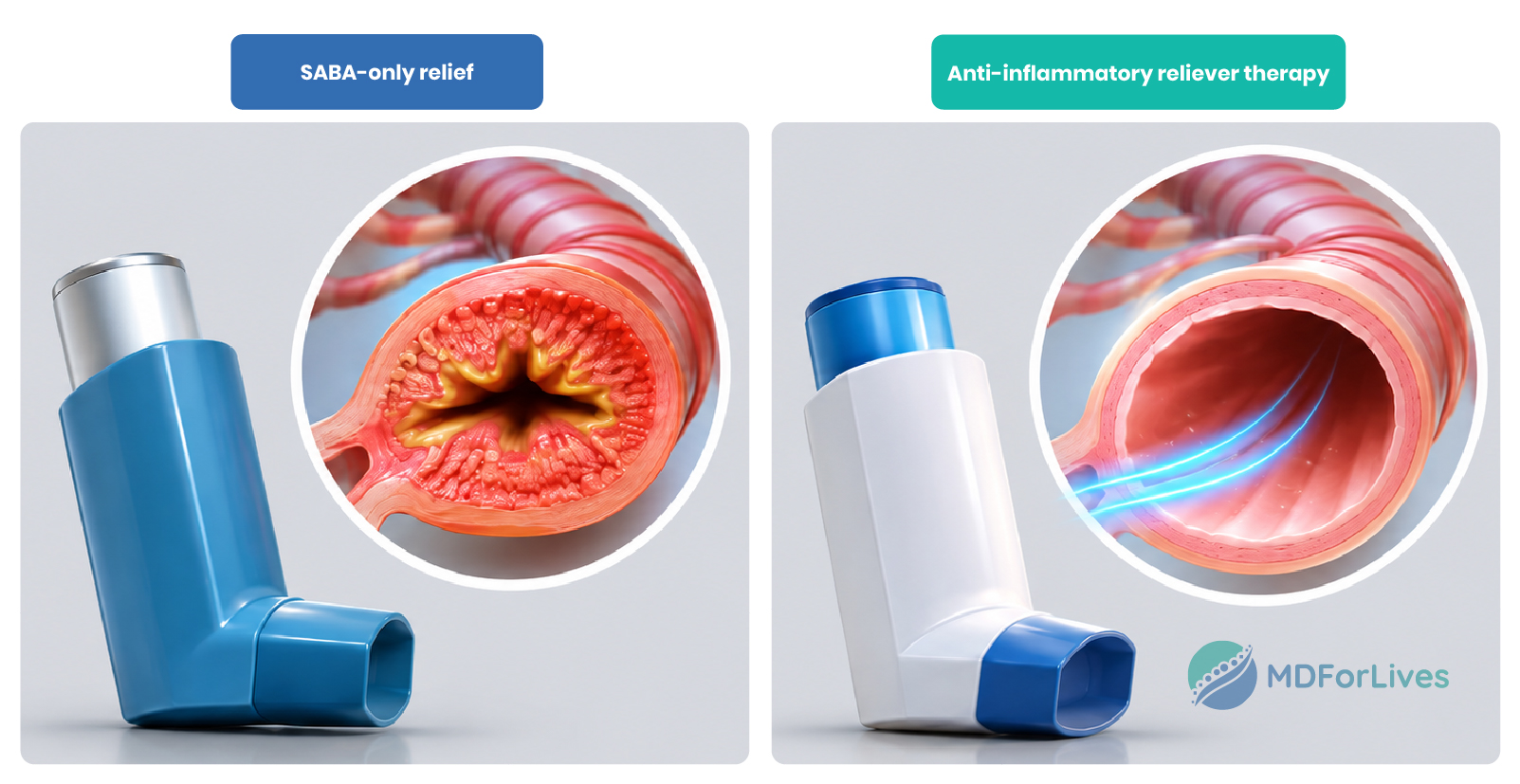
A traditional SABA inhaler, usually containing salbutamol or albuterol, can quickly relax those muscles. But it does not treat the airway inflammation that underlies asthma or may intensify as an exacerbation develops.
That distinction is reshaping modern asthma inhaler guidelines. Treatment is increasingly designed so that anti-inflammatory therapy accompanies symptom relief rather than treating the two as completely separate goals.
The question is therefore no longer whether the blue reliever works. It is “Whether symptom relief alone is enough when the goal is also to reduce the risk of the next exacerbation.”
The blue inhaler relieves bronchoconstriction, but that is only part of asthma
A SABA provides rapid symptom relief, which helps explain why patients can develop strong confidence in it. When wheeze or chest tightness improves within minutes, the inhaler appears to have solved the problem.
Clinically, however, immediate relief and asthma control are not the same outcome.
Asthma exacerbations involve both airway narrowing and inflammation. A SABA addresses the narrowing but does not provide inhaled corticosteroid treatment for the inflammatory component.
This is why the 2026 Global Initiative for Asthma strategy does not recommend SABA-only treatment for adults, adolescents or children aged 6 to 11 years. Instead, patients should receive an ICS-containing treatment strategy.
Respiratory care increasingly emphasizes prevention alongside symptom management, particularly in children. Explore how RSV prevention is changing pediatric respiratory care and where implementation challenges remain.
The asthma reliever inhaler is no longer being viewed only as something that makes a patient feel better in the moment. It is increasingly becoming part of a wider strategy to reduce future risks.
Frequent SABA use should trigger a control review, not just another prescription
Occasional use and repeated reliance are not clinically equivalent.
When patients repeatedly need a SABA, the pattern may indicate inadequate asthma control, insufficient anti-inflammatory treatment, poor adherence, incorrect inhaler technique, or another problem that needs reassessment.
A 2025 systematic review and meta-analysis of SABA overuse found that use of three or more canisters per year was associated with approximately twice the risk of mortality and acute exacerbations compared with lower use.
Earlier SABINA programme data involving more than 365,000 people with asthma also showed progressively increasing exacerbation and mortality risk as SABA collection increased.
These observational findings do not mean that frequent SABA use directly causes every poor outcome. In many cases, high reliever use may simply signal that the patient’s asthma is not well controlled.
Frequent blue-inhaler use should therefore be treated as a warning sign, not just as repeated medicine use.
When a patient needs the reliever more often, it should prompt a review of symptoms, previous exacerbations, treatment adherence, inhaler technique, and whether the current anti-inflammatory treatment is adequate.
Anti-inflammatory reliever therapy changes what happens when symptoms appear
One of the major changes in asthma care is the move toward relievers that address both bronchoconstriction and inflammation.
For adults and adolescents, GINA’s preferred Track 1 approach uses low-dose ICS-formoterol as the reliever, either as needed in milder asthma or within maintenance-and-reliever therapy at higher treatment steps.
The 2024 joint BTS/NICE/SIGN asthma recommendations also support as-needed low-dose ICS/formoterol for people aged 12 years and over with newly diagnosed asthma, and advise against using a SABA without inhaled corticosteroid treatment.
The idea is simple: when symptoms appear and the patient uses the reliever, the treatment can both open the airways and deliver corticosteroid to help address the inflammation that may be increasing at the same time.
This does not mean every patient should use the same combination inhaler for asthma. The right option still depends on age, product approval, availability, cost and local guidance.
The broader change is that symptom relief and anti-inflammatory treatment can now be delivered together, rather than being treated as completely separate parts of asthma care.
Randomized trials changed the treatment question in mild asthma
The move away from SABA-only treatment was driven by randomized evidence, not simply by a change in guideline philosophy.
In the Novel START randomized trial, adults with mild asthma who used budesonide-formoterol as their reliever experienced fewer exacerbations than those who used albuterol alone.
The PRACTICAL trial subsequently showed that adults with mild-to-moderate asthma who used budesonide-formoterol as their reliever had fewer severe exacerbations than those using maintenance budesonide with a SABA reliever.
Earlier SYGMA evidence in mild asthma had also shown that using budesonide-formoterol as the reliever could substantially reduce severe exacerbations compared with a SABA-only reliever strategy.
Together, these studies changed the treatment question.
It is no longer simply whether a patient needs a daily asthma preventer inhaler. It is also whether an appropriate reliever strategy can deliver corticosteroid at the same time symptoms prompt treatment use.
The important change is not less prevention. It is bringing anti-inflammatory treatment closer to the moment symptoms occur.
The anti-inflammatory reliever concept is extending beyond ICS-formoterol
More recent evidence suggests that this principle is not confined to one drug combination.
The MANDALA randomized trial found that adding budesonide to albuterol rescue therapy reduced severe exacerbation risk compared with albuterol alone in patients with moderate-to-severe asthma.
The 2025 BATURA trial extended the question into inadequately controlled mild asthma. Severe exacerbations occurred in 5.1% of participants receiving as-needed albuterol-budesonide compared with 9.1% receiving albuterol alone.
A network meta-analysis of 27 randomized trials involving more than 50,000 participants found that both ICS-formoterol and ICS-SABA reliever strategies were associated with fewer severe exacerbations than SABA alone.
More recently, 2026 meta-analysis of ICS-SABA reliever therapy also reported lower exacerbation rates and systemic corticosteroid exposure compared with SABA alone.
The wider message is becoming clearer: a reliever can do more than simply open the airways. In some treatment strategies, it can also help address the inflammation that contributes to asthma symptoms and future exacerbations.
Changing the inhaler is not enough if patients still think in “reliever versus preventer”
Treatment strategies can change faster than patient understanding.
Someone who has relied on a blue inhaler for asthma for years may see the reliever as the medicine that “works” because the benefit is immediate. Preventer treatment can seem less important because its effect is not felt in the same way.
That is why communication is an important part of the treatment change.
Patients need to understand what each inhaler contains, which inhaler should be used when symptoms occur, whether the same inhaler also provides anti-inflammatory treatment, and what frequent reliever use may indicate their asthma control.
Techniques should also be reassessed whenever the device or treatment strategy changes.
For clinicians, the transition is therefore larger than replacing one inhaler with another. Rather it is a shift from symptom-only thinking toward symptom, inflammation and future-risk management.
Closing perspective: the blue reliever still works, but relief is no longer the whole goal
The traditional blue SABA inhaler remains an effective bronchodilator.
What has changed is what asthma treatment is expected to achieve.
Relieving wheeze and breathlessness quickly remains important. Reducing the risk of the next severe exacerbation is also part of the goal.
Modern evidence increasingly supports combining symptom relief with anti-inflammatory treatment through ICS-formoterol, ICS-SABA or another appropriate ICS-containing strategy according to local guidance.
That does not make the blue inhaler for asthma obsolete in every setting. It does mean that relying on SABA alone is increasingly inconsistent with contemporary asthma management.
For healthcare professionals, repeated reliever use should therefore prompt a broader question: Are we only relieving the bronchoconstriction the patient feels today, or are we also addressing the inflammation that may influence what happens tomorrow?