
A pediatrician can now recommend newer RSV prevention options with confidence, follow updated guidance, and still face uncertainty in the consultation room.
That is the paradox shaping pediatric respiratory care today.
Respiratory syncytial virus has long been one of the most familiar seasonal threats in pediatrics. But the prevention landscape has changed meaningfully. Pediatric care now includes newer infant immunization options, maternal RSV vaccination pathways, and evolving guidance around which children should receive protection and when. In the United States, public health guidance now includes monoclonal antibody options for infants and selected young children, while maternal RSV vaccination is recommended during a specific window in pregnancy to protect newborns. Pediatric societies are also preparing clinicians for broader RSV prevention planning across respiratory seasons.
Yet clinical progress does not automatically remove real-world friction.
This gap between clinical progress and real-world uptake is also evident in cervical cancer prevention, where implementation challenges can affect outcomes despite available preventive tools
A MDForLives pediatrician pulse shows that RSV prevention is largely adopted, but not uniformly experienced. The findings suggest that pediatricians are no longer asking whether prevention matters. They are navigating a more practical question: how do you make prevention work when guidelines, parent expectations, diagnostic overlap, vaccine hesitancy, and consultation pressure all meet in one visit?
RSV Prevention Has Reached Scale, but Not Uniformity
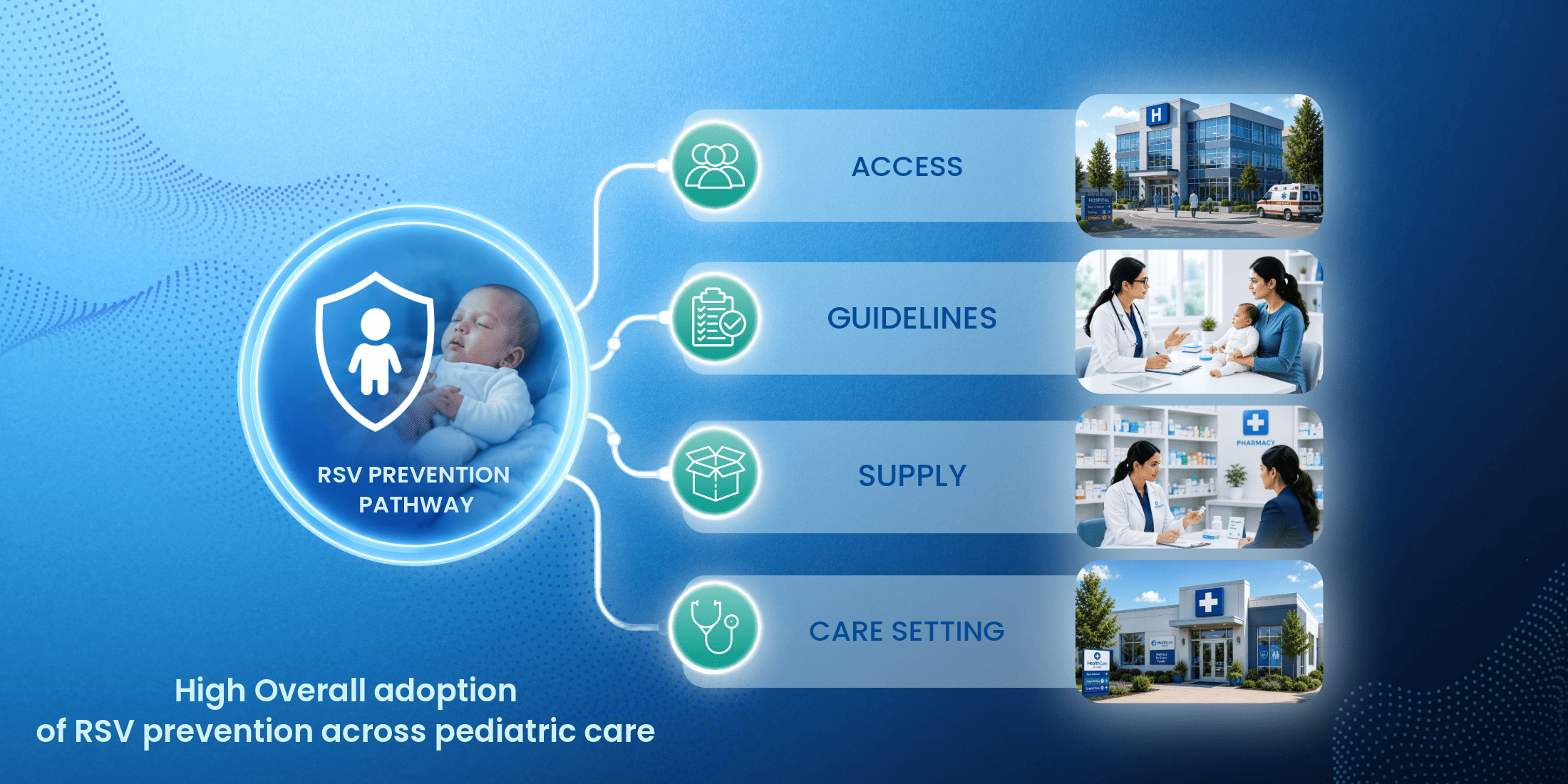
The clearest signal is adoption. In the MDForLives findings, 76.6% of clinicians report routinely using newer RSV prevention options, while another 19.3% use them selectively based on risk. Only small shares report limited use or ongoing evaluation.
That shows strong clinical uptake.
But the same dataset also shows that integration is uneven. Adoption ranges from 90.0% in Italy to 38.5% in the United Kingdom. This gap matters because it reveals that RSV prevention is not only a clinical decision. It is also shaped by local access, pathway readiness, implementation timing, and system design.
The insight is not that pediatricians are uncertain about RSV prevention. It is that prevention now depends on whether the surrounding system can deliver it consistently.
Guidelines Are Driving Decisions More Than Parent Demand
When clinicians were asked what most influences RSV prevention decisions, updated guidelines led at 47.2%, followed by age and gestational risk factors at 35.4%. Underlying conditions, access constraints, and parent expectations were less commonly selected as primary drivers.
This is an encouraging pattern. It suggests RSV prevention decisions are anchored in structured clinical reasoning, not demand-led pressure.
But guideline-led care can still be complex in practice. Pediatricians often have to translate changing recommendations into a short parent conversation, explain eligibility, clarify differences between maternal vaccination and infant immunization, and address concerns without creating confusion.
In other words, guidelines may drive the decision, but communication carries the decision into practice.
Confidence Is High, but Complexity Has Not Disappeared
The MDForLives data shows strong clinician confidence: 74.5% of respondents said they are very confident explaining RSV prevention options to parents, while 24.1% reported moderate confidence. Only a very small proportion expressed uncertainty.
This suggests that knowledge is not the major barrier.
But high confidence does not mean low complexity. Pediatricians may understand the prevention options clearly, yet still face parent hesitation, local supply variation, time constraints, or questions about why one child qualifies and another may not.
This is where the real-world challenge becomes visible. The pediatrician’s role is not only to recommend prevention. It is to make the prevention pathway understandable, acceptable, and actionable for families.
RSV Still Leads Clinical Uncertainty
Despite high prevention adoption, RSV remains the leading source of clinical uncertainty in pediatric respiratory care. In the survey, 31.0% of clinicians identified RSV as the respiratory condition creating the most uncertainty, followed closely by recurrent viral wheeze at 27.6% and post-viral symptoms at 20.0%.
That closeness is important. It shows that RSV uncertainty does not exist alone. It overlaps with other pediatric respiratory presentations that can look similar, evolve unpredictably, or create uncertainty around follow-up, escalation, and parent reassurance.
Prevention may reduce severe disease risk, but it does not remove diagnostic complexity. Pediatricians still need to distinguish between viral wheeze, RSV, influenza, post-viral symptoms, and other respiratory complaints, often under time pressure and parental concern.
This is why pediatric respiratory care continues to feel clinically demanding even when preventive tools are improving.
Antibiotic Stewardship Is Moving Toward Caution
The survey also shows a meaningful stewardship signal. 42.8% of clinicians report becoming more cautious and conservative in antibiotic use for respiratory illness management, while 36.6% say their approach is largely unchanged.
This suggests progress, but not full standardization.
Pediatric respiratory visits often sit at the intersection of symptoms, parental anxiety, diagnostic uncertainty, and expectations for action. Even when antibiotics are not clinically indicated, clinicians may need to spend time explaining why watchful waiting, supportive care, or follow-up may be more appropriate.
The shift toward caution is important. But it still has to operate inside real consultation pressure.
Parent Expectations Still Shape Testing and Prescribing
Parental expectations remain a consistent influence. In the MDForLives findings, 60.7% of clinicians said parent expectations sometimes influence prescribing or testing decisions, while 9.7% said this happens very often.
That does not mean parents are driving care inappropriately. It means pediatric respiratory care is deeply communication-dependent.
Parents bring fear, urgency, prior experiences, and expectations into the visit. Pediatricians must balance clinical judgment with reassurance, education, and shared understanding. This becomes especially important during RSV season, when families may be more aware of severe respiratory illness and more anxious about missed risk.
The clinical decision may be evidence-led. The consultation experience is often expectation-shaped.
Telehealth Helps Access, but Not Always Confidence
Telehealth appears to have a limited role in pediatric respiratory infection management. Only 6.9% described telehealth as very useful, while 42.1% said it has limited usefulness and 17.2% considered it not appropriate.
That pattern is understandable. Pediatric respiratory care often depends on physical assessment: breathing effort, hydration, auscultation, oxygen saturation, fever pattern, feeding behavior, and overall appearance.
Telehealth can support triage, follow-up, and parental reassurance in selected cases. But for acute respiratory illness, it may not provide enough clinical confidence to replace in-person evaluation.
This limitation is also being addressed through evolving models like telehealth nursing, which can strengthen remote support, patient monitoring, and caregiver communication in pediatric care pathways.
The insight is clear: telehealth is useful as a support layer, not a primary respiratory-care solution.
The Future Risk Is Behavioral

Looking ahead, one finding dominates: 73.6% of clinicians identify vaccine hesitancy as the primary future concern in pediatric respiratory care. This far exceeds rising infection burden, diagnostic uncertainty, access issues, or time constraints.
Open-text themes reinforce the same pattern. Vaccine hesitancy and trust gaps were the most prominent uncertainty theme, cited by 45.5% of clinicians, followed by system strain at 16.8% and diagnostic uncertainty at 11.2%.
This shifts the future challenge from clinical availability to behavioral acceptance.
RSV prevention may be scientifically stronger than before. But its real-world impact depends on whether families understand it, trust it, and accept it at the right time.
Across specialties, similar advances in targeted treatment approaches such as ADCs in oncology show how innovation is increasingly shifting toward precision, patient-specific care models.
Closing Perspective
RSV prevention is no longer a distant opportunity in pediatric care. It is already being used widely, explained confidently, and guided by structured recommendations.
Similar shifts in preventive and long-term disease management are also being seen in areas such as GLP-1 Therapy in Obesity Care, where newer treatment approaches are reshaping how chronic risk is addressed across populations.
Yet the MDForLives findings show that uncertainty has not disappeared. It has moved.
The challenge is no longer simply whether pediatricians have prevention tools. It is whether those tools can be applied consistently across systems, explained clearly to parents, and trusted by families during high-pressure respiratory seasons.
RSV prevention has scaled. Now pediatric care must close the gap between clinical readiness and family acceptance.
That is where the next phase of pediatric respiratory care will be decided.