
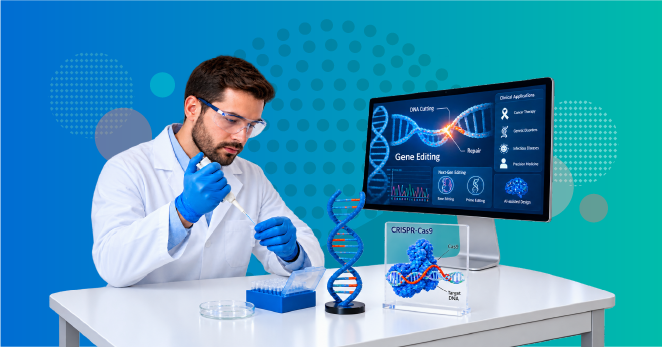
CRISPR gene editing has rapidly become one of the most transformative technologies in modern medicine and biotechnology. Originally discovered as part of a bacterial immune defense system, CRISPR now enables scientists to modify DNA with remarkable precision. Since the development of CRISPR-Cas9 gene editing in 2012, the technology has expanded into clinical trials, FDA-approved therapies, cancer research, diagnostics, and precision medicine applications.
Today, CRISPR gene editing in humans is no longer theoretical. Researchers are actively using the technology to investigate treatments for sickle cell disease, inherited blindness, cardiovascular disorders, rare genetic conditions, and some cancers. At the same time, debates surrounding ethics, safety, regulation, and long-term impact continue to shape how CRISPR technology evolves globally.
What Is CRISPR Gene Editing?
CRISPR stands for Clustered Regularly Interspaced Short Palindromic Repeats. It was first identified in bacteria, where it functions as a natural immune defense system against viruses.
When viruses infect bacteria, the bacteria store fragments of viral DNA within their own genome. These stored sequences allow bacteria to recognize and destroy similar viruses during future attacks.
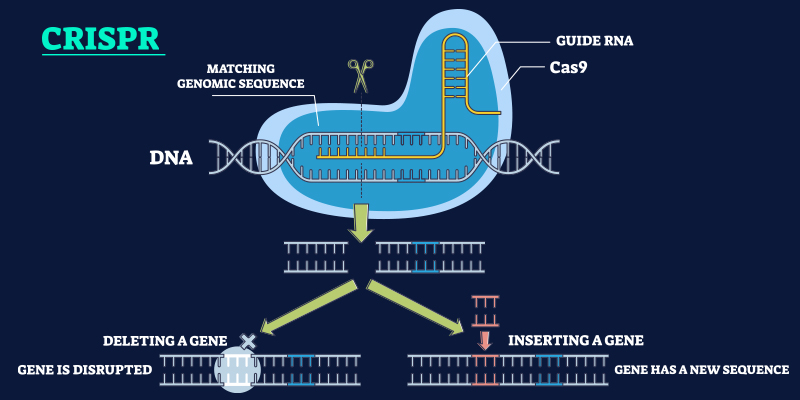
Scientists later adapted this biological mechanism into a programmable gene-editing tool by pairing guide RNA molecules with CRISPR-associated enzymes such as Cas9.
This innovation transformed CRISPR into a scalable platform capable of editing DNA sequences across plants, animals, and human cells.
How Does CRISPR Gene Editing Work?
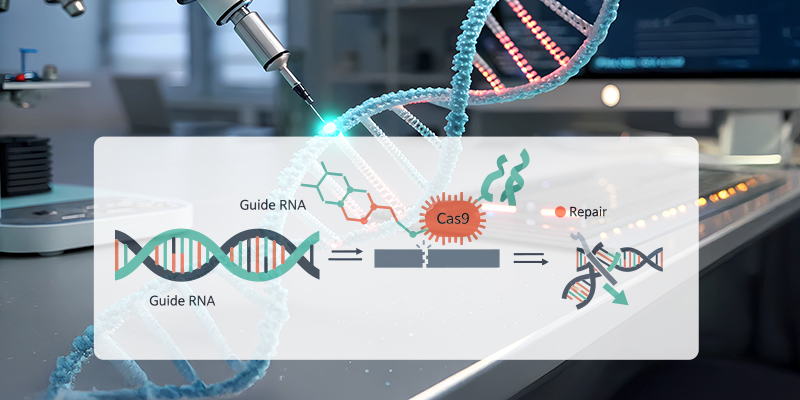
It works through a targeted molecular mechanism designed to locate and modify specific DNA sequences.
Step-by-Step CRISPR Gene Editing Process
- A guide RNA (gRNA) is engineered to match a target DNA sequence.
- The guide RNA directs the Cas enzyme to the exact genomic location.
- The Cas enzyme cuts the DNA strand.
- The cell activates its natural DNA repair mechanisms.
- During repair, scientists can:
- disable faulty genes
- insert corrected DNA
- modify mutations
This sequence-specific targeting is what makes CRISPR-Cas9 gene editing highly precise compared with older editing technologies.
The typical CRISPR gene editing includes:
- guide RNA
- Cas enzyme
- DNA target sequence
- DNA cut
- DNA repair pathway
Modern CRISPR systems now extend beyond simple cutting mechanisms.
Types of CRISPR Gene Editing Systems
Different CRISPR systems are optimized for different biological applications.
- CRISPR-Cas9: CRISPR-Cas9 gene editing is the most widely used system. Cas9 cuts double-stranded DNA and is commonly used in research and therapeutic development.
- CRISPR-Cas12: Cas12 systems can target DNA with different cutting mechanisms and are increasingly used in molecular diagnostics.
- CRISPR-Cas13: Cas13 targets RNA instead of DNA, making it useful for viral detection and transcript regulation.
These variants improve flexibility across therapeutic and research applications.
Research Origins and Scientific Progress
The scientific foundation of CRISPR gene editing emerged from microbiology research in the early 2000s.
Researchers studying bacterial genomes identified repetitive DNA sequences that appeared linked to viral resistance. Further investigation revealed that bacteria used CRISPR systems to recognize and destroy invading viruses.
A major breakthrough occurred in 2012 when Jennifer Doudna and Emmanuelle Charpentier demonstrated that CRISPR-Cas9 could be programmed using synthetic guide RNA to cut DNA at precise locations.
This discovery transformed genome engineering.
By 2014, proof-of-concept studies confirmed that CRISPR could edit genes in human cells, plants, mice, and non-human primates.
Throughout the late 2010s, research focused on:
- improving specificity
- reducing off-target effects
- engineering better Cas enzymes
- optimizing delivery systems
These developments moved CRISPR from laboratory research into clinical medicine.
CRISPR vs Traditional Gene Editing Techniques
Before CRISPR, gene editing relied on technologies such as TALENs and zinc finger nucleases (ZFNs).
Comparison of Gene Editing Technologies
| Technology | Precision | Complexity | Cost | Scalability |
| CRISPR | High | Lower | Lower | High |
| TALEN | Moderate to High | Complex | Higher | Moderate |
| ZFN | Moderate | Highly Complex | High | Limited |
CRISPR became dominant because it is:
- faster
- easier to program
- more scalable
- comparatively cost-effective
This accessibility accelerated global adoption across research laboratories and biotechnology companies.
Advantages of CRISPR Technology
This technology offers several advantages compared with earlier genome engineering methods.
- Precision: CRISPR enables highly targeted DNA modification.
- Scalability: Guide RNAs can be designed rapidly for multiple targets.
- Lower Cost: CRISPR workflows are generally less expensive than older editing systems.
- Broad Applications: The technology can be used across medicine, agriculture, diagnostics, biotechnology
- Faster Research Development: CRISPR has significantly accelerated genetic research timelines.
Read also about DNA Methylation
CRISPR Gene Editing Applications and Clinical Impact
Its applications are rapidly expanding across medicine.
Blood Disorders
In December 2023, the FDA approved Casgevy (exagamglogene autotemcel), the first CRISPR-based therapy for sickle cell disease.
This milestone demonstrated that CRISPR gene editing therapy could achieve meaningful clinical outcomes in humans.
The treatment works by editing hematopoietic stem cells to restore fetal hemoglobin production.
Read also on Eye Gene Therapy
Inherited Retinal Disorders
Researchers are investigating in vivo CRISPR delivery for inherited blindness conditions such as Leber congenital amaurosis. Early studies have shown promising improvements in visual function.
Cancer Research
CRISPR-engineered immune cells are being evaluated for:
- CAR-T therapies
- refractory cancers
- immunotherapy optimization
Researchers are also studying CRISPR applications in tumor biology and resistance mechanisms.
Read more on Immunotherapy Side Effects on Eyes
Cardiovascular Disease
Base-editing therapies targeting PCSK9 have shown sustained reductions in LDL cholesterol in early human studies. These approaches may support long-term cardiovascular risk reduction.
CRISPR Diagnostics
CRISPR-based diagnostics are enabling rapid detection of:
- infectious diseases
- viral pathogens
- genetic abnormalities
Read also on Genetic Testing for Rare Diseases
Latest Clinical Trials and Advances in CRISPR Technology
Recent news reflects rapid progress in precision medicine.
- Base Editing: Base editing allows scientists to modify single DNA bases without cutting both DNA strands. This reduces unintended damage.
- Prime Editing: Prime editing functions like a molecular “search-and-replace” system capable of correcting mutations with greater precision.
- AI-Assisted CRISPR Design: Artificial intelligence is increasingly used to optimize guide RNA selection, predict off-target risks, improve editing efficiency
- Improved Delivery Systems: Researchers are developing lipid nanoparticles, viral vectors, tissue-specific delivery systems. These advances may improve safety and scalability.
How Far Has CRISPR Technology Come Since 2012?
The pace of CRISPR development has been unusually rapid for a biomedical technology.
Major milestones include:
- transition from bacterial research to human trials within a decade
- FDA approval of CRISPR therapies
- emergence of precision editing approaches
- clinical expansion across multiple specialties
The field continues to evolve alongside advances in genomics, molecular medicine, and computational biology.
Limitations and Risks of CRISPR Gene Editing
Despite its potential, it still faces important technical and clinical limitations.
- Off-Target Effects: CRISPR may occasionally edit unintended DNA regions. These off-target mutations remain a major safety concern.
- Delivery Challenges: Efficiently delivering CRISPR systems into specific tissues remains difficult.
- Immune Responses: The immune system may react to CRISPR-associated proteins or delivery vectors.
- Mosaicism: Not all cells may be edited uniformly, especially in embryonic applications.
- Long-Term Safety Uncertainty: Researchers are still evaluating durability, late complications, genomic stability. These factors remain critical for regulatory approval.
Ethical Concerns of CRISPR Gene Editing
Ethical concerns surrounding it remain highly debated.
- Human Embryo Editing: Germline editing introduces heritable genetic changes that can pass to future generations. Many countries prohibit this practice.
- Designer Babies Debate: Critics argue that CRISPR could eventually be used for non-medical enhancement, including physical traits, intelligence, cosmetic selection
- Regulatory Concerns: Global regulation remains inconsistent across countries.
- Equity and Accessibility: Advanced gene therapies may remain inaccessible to many populations due to cost and infrastructure barriers.
- The He Jiankui Controversy: In 2018, Chinese scientist He Jiankui announced the birth of CRISPR-edited babies, triggering global ethical criticism and renewed regulatory scrutiny. This event intensified international debate around human gene editing governance.
Is CRISPR Gene Editing Legal in the USA?
It is legal in the United States for somatic cell applications under FDA oversight.
However:
- germline editing faces major restrictions
- federally funded embryo editing is prohibited
- regulatory approval is required for therapeutic use
Other countries maintain varying regulations depending on the application and ethical framework.
What’s the Future of CRISPR Gene Editing?
The future of CRISPR gene editing will likely focus on improving precision, safety, accessibility, and scalability.
Key future directions include:
- Epigenome Editing: Modifying gene expression without altering DNA sequences.
- Personalized Genomic Medicine: Custom therapies tailored to individual mutations.
- Expanded Therapeutic Areas: Potential future applications include neurodegenerative disease, autoimmune disease, metabolic disorders
- CRISPR 2.0 Developments: Newer editing systems aim to reduce unintended edits, improve delivery, increase efficiency. CRISPR is increasingly viewed not only as a research tool, but as a long-term therapeutic platform.
Significance and Considerations
It represents one of the most important developments in precision medicine.
Its impact extends across:
- rare disease treatment
- oncology
- diagnostics
- regenerative medicine
- translational research
At the same time, responsible implementation requires:
- ethical oversight
- long-term safety evaluation
- equitable access
- regulatory transparency
Understanding how healthcare professionals and researchers interpret emerging genomic technologies remains critical to evidence-based innovation.
Conclusion
CRISPR gene editing has transformed from a bacterial immune mechanism into a foundational technology in modern medicine.
The emergence of CRISPR-Cas9 gene editing, base editing, prime editing, and CRISPR-based therapies demonstrates how rapidly the field continues to evolve. Although technical, ethical, and regulatory challenges remain, CRISPR gene editing in humans is already reshaping how scientists approach genetic disease, diagnostics, and precision medicine. As research advances, CRISPR will likely play an increasingly important role in the future of healthcare innovation.
Contribute to evidence-based healthcare innovation.
Explore healthcare surveys and insights shaping the future of genomic medicine: https://mdforlives.com/healthcare-surveys/