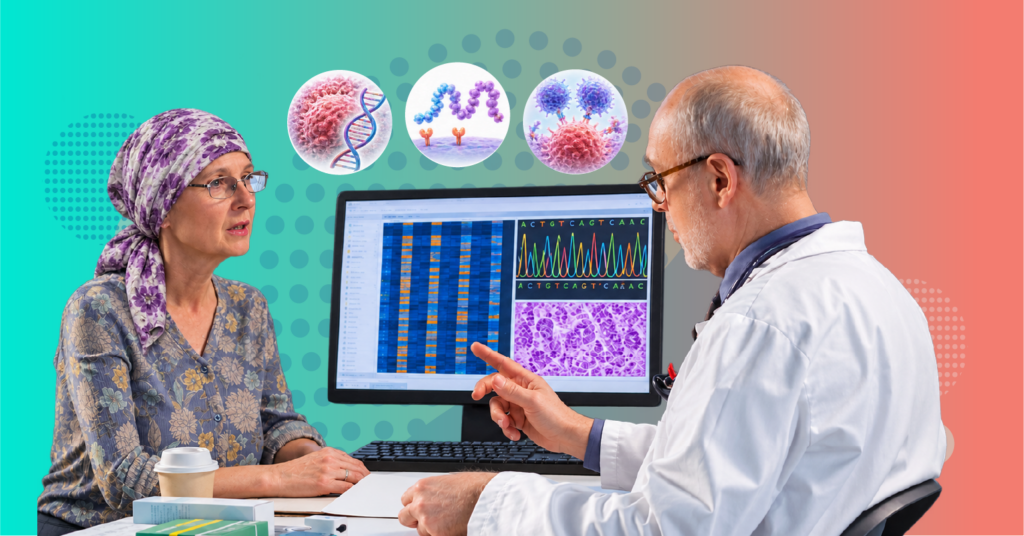
Cancer treatment has become increasingly precise, yet patients with the same cancer type can carry very different tumor mutations. That variation is one of the reasons that same therapy may work well for one patient and less well for another.
Personalized cancer vaccines take precision oncology a step further. Rather than targeting a feature broadly shared by a tumor type, they are designed around molecular changes identified in an individual patient’s cancer.
The aim is to train the immune system to recognize tumor-specific signals and attack cells carrying them. These are therapeutic vaccines, intended to treat existing cancer or reduce recurrence risk. They differ from preventive vaccines such as HPV vaccination.
Advances in tumor sequencing, neoantigen prediction and vaccine technology are now moving the field from proof of concept toward larger clinical trials.
“The central question is no longer simply whether a personalized vaccine can generate an immune response. It is whether that immune response can change what happens to the patient.”
Personalization begins with what makes each tumor different
Many personalized cancer vaccines are built around neoantigens, abnormal protein fragments created by tumor-specific mutations.
Because these targets are generally absent from healthy cells, they can provide a more tumor-specific immune signal.
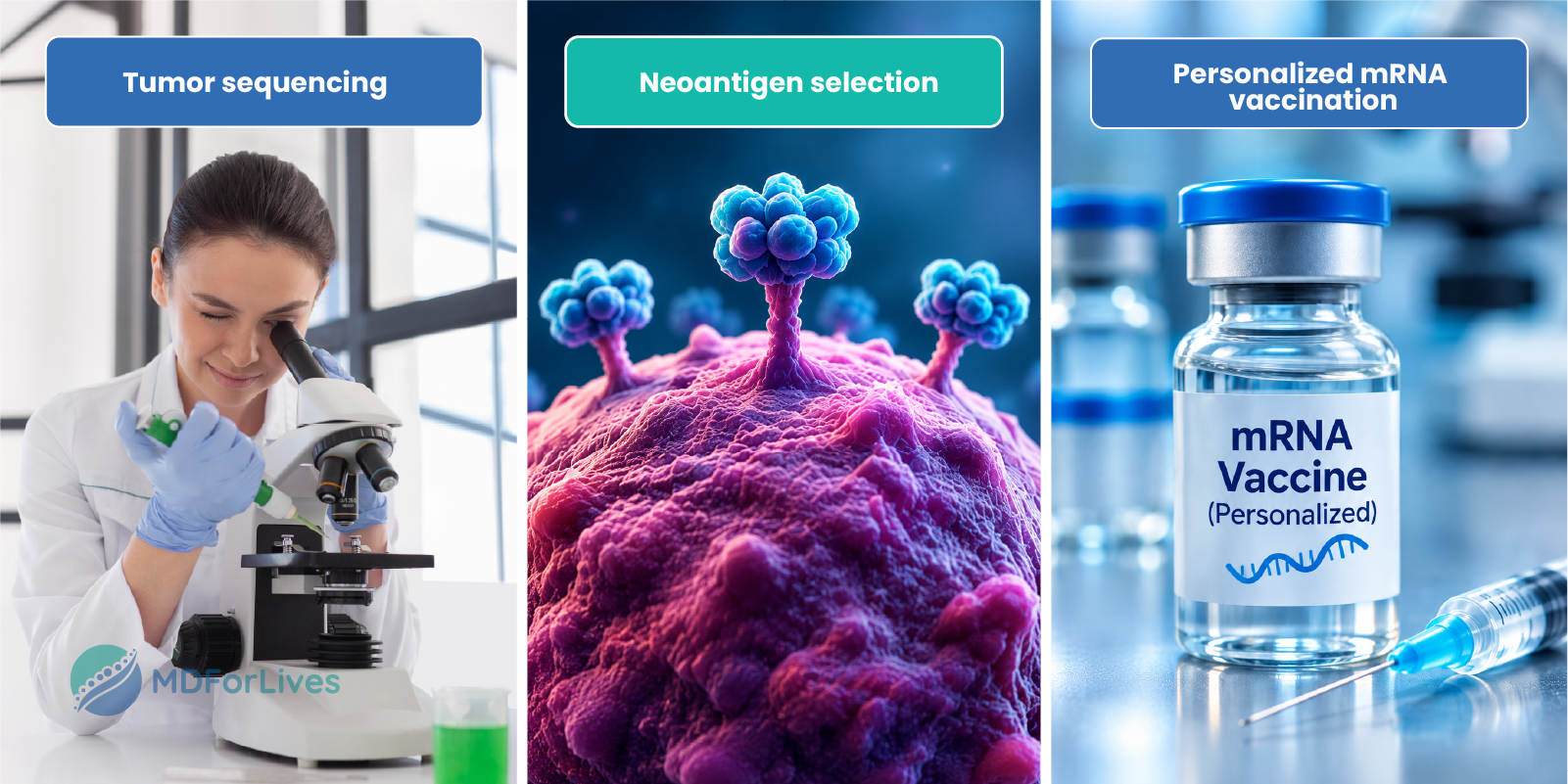
The process usually begins with tumor sequencing. Computational tools identify mutations and predict which altered peptides are most likely to be presented to T cells. Selected neoantigens can then be incorporated into a vaccine designed for that patient.
Treatment decisions are increasingly shaped by the molecular characteristics of an individual patient. Explore how precision medicine improves treatment selection and patient care.
In 2017, first-in-human melanoma studies demonstrated that personalized RNA vaccines and neoantigen vaccines could generate T-cell responses against multiple patient-specific targets, as shown in studies published in Nature on personalized RNA vaccination and personal neoantigen vaccination.
Those studies established that personalization was biologically feasible.
The harder question was whether those immune responses could improve clinically meaningful outcomes.
mRNA delivers the instructions, while neoantigens provide the target
The terms mRNA cancer vaccines and neoantigen cancer vaccines describe related but different parts of the strategy.
Neoantigens are the tumor-specific targets. mRNA is one method of delivering instructions for those targets.
With personalized mRNA vaccines, sequences encoding selected neoantigens are manufactured for an individual patient. After administration, cells produce proteins that can be processed and presented to immune cells.
Other platforms use peptides, DNA, dendritic cells or viral vectors.
A 2026 Nature Biotechnology review, The promises and challenges of neoantigen cancer vaccines noted that no single platform has yet proved optimal across cancers.
The clinical takeaway here is that “delivery technology alone is not enough. Success also depends on selecting neoantigens that are biologically relevant and capable of producing a useful antitumor response.”
Melanoma is moving the field from immune response toward clinical benefit
Melanoma currently provides some of the strongest clinical evidence for personalized mRNA-based cancer vaccination.
In the randomized Phase 2b KEYNOTE-942 study, 157 patients with completely resected high-risk melanoma received either mRNA-4157, now known as intismeran autogene, plus pembrolizumab or pembrolizumab alone.
The KEYNOTE-942 study has shown at 18 months, recurrence-free survival was 79% with the combination and 62% with pembrolizumab alone.
A five-year KEYNOTE-942 update published in 2026 reported sustained improvement in recurrence-free and distant metastasis-free survival with the combination.
The programme has also progressed to Phase 3.
In October 2026, Merck and Moderna reported that INTerpath-001 met its recurrence-free survival and distant metastasis-free survival endpoints in completely resected stage IIB-IV melanoma. According to the reported Phase 3 INTerpath-001 findings, intismeran plus pembrolizumab reduced the risk of recurrence or death by 42% compared with pembrolizumab alone.
The important shift is clear that “the field is moving from proving that vaccination can generate T cells to testing whether personalization can alter disease course.”
The Phase 3 findings are encouraging, but peer-reviewed publication, longer follow-up and regulatory assessment remain important before routine use is defined. Evidence beyond melanoma is encouraging, but earlier
Personalized vaccination is now being studied in cancers with very different biology.
In pancreatic ductal adenocarcinoma, individualized mRNA vaccination generated vaccine-induced T-cell responses in eight of 16 treated patients in an early-phase study. At a median follow-up of 3.2 years, responders maintained long-lived neoantigen-specific CD8+ T-cell responses and had longer recurrence-free survival than non-responders, as reported in the long-term pancreatic cancer study in Nature.
The study was small, so the finding should be viewed as biologically promising rather than definitive evidence of efficacy.
A 2026 study in triple-negative breast cancer also found durable vaccine-induced T-cell responses lasting for years, according to the individualized mRNA vaccine study in triple-negative breast cancer.
Here, the strongest signal was durable immune memory rather than proven survival benefit.
Together, these studies broaden the biological case for personalized vaccination while reinforcing an important principle:
“Evidence maturity must be judged separately for each cancer type.” And “An immune response is not the same as clinical benefit.”
That distinction is central to interpreting neoantigen cancer vaccines.
A vaccine may generate neoantigen-specific T cells without preventing recurrence or extending survival.
Tumors can suppress immune activity, alter antigen expression, reduce antigen presentation, or create a microenvironment that limits T-cell function. Neoantigen prediction is also imperfect. This is why larger randomized trials matter.
An immune response does not guarantee that every patient will benefit from immunotherapy. Discover why predicting immunotherapy response remains a challenge in cancer treatment.
The field is moving from asking: “Did the vaccine generate T cells?” to “Did those T cells change what happened to the patient?”
This also explains the interest in combining personalized vaccines with checkpoint inhibitors.
Vaccination may expand tumor-specific T cells, while checkpoint blockade may help those cells remain active.
The optimal combinations, timing, and patient-selection strategies are still being defined.
Manufacturing becomes part of the treatment pathway
Personalization introduces practical challenges that do not arise in the same way with off-the-shelf therapies.
Adequate tumor material must be obtained, sequencing completed, candidate neoantigens prioritized, and a patient-specific product manufactured, and quality checked within a clinically meaningful timeframe.
Turnaround time, tissue availability, manufacturing capacity, cost and coordination with surgery or systemic therapy therefore become part of the treatment pathway.
Promising cancer innovations must overcome practical barriers before they can become accessible parts of routine treatment. Explore the other side of oncology innovation and why progress can remain uneven in practice.
This is particularly important in the adjuvant setting, where manufacturing must fit within an existing clinical window.
For personalized cancer vaccines, scalability is not separate from effectiveness. It may determine whether an effective strategy can reach the right patient at the right time.
Closing perspective: the field is moving from possibility to proof
Personalized cancer vaccines are moving beyond the question of whether patient-specific tumor mutations can be targeted.
Early studies established durable immune responses. Pancreatic and breast cancer studies are extending that biological evidence, while melanoma has moved furthest toward randomized evidence of clinical benefit.
The next questions are more demanding: which neoantigens matter most, which patients are most likely to benefit, which combinations work best, and whether personalization can be delivered consistently in real-world oncology.
Tumor sequencing, computational neoantigen selection, manufacturing and immunotherapy are converging into a strategy built around the molecular identity of an individual cancer.
Whether personalized cancer vaccines become routine practice will depend on durable clinical benefit, reliable manufacturing and successful integration into cancer care, not simply a strong immune response.