

















Pharmacists may use workarounds when prescribers are difficult to reach, response times are slow, workload is high, or the issue can be managed safely within scope. Frequent workarounds can also signal a communication-system problem.
Pharmacist-Prescriber Communication: Why Why Safety Concerns Still Lose Momentum
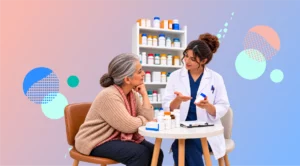
Pharmacists identify clinically important medication risks every day. The unresolved question is what happens after the message leaves the pharmacy and before the prescription changes.
Audience: Practicing Pharmacists
Countries: USA, UK, Canada, France, Italy, Germany
SGID: 8799556
– Hero finding
Quick Read — Key Findings
⚠️
83.5%
📞
78.3%
🎯
57.0%
⏳
37.3%
🔌
83.4%
🤝
67.7%
What turns a pharmacist alert into a completed clinical action?
Explore where the communication loop slows, why workarounds become routine, and which conditions make prescribing decisions change.
// The backstory
Medication safety depends on what happens after the pharmacist identifies the risk
Pharmacists routinely detect interactions, contraindications, dosing concerns, legal issues, and patient-specific risks. The safety value of that expertise depends on whether the right prescriber can be reached, the concern is understood, and the action is completed in time.
WHO’s Medication Without Harm initiative frames medication safety as a system priority. FIP guidance positions pharmacists as essential partners in collaborative care, while AHRQ closed-loop communication requires confirmation that a message is received, understood, and completed.
WHO describes adherence as a multidimensional behaviour, while AHRQ recommends teach-back to confirm that information has been explained clearly. NICE guidance also asks clinicians to explore beliefs, concerns, preferences, and non-verbal cues rather than assuming that agreement equals readiness.
Sources: World Health Organization, Medication Without Harm; International Pharmaceutical Federation, Collaborative Practice; AHRQ, Closed-Loop Communication.
We asked practising pharmacists in the United States, United Kingdom, Canada, France, Italy, and Germany what prompts outreach, what makes recommendations influential, and where communication loses momentum.
Finding 1
Pharmacist-prescriber contact is already a routine safety function
78.3% initiate communication very frequently or frequently. The main triggers are drug interactions, contraindications, and concerns about dose, duration, or regimen complexity.
What the pattern means: Pharmacists are not contacting prescribers only at the edge of an emergency. They are functioning as a routine clinical checkpoint before medication risk reaches the patient.
Finding 2
Safety language carries more influence than broader clinical insight
A safety concern supported by clear clinical risk is the communication most likely to influence prescribing at 57.0%. Dosing optimization and therapeutic alternatives follow, while patient-behaviour insight has limited reported influence.
The insight: The pharmacist’s voice is strongest when the risk is concrete, immediate, and easy to translate into an action. This may undervalue earlier input about adherence, tolerability, or preventive optimization, even when those issues shape long-term outcomes.
Finding 3
Most concerns are heard, but many lose momentum before action
43.0% report prompt action, while 37.3% say the concern is acknowledged but delayed or dependent on further validation. The gap is not mainly rejection. It is the time between recognition and completion.
Why this matters: A delayed response can leave the patient waiting, delay treatment, or force repeated calls. Medication safety depends on a completed action, not simply a message sent.
Finding 4
The communication loop breaks at access and response
Difficulty reaching the prescriber and delayed or absent responses account for 83.4% of reported breakdowns. This points to infrastructure and availability, not a lack of pharmacist willingness to communicate.
What may be behind it: Prescribers and pharmacists work across different systems, schedules, and priorities. Without a shared urgent pathway and a response expectation, the pharmacist may need to repeat the same message through multiple channels.
Finding 5
Workarounds are common because the formal path is not always efficient
53.1% resolve issues informally very frequently or frequently, and another 39.6% do so occasionally when appropriate and within scope.
The deeper pattern: A workaround can be an appropriate use of professional scope. Repeated workarounds can also be a system signal: the official communication route may be slower than the clinical problem allows.
Finding 6
Evidence helps, but relationships and channels determine whether evidence moves
An established working relationship and a clear evidence-based rationale together account for 67.7% of what most improves action. Direct and timely communication channels add another 21.9%.
What the pattern means: The same recommendation can produce a different result depending on trust, access, and how clearly the next step is framed. Effective collaboration is therefore both a clinical skill and a system design issue.
Context: AHRQ closed-loop communication confirms that a message is received, understood, and completed. FIP collaborative-practice guidance emphasizes integrated teamwork and the pharmacist’s contribution to safer medication use.
What a stronger communication pathway looks like
Match the channel to the urgency
Use direct contact for time-critical risk and reliable electronic channels for issues that can wait, with clear acknowledgement expectations for both.
Make the recommendation easy to act on
State the patient-specific risk, relevant evidence, recommended action, and a practical alternative in a concise structured message.
Close and document the loop
Confirm who is acting, what decision is made, and whether the prescription or monitoring plan changes. Repeated unresolved concerns should trigger escalation rather than repeated informal workarounds.
Dermatology
7Endocrinology, Diabetes & Metabolism
7Oncology & Hematology
7Hospital Administration
6Ophthalmology
6Neurology
6Gastroenterology & Hepatology
6Pharmacy
6Primary Care & Family Medicine
6Diabetes, Weight & Metabolic Health
5Surgery & Procedural Care
5Dentistry & Oral Health
5Nurses, NPs & Physician Assistants
5Pediatrics
5
Cardiology
4Laboratory & Diagnostics
4Radiology & Imaging
3Optometry & Optical Care
3Skin & Aesthetic Care
2Insights for Patients & Caregivers
1Social Work & Patient Support
1Cancer Care
1
Help turn frontline experience into healthcare intelligence.
//People Also Ask
Frequently asked questions
Direct answers to the questions professionals most often search around this topic.
When should a pharmacist contact a prescriber?
A pharmacist should contact the prescriber when a prescription creates a clinically meaningful safety, dosing, legal, interaction, contraindication, duplication, allergy, monitoring, or patient-specific concern that cannot be resolved safely within the pharmacist’s scope.
What makes a pharmacist recommendation more likely to change a prescription?
Recommendations are more likely to lead to action when they are concise, patient-specific, evidence-based, and paired with a practical alternative. An established working relationship and a direct communication channel also improve response.
How can pharmacist-prescriber communication be improved?
Use agreed escalation pathways, shared clinical information, direct contact for urgent risks, structured messages such as SBAR, clear ownership of follow-up, and a closed-loop confirmation that the recommendation is received and acted on.
What is closed-loop communication in medication safety?
Closed-loop communication confirms that the message is received, understood, and completed. The receiver repeats or acknowledges the concern, the next action is stated, and the pharmacist receives confirmation of the outcome.
Why do pharmacists use informal workarounds?
Which communication channel works best for urgent prescription concerns?
Direct phone or in-person communication is usually most appropriate for urgent risks because it supports immediate clarification and closed-loop confirmation. Secure EHR messaging is useful when it is reliably monitored and the concern is less time-critical.
Related Reports
Direct answers to the questions healthcare professionals are most likely to ask about these findings.