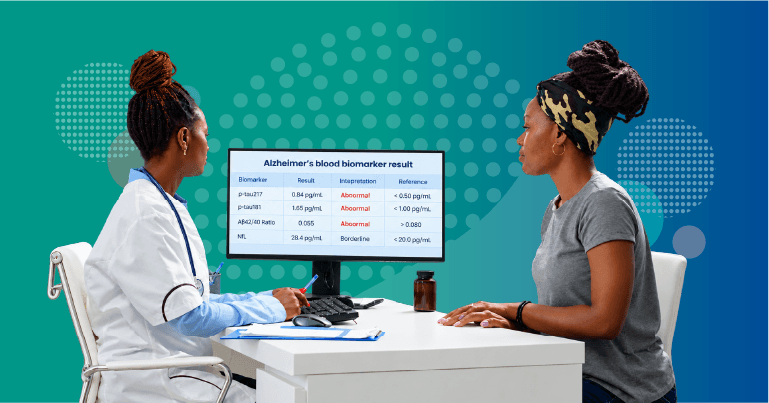
What happens when a blood test points toward Alzheimer’s pathology before the care pathway is ready to respond?
That is the new diagnostic tension facing neurology.
Alzheimer biomarkers, particularly blood-based biomarkers, are bringing real momentum to dementia evaluation. They may help identify Alzheimer’s-related pathology earlier, reduce reliance on more invasive or less accessible testing, and support faster referral or treatment-readiness conversations. For patients and families waiting for answers, this progress matters.
But earlier detection is not the same as clearer action.
The MDForLives neurologist draft reveals a strong pattern: blood-based biomarkers are gaining use and attention, but confidence remains conditional. Neurologists can increasingly detect signals earlier. The harder question is what should happen next, especially when the clinical picture is mixed, the patient is early in the disease course, or confirmatory testing is still needed.
The core insight is clear: diagnosis is moving faster than decision-making.
The Promise of Alzheimer Biomarkers: Earlier Diagnostic Clarity
The strongest perceived value of Alzheimer’s blood biomarkers is early detection. In the MDForLives draft, 40.5% of neurologists identify earlier detection and confirmation of Alzheimer’s pathology as the greatest value of these tests.
That finding is important because Alzheimer’s diagnosis has historically depended on clinical assessment, cognitive testing, neuroimaging, cerebrospinal fluid testing, and in some settings, PET imaging. These pathways can be expensive, invasive, hard to access, or limited by specialist availability.
Blood-based testing changes the conversation because it could make evaluation more scalable and accessible, especially in specialty care pathways where clinicians are already assessing cognitive impairment.
But the value is not simply the test itself. The value is what the test helps clinicians decide: who needs confirmatory testing, who should enter a treatment workup, who needs closer monitoring, and how families should be counseled.
Adoption Is Growing, but Not Standardized
The draft shows that familiarity is rising. About 48.6% of neurologists are already using blood biomarkers either selectively or routinely, with 29.7% using them selectively and 18.9% using them routinely. Another 32.4% are somewhat familiar.
This suggests that Alzheimer’s blood biomarkers are no longer only a research topic. They are entering real-world neurology practice.
Still, use remains uneven. Selective adoption is not the same as standardized care. It often reflects clinician comfort, practice setting, local access, reimbursement, available confirmatory testing, and the maturity of internal workflows.
That is why the next phase is less about whether neurologists know these tests exist, and more about whether health systems can define how they should be used consistently.
The Action Gap Is the Real Barrier
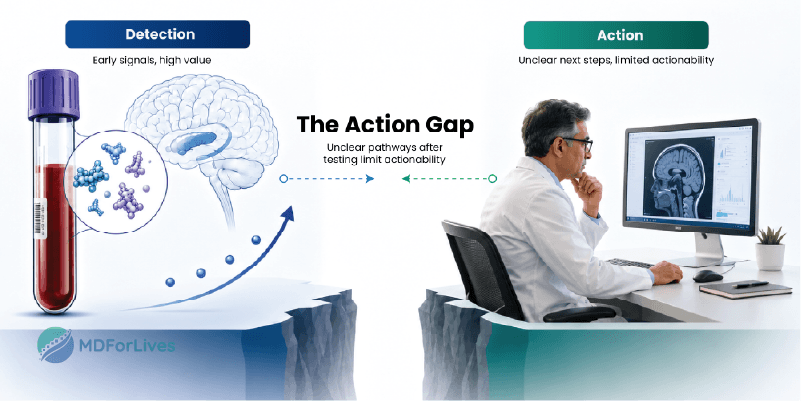
The most important barrier in the draft is not awareness. It is actionability.
About 32.4% identify unclear action pathways after testing as the biggest barrier to making biomarkers useful in day-to-day practice. This is the heart of the issue.
A blood biomarker can indicate Alzheimer’s pathology. But what should happen after that result? Should the patient move to PET or CSF confirmation? Should treatment eligibility be discussed? Should the clinician monitor, repeat, refer, or wait? How should a borderline or mixed result be explained?
These are not small operational questions. They determine whether the test improves care or simply adds another uncertain data point.
Alzheimer’s blood biomarkers become truly useful only when they connect to a pathway that clinicians, patients, and families can understand.
Biomarkers Influence Decisions, but Rarely Replace Confirmation
The MDForLives draft shows that neurologists remain cautious even when biomarkers suggest Alzheimer’s pathology. About 43.2% would order confirmatory CSF or PET testing and reassess before making major decisions.
That finding is clinically meaningful.
It suggests neurologists are not dismissing blood biomarker results. They are placing them inside a broader diagnostic framework. The result may move the case forward, but it does not necessarily settle the case on its own.
This is especially important in mixed or atypical presentations. Cognitive symptoms may reflect Alzheimer’s disease, vascular pathology, Lewy body disease, depression, medication effects, sleep disorders, or multiple overlapping contributors. In that context, a biomarker result needs interpretation, not just reporting.
The test may sharpen suspicion. It does not remove clinical judgment.
The Risk Is Not Just Accuracy. It Is Consequence.
The draft identifies major concerns that shape adoption. About 35.1% cite false positives or false negatives leading to mismanagement, while 21.6% highlight the lack of clear actionability after a positive result.
These concerns are connected.
An inaccurate result can lead to wrong reassurance, unnecessary anxiety, inappropriate referral, premature treatment discussions, or missed alternative diagnoses. But even an accurate result can create difficulty if the clinician does not have a clear next step.
In Alzheimer’s care, information carries emotional weight. An abnormal biomarker result can reshape a patient’s sense of future, family planning, treatment expectations, and anxiety. That is why patient communication tools are not optional. They are part of responsible implementation.
Earlier Conversations Are Already Happening
Even with these limitations, Alzheimer’s blood biomarkers are beginning to change the timing of care. In the draft, 37.8% of neurologists report that biomarkers are driving earlier conversations about diagnosis and patient planning.
This is where the practical impact is visible.
A test may not yet replace established diagnostic pathways, but it can bring discussions forward. It can help neurologists explain why additional evaluation may be needed. It can prepare patients and families for next steps. It can support treatment-readiness conversations where appropriate.
The shift is not from uncertainty to certainty. It is from later uncertainty to earlier structured discussion.
Confidence Needs Guidelines, Validation, and System Readiness
Neurologists are clear about what would increase confidence. In the draft, 35.1% say clearer guidelines on when to test and how to act would most increase confidence, while 29.7% want stronger real-world performance data.
That is a practical roadmap.
For Alzheimer’s blood biomarkers to feel actionable, neurology needs more than promising test performance. It needs guideline-based workflows, reimbursement clarity, clinician education, confirmatory testing pathways, patient communication tools, and evidence linking results to meaningful care decisions.
Without those, adoption may expand faster than practice systems can absorb.
Closing Perspective
Alzheimer’s blood biomarkers are not being rejected. They are being integrated cautiously.
The MDForLives findings show a field in transition. Neurologists see clear value in earlier detection. Many are already using these tests selectively or routinely. But abnormal results still raise questions about confirmation, interpretation, treatment readiness, counseling, and next steps.
The diagnostic signal is getting stronger.
The decision pathway is still catching up.
The future of Alzheimer’s blood biomarkers will not depend only on whether they detect pathology earlier. It will depend on whether they help neurologists act earlier with confidence, consistency, and clarity.
Because earlier answers matter.
But earlier answers need a place to go.