
A test can be analytically accurate and still arrive too late to support the decision it was meant to inform.
That is the tension between send-out testing and an in-house lab. Reference laboratories offer specialization and scale, while local testing can shorten the path from diagnostic questions to clinical action.
The decision is not simply whether a hospital can perform a test itself. It is whether in-house lab testing can improve care enough to justify the staffing, validation, workflow, quality, and operational responsibility required to sustain it.
MDForLives surveyed laboratory managers, supervisors, and directors across the USA and UK. The detailed findings are available in the MDForLives In-House vs Reference Laboratory Testing Insight Report.
For laboratory leaders and allied healthcare professionals, the useful question is: which tests need to be closer to care, and can the laboratory support them reliably?
Faster results matter only when they change a clinical decision
Turnaround time is often the first reason to consider moving a test in-house, but speed is valuable only when it changes what happens next. In the MDForLives survey, 62.5% of respondents said turnaround time and clinical impact had the greatest influence on the final in-house versus reference-laboratory decision.
A faster result may support earlier treatment, discharge, or escalation of care. In another pathway, the same turnaround gain may have little effect on management.
So, the better question is not, “Can this assay run faster locally?” It is, “What clinical decision becomes possible sooner if it does?”
Faster laboratory results matter most when they change what clinicians can do next. Explore what lab turnaround time pressure can mean for clinical decisions and laboratory performance.
Volume matters when the service must remain sustainable
Once clinical value is clear, the next question is whether the service can be supported consistently. Half of surveyed laboratory leaders identified high volume with consistent demand as the primary factor that makes a test a strong in-house candidate.
An in-house laboratory does more than run the assay. It must support specimen handling, quality control, competency, reporting, troubleshooting, and ongoing review.
This is why “What does in-house lab testing involve?” is broader than running a test. A strong candidate combines a reason to want the result sooner with enough predictable demand to justify maintaining the capability.
Clinical urgency creates the reason to consider insourcing; sustainable demand helps determine whether it can last.
Operational readiness can stop a clinically attractive launch
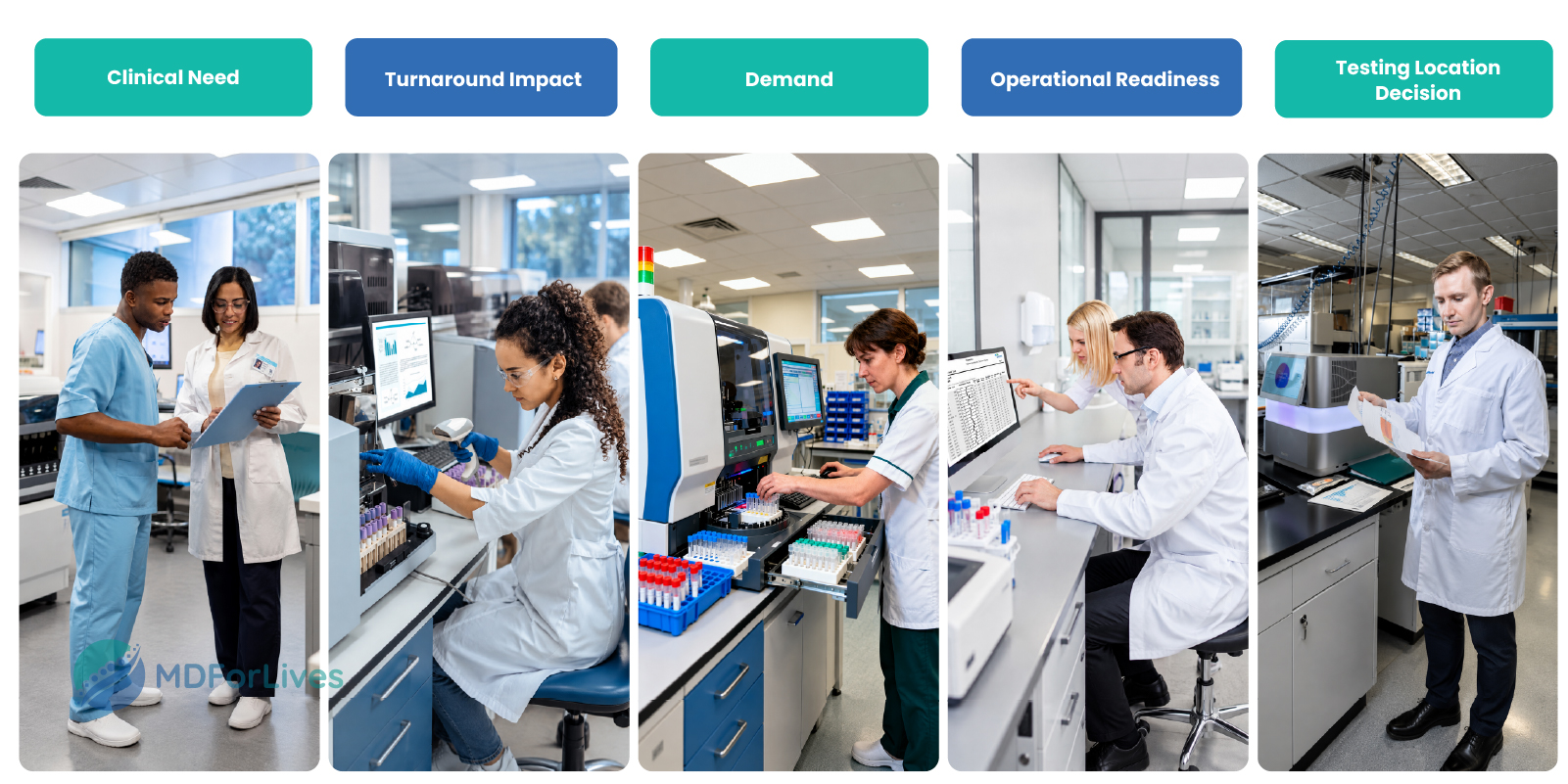
Even when urgency and volume support local testing, implementation can fail if the pathway around the assay is not ready. In the survey, 37.5% identified qualified laboratory staffing and expertise as the primary operational hurdle when launching a new in-house assay.
Laboratory teams still need to support validation or verification, competency, quality oversight, troubleshooting, and coverage. A new assay also must fit ordering, specimen tracking, result transmission, and clinician workflows.
Running an assay locally requires more than technical capability. Laboratory teams also need the systems, oversight, staffing, and workflows needed to keep testing reliable. Explore the shift from bench work to system oversight.
The practical decision is not only “Can we perform this test?” It is “Can we operate it safely and reliably within the existing laboratory service?”
A “not yet” decision can therefore be appropriate even when the clinical case is strong.
Reference laboratories remain valuable when specialization outweighs speed
Bringing testing closer is not automatically better.
Reference laboratories may remain more appropriate when local volume is low; specialized expertise is required, or the care pathway can safely accommodate send-out turnaround.
This helps answer “How do external labs differ from in-house labs?” The difference is not simply location. It is the operating model.
An in-house lab provides more direct control over turnaround and workflow but assumes the staffing, quality, infrastructure, and support burden. A reference laboratory provides specialized capability without requiring every service to be built locally.
The goal is not maximum insourcing. It is to place each test where quality, timing, expertise, and sustainability align with the care pathway.
For AHP laboratory teams, local and reference testing are two parts of the same diagnostic network.
Testing location should change when the care pathway changes
A testing decision can be outdated. The MDForLives findings show that laboratories revisit send-out decisions over time, with annual reassessment emerging as the largest single review pattern.
The assumptions behind the original choice may change as volume, urgency, staffing, technology, or reference-laboratory performance changes.
A useful review asks whether the original reasons still hold: Is send-out volume now high enough to reconsider? Is turnaround delaying care? Has local capability changed? Is the in-house service still delivering the advantage that justified it?
The boundary between local and reference testing should therefore be managed as a portfolio, not treated as permanent.
The right testing location is a decision to maintain, not a decision to avoid.
Automation may change feasibility, but not the decision logic
Technology can change the operating equation, but it does not remove the earlier questions. Half of surveyed leaders said automation and AI-enabled laboratory workflows are most likely to reshape the in-house versus reference-testing model over the next three to five years.
Automation may reduce manual work, support quality review, and make selected processes easier to standardize. It does not remove the need for validation, integration, monitoring, trained staff, and professional accountability.
Automation can make laboratory workflows more efficient, but technology does not remove the need for human oversight and accountability. Explore the transition from automation to accountability in modern laboratory practice.
The same distinction applies to an online laboratory test or digital result workflow. Digital ordering or online result access does not determine where analytical testing should occur.
Technology may make local services more practical, but it does not make every assay a good candidate for insourcing.
Closing perspective: bring testing closer when care benefits from it
The strongest case for an in-house lab begins with the care pathway, not the analyzer.
A practical sequence is: identify where send-out turnaround creates a meaningful clinical delay → confirm sustainable demand → assess staffing and infrastructure readiness → compare local and reference-laboratory options → review the decision as conditions change.
These factors overlap. High volume alone may not justify insourcing, while a lower-volume test may justify local capability when turnaround has major clinical consequences.
For laboratory managers, supervisors, and directors, the question is not “How much testing can we bring in-house?” It is “Which testing should be closer to care, and can we sustain the advantage?”
When clinical urgency, demand, workforce readiness, quality systems, and workflow integration point in the same direction, in-house lab testing can shorten the path from diagnostic questions to clinical decisions.
When they do not, the reference laboratory remains an essential part of the diagnostic network.