

Finishing cancer treatment does not mean clinical uncertainty disappears. For many patients, the next phase brings different questions: How likely is the cancer to return? How closely should the patient be monitored? Which tests are appropriate? And how should follow-up account for treatment effects that may continue long after active therapy ends?
That is where cancer recurrence assessment becomes part of a broader survivorship plan. Follow-up cannot rest on recurrence surveillance alone: cancer type and stage, tumor biology, treatment exposure, persistent toxicity, new symptoms, comorbidities and changing health needs all influence what happens next.
To understand how these decisions are approached in practice, MDForLives surveyed oncology healthcare professionals across the USA, UK, Canada, Italy, France and Germany. The detailed clinician findings and methodology are available in the MDForLives Cancer Survivorship Care: Balancing Recurrence Risk and Long-Term Toxicity Insight Report.
Risk sets the starting point
The first step after active treatment is deciding what level of surveillance the patient actually needs. Not every survivor carries the same risk of recurrence. Stage, tumour biology, treatment response and history influence the baseline, while unresolved toxicity and comorbidity affect how closely the patient stays connected to specialist care.
In the survey, 46.1% of oncology HCPs identified recurrence risk as the factor that most influences surveillance intensity, so follow-up should begin with risk stratification rather than a uniform schedule. But that assessment is not permanent. New symptoms, complications or changes in wider health can alter the picture, so a useful plan also asks what would make the current level change.
Structure without rigidity
Once baseline risk is understood, it needs to become a workable plan. Disease-specific guidance provides structure around clinical review, imaging and other investigations, yet patients with the same diagnosis may differ substantially in biology, treatment exposure, comorbidity and ongoing effects.
The findings reflect this balance: 42.0% of respondents reported guideline-based imaging as their primary surveillance strategy, while 38.6% selected individualized risk-based surveillance. The takeaway is not that one should replace the other. Guidelines establish a reliable framework; individual risk determines how it is applied or adapted. More surveillance is not automatically better: a test is useful only when it answers a meaningful question and can guide the next step.
New symptoms trigger reassessment
Scheduled follow-up cannot capture everything that happens between visits. Fatigue, pain, neurological symptoms, cardiopulmonary changes or declining function may raise concern for recurrence, but can also reflect treatment-related effects, another condition, or several factors at once.
The task is not simply to ask whether a symptom could represent recurrence, but whether it changes the current risk picture. Context matters: Which cancer and therapies were involved? Does the symptom fit a recognized late effect? Has it changed? Do recent findings reassure, or justify earlier imaging, labs or specialist review? Follow-up works best when scheduled surveillance and clinical reassessment support each other. The schedule sets up a baseline; new information shows when it should change. Hence, it is said that surveillance should be planned, not mechanically fixed.
Late effects, a second reason to follow up
After treatment, the purpose of follow-up can broaden. A patient may have no evidence of recurrent cancer yet still face consequences of treatment that need monitoring, such as cardiac dysfunction, neuropathy, cognitive changes or fatigue, which can affect function and long-term health even when disease surveillance is stable.
In the survey, 46.6% of oncology HCPs identified treatment-related cardiotoxicity as the complication most likely to change survivorship strategy. Recurrence surveillance may not be the only reason a patient needs ongoing specialist involvement. Some survivors effectively follow two parallel pathways: one monitoring for recurrent disease, another managing the consequences of treatment, which may involve cardiology, neurology, rehabilitation, pain services or primary care.
Cancer survivorship involves more than remaining free from disease; long-term health, treatment effects and quality of life matter too. Explore whether living longer is the only measure of cancer treatment success.
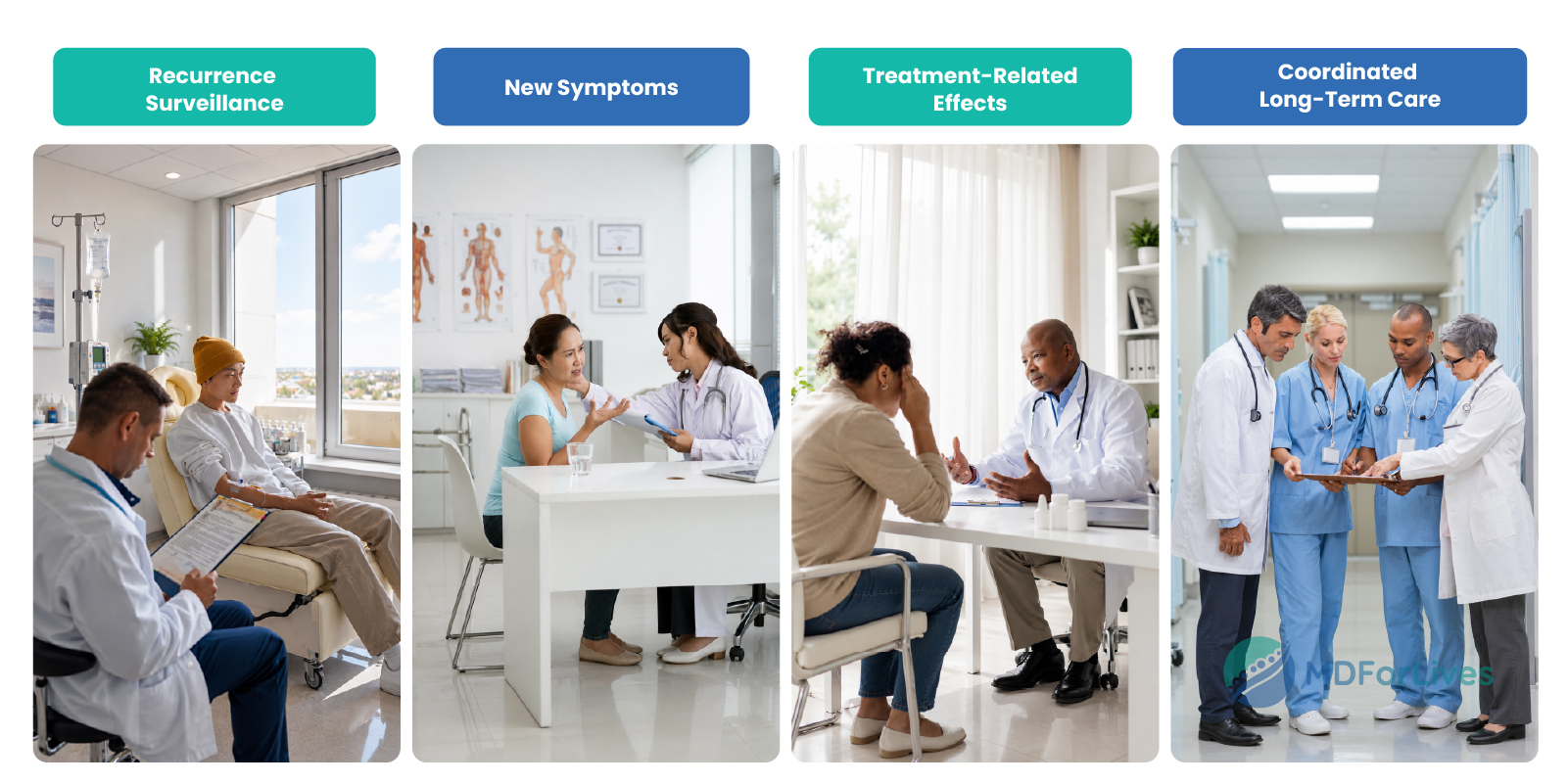
Transition by stability, not the calendar
As time passes, the intensity and ownership of follow-up may change, but the number of years since treatment should not be the only reason to change the care model. The research found that clinicians valued stable surveillance findings and lower recurrence risk more than simply completing a defined surveillance period.
That distinction is useful. A patient may be years beyond treatment but still carry meaningful recurrence risk, persistent toxicity or complex comorbidity needing specialist involvement. Another, with reassuring surveillance and stable treatment-related issues, may suit less oncology-intensive or shared follow-up. The decision should rest on evidence of stability, not an administrative milestone.
Shared care needs clear ownership
As survivorship progresses, care often becomes more distributed: oncology may continue recurrence surveillance, primary care may take on preventive and chronic disease care, and others may manage treatment-related problems. Shared care works only when responsibilities are explicit.
This was the strongest system-level signal in the survey. 54.0% of respondents identified fragmented oncology-primary care coordination as the biggest barrier to coordinated survivorship care. The issue is more than communication; it is ownership. Who monitors recurrence? Who manages late effects? Who reviews preventive health? Who acts if the result becomes abnormal? Treatment summaries, survivorship plans, clear re-referral criteria, and reliable information exchange can make those responsibilities visible. Continuity does not require oncology to manage everything indefinitely; it requires each part of the pathway to have a clearly identified owner.
Better prediction, more precise follow-up
Future surveillance may become increasingly personalized. In the research, oncology HCPs showed particular interest in biomarker-based recurrence detection and AI-based recurrence risk prediction. The potential is not simply to test more, but to identify more accurately who may benefit from intensified surveillance and who may safely receive less.
Liquid biopsy is creating new possibilities for detecting molecular signs of cancer and identifying recurrence earlier. Explore how liquid biopsy could change treatment before recurrence is visible.
More precise information also needs a clear action pathway. What does an abnormal biomarker mean for that cancer? Is the tool validated? Who reviews the signal, and does it trigger repeat testing, imaging, or specialist assessment? Technology may improve risk assessment, but it cannot replace validated evidence, clinical judgement, or continuity between teams.
Oncology innovation can improve clinical possibilities, but translating new developments into consistent patient care remains challenging. Explore the other side of oncology innovation and why progress still feels uneven in practice.
Follow-up should change as risk changes
The end of active treatment begins with another clinical phase, not the end of the pathway. Recurrence remains a concern, but follow-up must also account for treatment-related toxicity, comorbidity, new symptoms, and the transition toward longer-term care.
The practical story is dynamic: establish surveillance according to recurrence risk, adapt it when new information appears, manage important late effects alongside disease monitoring, and change the care model when stability supports that transition. For clinicians, the most useful question is not how long it has been since treatment ended. It is what risks this patient carries now, how they have changed, and who is responsible for managing them next.