

When weight loss feels difficult, the usual focus is often food, physical activity, or treatment. Sleep may receive less attention. Repeated waking, daytime fatigue, insomnia, loud snoring or breathing pauses can make a weight-management routine harder to sustain.
That is why the relationship between sleep and weight loss deserves a closer look.
To understand how these issues overlap, MDForLives surveyed people living with obesity or receiving weight-management care across the USA, UK, Canada, Italy and France. The detailed findings and methodology are available in the MDForLives Obesity and Sleep: Why Better Rest Matters for Weight Management Insight Report.
Hence, the practical question is not simply, “Will sleeping more help me lose weight?” It is: “Could an unresolved sleep problem be making my weight-management plan harder to follow?”
Poor sleep can make the weight-management routine harder
Weight management depends on routines that can be sustained over time, including meals, activity, and treatment. Poor sleep can make each of those steps harder.
In the MDForLives survey, 39.5% of respondents said difficulty sustaining daily routines was the factor that most disrupted their current sleep and weight-management plan. Difficulty following a plan does not always mean someone does not know what to do. Fatigue or disrupted sleep can reduce the energy needed to stay consistent.
Concerns about sleep deprivation and weight gain or lack of sleep and weight loss difficulty should not be reduced to a simple equation. Body weight has many influences.
Better sleep does not replace weight-management treatment. It may make the rest of the plan easier to sustain.
Snoring and breathing pauses are more than a bad night’s sleep
Not every sleep problem is simply about going to bed too late. In the MDForLives survey, 35.8% of respondents said snoring or breathing pauses were the sleep problem affecting their weight management most.
Loud snoring, witnessed pauses in breathing, choking or gasping during sleep, and persistent daytime sleepiness can be associated with obstructive sleep apnea.
You may spend enough hours in bed and still wake unrefreshed if sleep is repeatedly disrupted.
If fatigue is making activity, meal planning, or treatment routines harder, the sleep problem itself may need attention.
Sleep apnea and weight loss may need attention at the same time
The connection between sleep apnea and weight loss can easily become oversimplified.
Weight reduction may improve obstructive sleep apnea for some people. But suspected or diagnosed sleep apnea should not automatically be treated as something that can wait until weight loss happens.
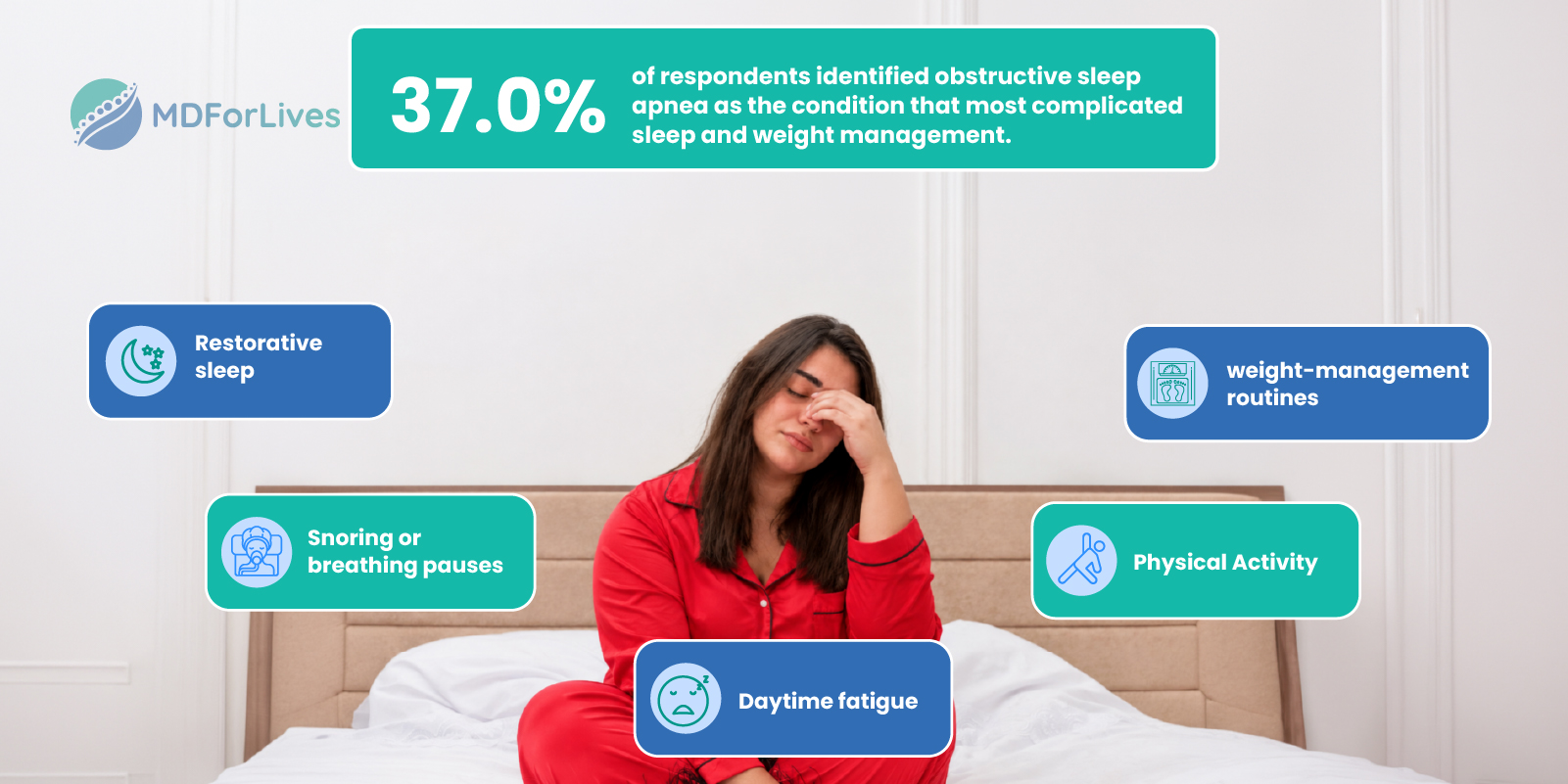
In the MDForLives survey, 37.0% of respondents identified obstructive sleep apnea as the condition that most complicated sleep and weight management.
The practical message is that both issues may need attention together.
Depending on your diagnosis, sleep-apnea treatment may involve positive airway pressure therapy, while weight management may involve nutrition, activity, behavioral support, medicines, or other approaches.
Medication may be one part of a broader obesity-management plan, alongside lifestyle and clinical support. Learn more about GLP-1 therapy in obesity care and its role in treatment.
One does not automatically replace the other. If you have breathing-related sleep symptoms, discussing them with a healthcare professional can help determine whether formal assessment is appropriate.
Better sleep supports the plan; it does not replace it
There is no single starting point for everyone dealing with sleep and obesity. Some people may need support with nutrition and activity; others may need sleep evaluation, treatment or help with insomnia or fatigue.
That is why asking whether better sleep alone will cause weight loss can miss the bigger picture.
Sleep, appetite, energy, and treatment response can overlap. Ask what is making the plan hardest right now. Is it persistent fatigue? Poor sleep? Snoring or breathing pauses? Treatment side effects? Difficulty sustaining routines? Or several of these together?
Improving sleep does not replace appropriate weight-management care, just as weight loss does not automatically solve every sleep disorder.
Poor progress does not mean you are not trying hard enough
When progress slows, it can be easy to feel that you simply need to try harder.
Fatigue, irregular schedules, treatment side effects, and untreated sleep problems can all make a reasonable plan harder to maintain. This is where poor sleep and weight gain need careful interpretation.
Obesity management involves more than changes on the scale. Daily challenges, physical wellbeing and treatment experiences can all influence progress. Explore the hidden burden of obesity and why life beyond the scale feels heavier than numbers show.
Poor sleep does not prove why your weight has changed. But persistent sleep disruption is worth discussing before repeatedly changing food or activity goals.
Ask yourself: Are you waking refreshed? Are you sleepy during the day? Is snoring or fatigue interfering with daily routines? These questions can shift the conversation away from blame and toward understanding what is making the plan difficult to follow.
Better sleep can be a meaningful treatment outcome too
Weight on the scale is one way to judge progress. It is not the only one.
In the MDForLives survey, 30.9% of respondents said better sleep quality was the factor that most influenced staying with long-term treatment, second only to sustained weight loss.
You may value weight reduction while also noticing better energy or easier daily routines.
If you are working on sleep and weight loss, consider tracking sleep quality, daytime energy, activity and symptoms such as snoring alongside body weight. A plan may be easier to continue when the benefits are noticeable in everyday life as well as on the scale.
Closing perspective: better rest may make the plan easier to live with
The relationship between sleep and weight loss is not a simple equation. Better sleep does not guarantee weight loss, and difficulty losing weight does not automatically mean poor sleep is the cause.
But sleep shapes the conditions in which weight management happens. Fatigue can limit activity, fragmented sleep can disrupt routines and sleep apnea can remain untreated.
A useful question is therefore not only, “Is my weight-management plan working?” It is also, “Could a sleep problem be making this plan harder for me to follow?”
Sometimes the next step is not another weight-loss strategy. It may be identifying a sleep problem that has been making the rest of the plan harder all along.