

For someone living with osteoarthritis, the question seems simple; Can cartilage grow back once it has been damaged? For decades, the answer has largely not been very well.
Articular cartilage is the smooth tissue covering the ends of bones inside a joint. Once significantly damaged, it has limited ability to restore itself. Osteoarthritis treatment has therefore focused mainly on reducing pain, maintaining function, and, in advanced disease, replacing the affected joint.
But research into cartilage regeneration is changing the conversation. Scientists are exploring ways to stimulate existing cartilage cells, activate cartilage-forming pathways, use mesenchymal stromal cells, and create biological environments that support repair.
Some human studies have already shown measurable changes in cartilage structure. New laboratory research suggests existing cartilage cells may also retain more regenerative potential than previously thought.
The important distinction is this: “Cartilage repair is not automatically the same as regenerating durable, healthy articular cartilage.”
Why cartilage is difficult to regenerate
Healthy articular cartilage has a highly organized structure that allows joints to tolerate compression and movement while maintaining a low-friction surface. Its main cells, chondrocytes, sit within a dense extracellular matrix. Unlike many other tissues, articular cartilage has no direct blood supply and relatively few cells available to repair substantial damage.
When repair does occur, the replacement tissue may include fibrocartilage. This can fill a defect but does not have the same organization and mechanical properties as native hyaline cartilage.
So, when researchers ask, “can cartilage regenerate?”, simply filling a damaged area is not enough.
True cartilage restoration would need to recreate tissue that resembles healthy cartilage, integrates with the surrounding joint, and remains durable under repeated loading. That is a much higher bar than improving an MRI image.
Human studies show cartilage structure can change
One of the clearest demonstrations that cartilage structure can be modified comes from research on sprifermin, an investigational form of fibroblast growth factor 18.
The FORWARD randomized trial included 549 people with symptomatic knee osteoarthritis.
After two years, patients receiving the higher sprifermin dose showed a statistically significant increase in femorotibial cartilage thickness compared with placebo. With 100 μg administered every six months, the difference was approximately 0.05 mm.
Follow-up suggested that the structural difference persisted to five years. But there was an important clinical lesson.
Greater cartilage thickness did not consistently produce greater pain or functional improvement across the overall trial population.
That matters because osteoarthritis is more than a cartilage disorder. Subchondral bone, synovium, meniscus, inflammation, biomechanics and pain-processing pathways can all contribute to symptoms.
For knee cartilage regeneration, therefore, structural improvement and patient improvement need to be demonstrated separately.
Could existing cartilage cells be reactivated?
Some of the most interesting new research asks whether cartilage regeneration could occur without adding new cells. A recent Science study investigated an enzyme called 15-PGDH, which was increased in ageing and injured cartilage.
In mouse models of age related and post traumatic osteoarthritis, blocking 15-PGDH promoted articular-cartilage regeneration and reduced OA-associated pain.
The mechanism was particularly interesting.
The researchers found fewer degenerative, hypertrophic-like chondrocytes and more extracellular matrix producing cartilage cells. The effect appeared to come from changes in existing chondrocytes, rather than proliferation of stem or progenitor cells.
Human osteoarthritic cartilage removed during surgery also showed molecular changes toward a more regenerative state when exposed to the approach experimentally.
This suggests a new possibility for how to regenerate cartilage instead of replacing damaged cells; future treatments might alter the behavior of cells already present in the joint.
But this remains in preclinical research. It does not yet demonstrate that 15-PGDH inhibition can regrow cartilage in people with osteoarthritis.
Another strategy: stimulating cartilage formation
Researchers are also studying biological molecules that directly encourage cartilage-forming pathways.
One example is LNA043, an investigational molecule designed to stimulate chondrogenesis and cartilage-matrix production. Preclinical research showed regeneration of hyaline articular cartilage. Researchers then tested the molecule in a phase 1 study involving 28 patients with knee osteoarthritis who were scheduled for knee replacement.
A single intra-articular injection reached the cartilage and altered gene-expression patterns for at least 21 days. These changes included increased expression of hyaline-cartilage matrix components and anabolic pathways. This provides evidence that cartilage biology can be influenced in humans. But it does not yet prove clinically meaningful knee cartilage repair.
That difference between biological activity and proven regeneration is important when interpreting early-stage studies.
About stem cell Treatment
Stem-cell treatments are probably the approach most commonly associated with how to regrow cartilage.
The evidence is more complicated than many commercial claims suggest.
A 2026 first inr uman phase 1 study evaluated an injection combining allogeneic mesenchymal stromal cells with cartilage-derived acellular matrix in 12 patients with knee osteoarthritis.
At 24 weeks, MRI-based cartilage-repair scores improved in 70% of participants, while cartilage-integrity measures improved in 50%. The study primarily evaluated safety and had no placebo comparison, so these results remain exploratory.
The broader evidence is also uncertain.
A 2025 Cochrane review included 25 randomized trials involving 1,341 participants. Stem-cell injections may slightly improve pain and function, but the evidence was low certainty. The reviewers remained uncertain about their effects on structural progression and cartilage regeneration.
So, the statement “stem cells regrow cartilage” goes beyond what current evidence supports.
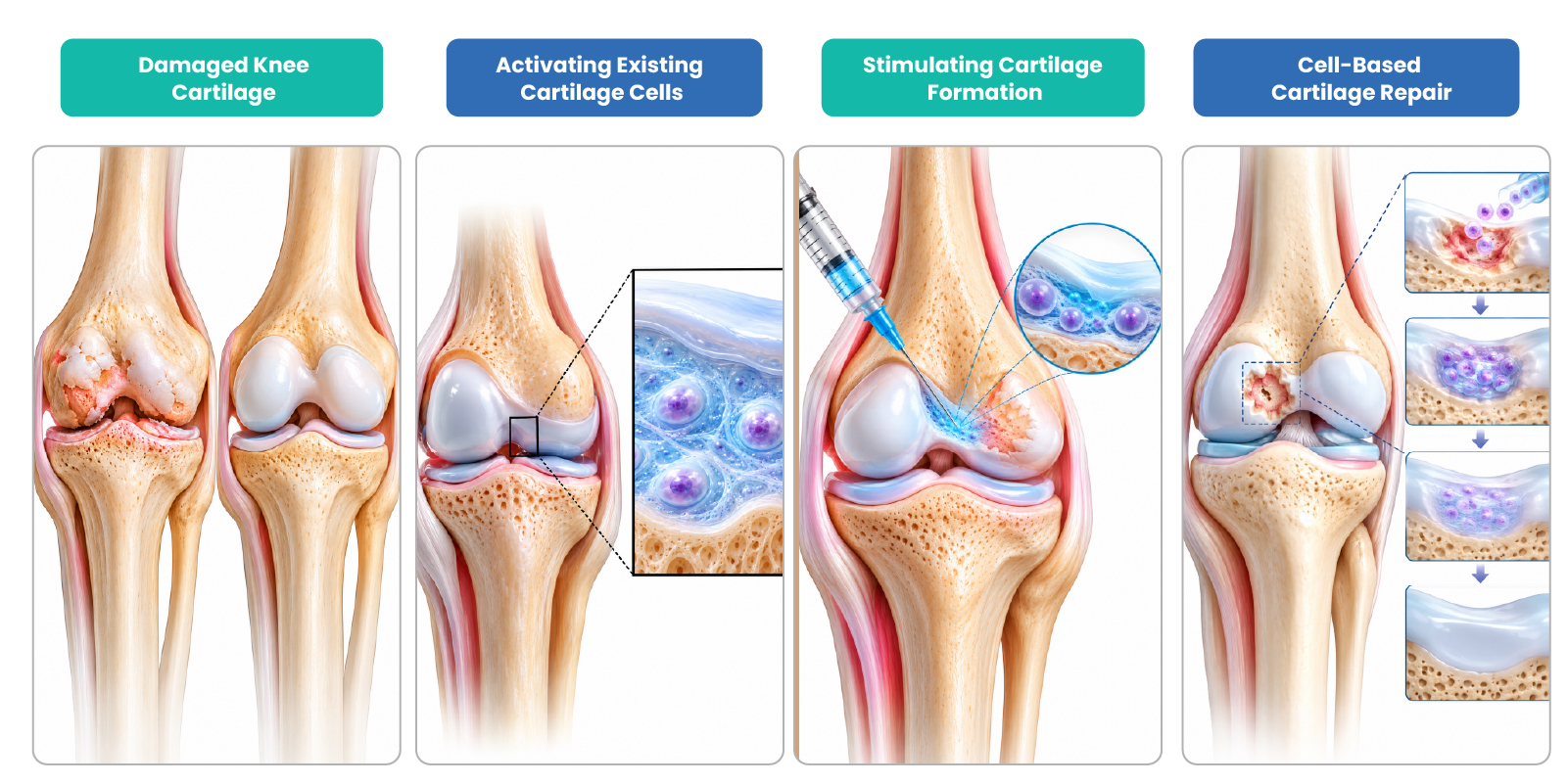
The language used in regenerative medicine are:
- Symptom improvement: pain or function improves, without necessarily changing cartilage.
- Cartilage repair: damaged tissue is filled or structurally improved, but it may not reproduce native cartilage.
- Cartilage regeneration: tissue resembling healthy articular cartilage is recreated biologically and structurally.
- Cartilage restoration: regenerated or repaired tissue remains integrated, mechanically functional and durable over time.
This is why the question “can cartilage regrow?” cannot be answered by MRI appearance alone.
A successful therapy would ideally produce durable structural improvement and meaningful improvements in pain, function or disease progression.
What does this mean for osteoarthritis today?
Despite the progress, there is still no approved intra-articular disease-modifying osteoarthritis drug that reliably restores cartilage matrix.
Current osteoarthritis care therefore still relies on established approaches: symptom control, physical function, exercise, weight management where appropriate, and surgery for advanced disease.
While cartilage-regeneration research continues to develop, managing pain and preserving function remain central to current osteoarthritis care. Explore pain management, relief, treatments, and patient support.
Patients should not interpret emerging cartilage repair research as evidence that a currently available drug, supplement or injection can reliably rebuild normal joint cartilage.
What has changed is the scientific direction; researchers are moving beyond asking whether cartilage loss can be slowed, toward whether damaged cartilage can be shifted into a genuinely regenerative state.
Closing perspective: the question is becoming more precise
So, can cartilage grow back? For people with osteoarthritis, the answer is not yet a straightforward yes.
Human trials show that cartilage thickness and biological activity can be modified. Early cell-based approaches are producing structural signals that may eventually contribute to knee cartilage repair.
At the same time, laboratory research suggests existing chondrocytes may retain regenerative potential that could potentially be activated therapeutically. But producing more tissue is only part of the challenge.
Researchers need to regenerate the right type of cartilage, integrate it into an osteoarthritic joint, make it durable, and show that structural change improves outcomes that matter to patients.
The question is therefore shifting from: “Can cartilage regenerate at all?” to “Can we regenerate durable cartilage that meaningfully changes the course of osteoarthritis?”
That is the standard future cartilage-regeneration therapies will need to meet.