

HbA1c is one of the most familiar measures in type 2 diabetes care, helping clinicians assess glycemic exposure and whether treatment is moving glucose control in the intended direction. But complex diabetes care rarely fits into one number.
A patient may have an HbA1c above target while living with obesity, chronic kidney disease, cardiovascular risk or treatment burden; another may show only modest HbA1c improvement while gaining meaningful benefit elsewhere. The challenge is therefore not simply interpreting HbA1c levels but deciding what the result means in the context of the whole patient.
To explore how clinicians’ approach that complexity, MDForLives surveyed diabetes-care healthcare professionals across the USA, UK, Canada, Italy, France and Germany. The detailed findings and methodology are available in the MDForLives Complex Diabetes Care: When HbA1c Is Only Part of the Decision Insight Report.
The practical question is not whether HbA1c still matters; it does. It is what clinicians should consider once the result is known, and the decision becomes more complex.
Start the conversation, not finish it
In the survey, 55.3% of respondents selected HbA1c and the glucose profile as the assessment that most influences treatment decisions. That confirms how central glycemic status remains, but its meaning depends on what surrounds it.
The same HbA1c value may mean different things in a patient with stable kidney function than in one with chronic kidney disease, obesity, heart failure or cardiovascular disease, and hypoglycemia risk, tolerability and treatment burden may further change what is appropriate. An HbA1c levels chart can communicate glycemic ranges and trends but cannot determine the treatment pathway by itself. The principle is simple: HbA1c is a decision signal, not the entire decision framework.
HbA1c provides an important view of glycemic control, but it may not capture the full picture of day-to-day glucose patterns. Explore blood glucose levels beyond HbA1c and what stable blood sugar can mean in everyday life.
What else is shaping risk?
The question of what HbA1c means becomes more useful with: what else is shaping this patient’s risk? Kidney function and albuminuria may influence treatment choice, cardiovascular disease or heart failure may shift priorities, and weight affects both metabolic risk and treatment goals.
In the research, obesity was the comorbidity most often selected by surveyed HCPs as complicating diabetes management. That reflects clinician perspectives, not direct patient-reported experience, but the implication is important: an elevated HbA1c in a patient with obesity, kidney disease or cardiovascular risk should not automatically be treated as an isolated glucose problem; it may be part of a broader metabolic and cardiorenal picture. The goal is not to replace glycemic management with another priority, but to decide how they should be managed together.
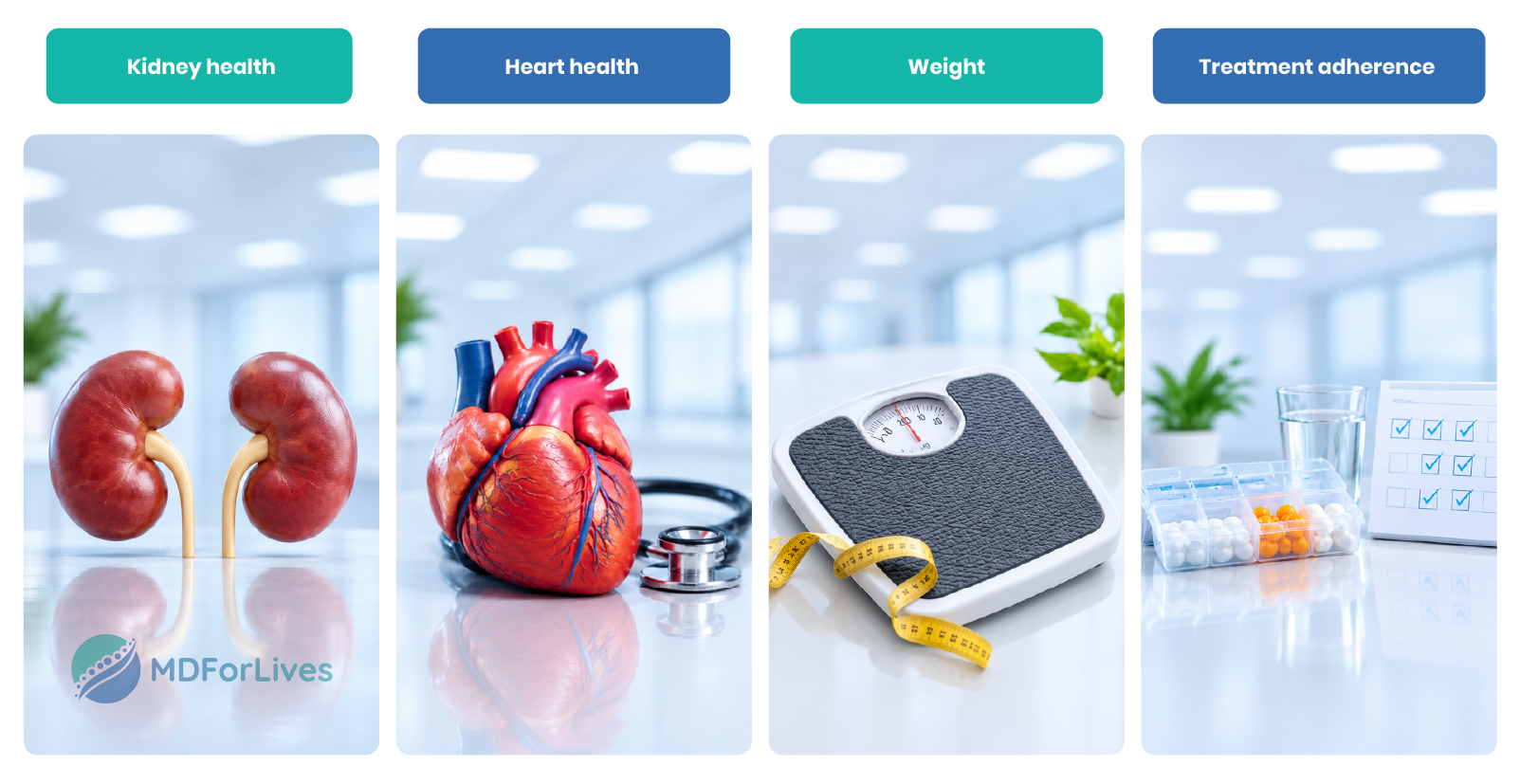
Separate uncontrolled from working
A result above the individualized HbA1c target signals that glycemic control may still need attention, but not that every element of the current strategy has failed.
In the survey, 42.9% selected cardiovascular risk reduction as the leading outcome that could justify continuing therapy despite suboptimal HbA1c, with weight reduction and kidney protection also relevant. This marks an important distinction between incomplete glycemic control and complete treatment failure. If a therapy contributes meaningfully to cardiovascular, kidney or weight goals, the remaining HbA1c gap may need addressing while preserving benefits that still matter. Two questions help: what remains uncontrolled, and what is already working? That distinction helps clinicians decide whether treatment needs to be supplemented, intensified, simplified, or reconsidered, rather than judging the whole regimen through one laboratory value.
When comorbidities change the goal
Looking beyond HbA1c matters most when type 2 diabetes coexists with chronic kidney disease, heart failure or cardiovascular disease, where the next decision may need to solve more than a glucose problem.
Two patients with the same HbA1c may need different priorities: one greater glycemic intensification, another stronger kidney or cardiovascular protection, a third changes for tolerability, treatment burden or access despite an already appropriate strategy. The objective is not to reduce the importance of HbA1c, but to avoid letting a familiar measure overshadow other risks that influence long-term treatment.
Can the plan be sustained?
A clinically appropriate strategy still needs to work outside the consultation. In the survey, 45.7% identified poor treatment adherence as the biggest barrier in complex diabetes care, and the research also flags affordability and access as constraints on optimization. These are clinician perceptions of barriers in practice, not direct patient-reported evidence.
That distinction matters when HbA1c remains above target. An elevated result may reflect a need for more treatment, but may also coexist with adverse effects, complexity, cost, reimbursement or access limits, or difficulty sustaining the regimen. Before adding another layer of therapy, clinicians may need to understand whether the existing plan is being followed and remains realistic. Sometimes the next step is another medicine; sometimes it is simplifying the regimen, addressing tolerability, clarifying the purpose of treatment, or resolving barriers preventing the current strategy from working.
Diabetes management extends beyond improving a laboratory value; treatment also needs to remain practical and sustainable in everyday life. Explore living with diabetes, managing blood sugar and staying healthy.
Reassess the whole picture
The HbA1c test remains important at follow-up, but reassessment can answer more than whether one number improved. Is glycemic control moving toward the individualized goal? Have kidney function, albuminuria or weight changed? Has cardiovascular risk changed priority, or has hypoglycemia become more important? Can the patient obtain, tolerate, and continue the regimen?
These questions place HbA1c within a longitudinal assessment rather than a standalone score and explain why one treatment sequence cannot fit every patient. The next decision depends not only on how far HbA1c is from target, but on which risks remain unresolved, which benefits are already being achieved, and which parts of the strategy can realistically be sustained.
Understanding diabetes increasingly involves looking beyond periodic HbA1c results toward the broader picture of glucose patterns and daily management. Explore how diabetes tools are reducing the daily burden.
HbA1c remains essential, the decision is bigger
HbA1c remains central to type 2 diabetes management; what changes in complex care is not its importance, but the number of other factors to consider alongside it. The findings show surveyed clinicians rely heavily on HbA1c and the glucose profile while also weighing obesity, kidney function, cardiovascular outcomes, adherence, affordability and treatment sustainability.
That changes the clinical question: instead of asking only what the HbA1c is, complex diabetes care increasingly asks what it means for this patient, given the other risks, benefits and barriers that may influence the next decision. The Insight Report provides detailed findings; the practical task is deciding how they shape the next step for the individual patient.