

A woman may not describe menopause as a crisis.
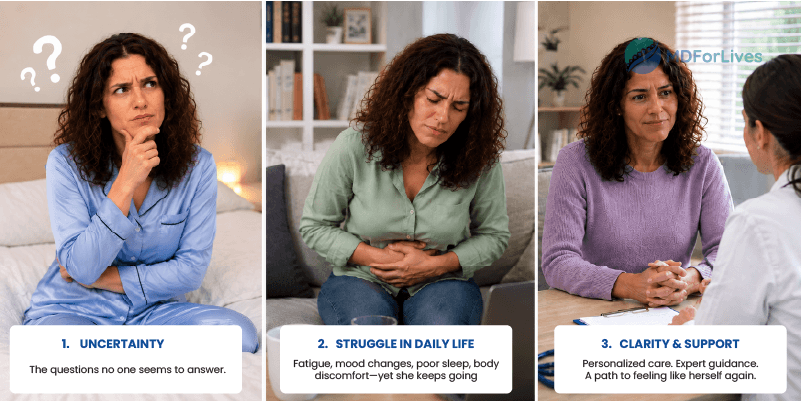
She may still go to work, manage her home, meet people, make decisions, and keep moving through the day. But beneath that routine, sleep may be broken, energy may be lower, mood may feel unfamiliar, weight or joint changes may feel harder to explain, and the right support may still feel difficult to find.
That is the quiet gap in menopause care.
Menopause is often discussed through a few familiar symptoms, especially hot flashes and night sweats. But for many women, the experience is broader. It affects sleep, energy, emotional well-being, confidence, daily functioning, relationships, work, and quality of life. Awareness may be improving, but awareness does not automatically become care.
MDForLives survey data shows this clearly. Many women describe symptoms as manageable in parts, but not fully supported. The strongest pattern is not severe distress for everyone. It is incomplete care for many.
Menopause Is Common, but the Experience Is Not Uniform
Menopause is a natural life stage, not a disease. But that does not mean symptoms are minor or easy to navigate. The menopausal transition can affect physical, emotional, cognitive, and social well-being, and the support women need can vary widely.
The MDForLives survey included women across perimenopause, postmenopause, surgical menopause, and women unsure of their stage but experiencing symptoms. Perimenopause formed the largest group, with 50.8% currently in perimenopause, followed by 31.1% postmenopause.
That matters because menopause care cannot be designed around one fixed experience. A woman in perimenopause may still be trying to connect irregular symptoms to hormonal change. A postmenopausal woman may be dealing with longer-term health and quality-of-life concerns. A woman in surgical menopause may experience sudden changes that need more focused support.
Daily Impact Is Often Moderate, Not Minimal
When asked about the overall impact of menopause symptoms on daily life, 35.3% described a moderate impact requiring ongoing adjustment, while 15.2% reported a significant impact affecting multiple aspects of daily life.
Together, this means about half of women described menopause symptoms as requiring meaningful adjustment or affecting multiple areas of life.
This is an important distinction. Menopause may not always stop daily life, but it can change the effort required to get through it. A woman may still function, but with less energy, more planning, more self-monitoring, or more emotional strain.
Good menopause care should recognize this middle ground. Support should not begin only when symptoms become severe. It should help women before “manageable” becomes exhausting.
Sleep and Energy Are the Leading Quality-of-Life Burden
The symptom with the greatest impact on quality of life was sleep disturbances or fatigue, selected by 32.2% of respondents. Physical changes such as weight gain or joint pain followed at 23.2%, while mood changes were selected by 18.0%, and hot flashes or night sweats by 17.5%.
This challenges the usual menopause story.
Hot flashes matter, but they were not the leading quality-of-life concern in this survey. Sleep and fatigue were. That suggests many women may judge menopause care not only by whether visible symptoms improve, but by whether they can feel rested, steady, focused, and physically capable again.
Hot flashes remain a common part of the menopausal experience, but their timing and persistence can vary. Explore hot flashes after menopause, including causes, duration, and treatment options.
Fatigue can affect everything: work, caregiving, decision-making, exercise, mood, relationships, and patience with daily life. When sleep is disrupted, the burden of menopause becomes continuous, not episodic.
Many Women Have Not Sought Help
One of the clearest support gaps appears before treatment even begins. In the MDForLives survey data, 36.3% said they have not sought help. Among those prompted to seek help or consider treatment, emotional or mental health impact was selected by 20.9%, and symptoms becoming difficult to manage daily by 19.3%.
This suggests that many women wait, adapt, or manage privately until symptoms become harder to absorb.
The question is why. Some may normalize symptoms. Some may not know what support exists. Some may worry about treatment safety. Others may have had limited or unhelpful conversations in the past.
Menopause care needs to make help-seeking feel normal, not like a last resort.
Symptom Management Is Often Incomplete
The strongest care gap is visible in symptom management. Only 16.3% said their symptoms are very well managed with effective support. In contrast, 47.5% said symptoms are partially managed but gaps remain, 10.1% said they are poorly managed despite seeking help, and 26.1% said they have not received any meaningful support.
This means most women did not describe their symptoms as fully supported.
That is the core insight of the survey. Menopause care is not absent for everyone, but it is incomplete for many. Women may be doing something, using lifestyle changes, medical treatments, supplements, or combined approaches, but still not feeling fully guided.
Lifestyle Is Leading the Current Approach
The most common current approach to managing menopause was lifestyle change, selected by 36.5%. Medical treatments such as hormone or prescribed therapies were selected by 19.4%, while 18.9% used a combination of approaches, and 16.8% were not actively managing symptoms.
This does not mean lifestyle support is wrong. Diet, exercise, stress management, sleep routines, and behavioral approaches may be meaningful for many women. But the pattern also suggests that many women may be self-managing because clinical pathways feel unclear, inaccessible, or difficult to personalize.
Lifestyle changes can be valuable, but some women may also need medical treatment tailored to their symptoms and health profile. Learn more about hormone replacement therapy for menopause and what to expect.
Effective menopause care should not force women to choose between lifestyle support and medical guidance. It should help them understand what fits their symptoms, health history, risk profile, preferences, and goals.
Guidance and Choice Are the Main Barriers
When asked about the biggest barrier to receiving or trying effective treatment, two answers tied at the top: lack of clear or consistent medical guidance and uncertainty about which option is right, each selected by 29.8%. Concerns about safety or side effects followed at 21.4%.
This is a practical finding.
The barrier is not only access or cost. It is decision clarity.
Women are not simply asking whether treatment exists. They are asking which option is right for them, what the risks mean, what benefits are realistic, and how to make a confident decision.
That is why provider communication is central to menopause care. Women need guidance that is specific, balanced, and personalized, not generic reassurance or fragmented advice.
Provider Conversations Are Still Uneven
Only 26.6% described their healthcare-provider discussion as open, informative, and supportive. Another 20.4% said it was somewhat helpful but lacked depth or personalization. About 22.2% reported limited discussion focused only on basic symptoms, 10.7% felt their concerns were not fully taken seriously, and 20.1% had not discussed menopause with a provider.
This shows that the consultation itself can be a care gap.
A brief symptom checklist may not be enough. Women need space to discuss sleep, mood, energy, cognitive changes, physical changes, treatment concerns, safety questions, and long-term health. They also need their concerns to be taken seriously even when symptoms are common.
Common does not mean insignificant.
Women Want Information They Can Use
The information gap is also clear. About 49.3% said they were somewhat informed but still had unanswered questions. Another 18.5% said they were not well informed and often confused, while 4.7% had difficulty finding reliable information.
Open-ended responses reinforced this need. Women asked for help managing weight gain, more psychological support, specialist input and continuous support, better information about symptoms and treatment options, help with brain fog and multitasking, more energy support, better GP knowledge, and a “one stop shop” including emotional support.
These responses show that women are not asking for vague awareness. They are asking for practical, continuous, trustworthy menopause care.
Menopause can involve symptoms and daily challenges that women may not always expect or receive guidance about. Explore how women are really experiencing menopause in 2026.
Closing Perspective
The MDForLives survey data shows a clear pattern: menopause symptoms are common, but support is uneven. Many women describe moderate daily impact, sleep and fatigue as the leading quality-of-life burden, partial symptom management, unclear guidance, unanswered questions, and provider conversations that do not always go deep enough.
The next step in menopause care is not simply telling women that symptoms are normal.
It is helping them understand what is happening, what options exist, what is safe for them, and how to manage symptoms in ways that fit their lives.
Because menopause care should not begin only when women feel overwhelmed.
It should begin when symptoms start changing how they live.