
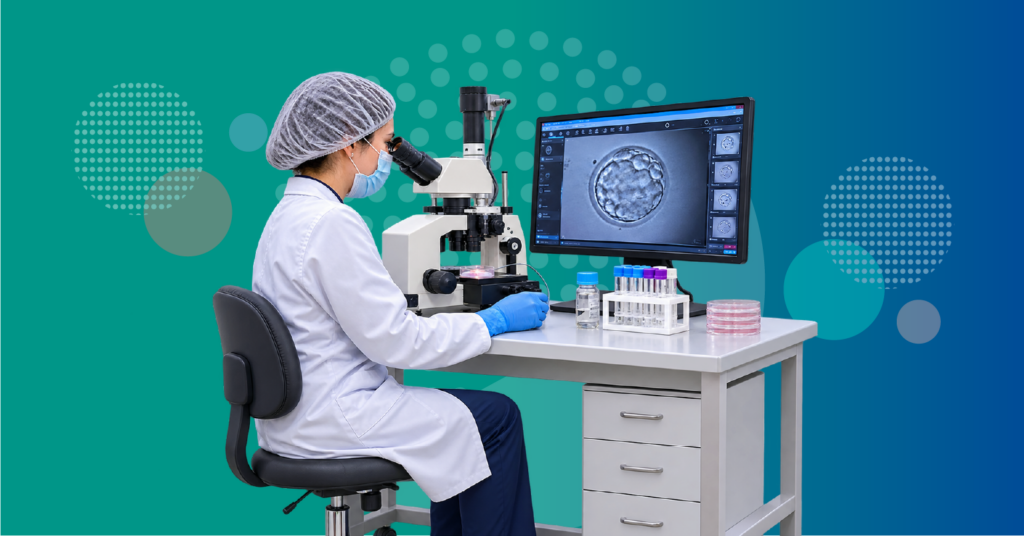
Selecting an embryo for transfer is one of the most consequential decisions in IVF. Morphology remains central to IVF embryo selection, while time-lapse imaging, genetic testing and artificial intelligence are increasingly being explored to add information beyond appearance alone.
Preimplantation genetic testing for aneuploidy, or PGT-A, can provide chromosomal information, but conventional testing usually requires removing trophectoderm cells from a blastocyst. This has created interest in a different possibility: can useful genetic information be obtained without biopsying the embryo?
Non-invasive embryo testing aims to do exactly that, most notably through analysis of cell-free DNA released into embryo culture medium.
The concept is clear. If useful biological information can be obtained without removing cells, embryo assessment could become less physically invasive. But avoiding biopsy is only the first step.
Here, the more important question is whether these methods are reliable enough to improve embryo selection and, ultimately, reproductive outcomes.
The embryo may leave genetic information behind in the culture dish
As a blastocyst develops in vitro, small amounts of cell-free DNA can be released into the surrounding culture medium. Instead of removing cells from the embryo, non-invasive PGT-A analyses this spent culture medium.
A 2020 prospective multicentre study involving 1,301 blastocysts found substantial agreement between cell-free DNA results and trophectoderm biopsy.
The concept was promising, but accuracy depended on more than simply detecting DNA. A 2022 review of non-invasive PGT-A highlighted the potential of embryo testing for IVF while also noting that collection timing, embryo manipulation and contamination could influence results.
The challenge is therefore not simply finding a genetic signal.
Modern healthcare increasingly uses biological and molecular information to support more individualized clinical decisions. Explore how precision medicine improves treatment selection and patient care.
It is making that signal consistent and reliable enough to influence which embryo is transferred.
Avoiding biopsy does not remove biological uncertainty
More recent evidence shows why less invasive does not automatically mean more certain.
A 2026 international multicentre study of 2,539 blastocysts reported 79.1% concordance between spent blastocyst media and trophectoderm biopsy in cycles using autologous oocytes. Concordance increased to 87.0% when results were compared with the inner cell mass.
Those figures are encouraging, but discordant results remain clinically important.
DNA quantity, fragmentation, contamination, and differences in laboratory protocols can all affect interpretation. In a decision as consequential as embryo transfer, even relatively small levels of uncertainty can matter.
For fertility professionals, the question is therefore not simply whether “IVF embryo testing can avoid biopsy.” It is “Whether the information gained without biopsy is reproducible enough to support a high-stakes clinical decision.”
Reducing physical intervention is valuable only if it does not introduce greater uncertainty elsewhere.
The 2026 randomized trial moves the question from accuracy to outcomes
Earlier, niPGT-A research focused largely on whether non-invasive results agreed with conventional biopsy.
A 2026 randomized clinical trial moved the discussion forward by asking a more clinically relevant question: does using non-invasive PGT-A to prioritize embryos actually improve reproductive outcomes?
The multicentre trial included women aged 35 to 42 with at least two available blastocysts. Embryos were prioritized using either niPGT-A or conventional morphology.
In the 2026 randomized niPGT-A trial published in Nature Communications, ongoing pregnancy rates were 38.7% with niPGT-A and 36.8% with morphology, while live birth rates were 37.0% and 35.5%, respectively. Neither difference was statistically significant.
That result changes the emphasis.
Non-invasive embryo testing may provide additional biological information without biopsy, but additional information does not automatically translate into more live births.
That matters because pregnancy and live birth, rather than technical agreement alone, ultimately determine whether a new selection strategy adds clinical value.
Less invasive should not automatically mean clinically superior
The benchmark itself is also not straightforward.
Conventional PGT-A is used in selected IVF settings, but its value as universal screening has not been established. The American Society for Reproductive Medicine’s 2024 committee opinion notes that randomized trials have not consistently shown improved overall pregnancy outcomes from routine PGT-A.
This means that non-invasive PGT-A should not be judged only by how closely it reproduces biopsy-based testing.
A clinically useful method needs to show where it adds meaningful information, which patients are most likely to benefit, and whether it improves outcomes such as live birth, miscarriage or time to pregnancy.
Genetic testing can provide important information about inherited conditions and support clinical decision-making. Learn more about genetic testing for rare diseases and what patients should know.
The objective is not simply to recreate an existing test without a biopsy. It is to improve embryo-selection decisions in a way that matters clinically.
AI can assess embryos without touching them, but it answers a different question
Genetic analysis is not the only route toward less invasive IVF embryo selection.
Artificial intelligence can analyse embryo images and developmental patterns without removing cells. 2026 multicentre trial-emulation study found that non-invasive AI scoring was associated with implantation potential and supported further prospective evaluation.
But AI-based embryo ranking should not be confused with genetic testing.
The 2026 comparison of AI embryo-ranking approaches found that AI could match or slightly improve conventional non-invasive embryo ranking, yet it could not reliably prevent aneuploid embryos from being prioritized.
Similarly, a 2026 systematic review and meta-analysis found no significant improvement in clinical pregnancy rates with AI-assisted embryo selection compared with conventional morphology.
These technologies therefore answer different questions.
AI evaluates how an embryo looks and develops. Cell-free DNA aims to provide chromosomal information. But neither provides a complete picture of embryo competence on its own.
The future may be less invasive because selection becomes multidimensional
The next phase of non-invasive embryo testing may depend less on finding one replacement test and more on combining complementary information.
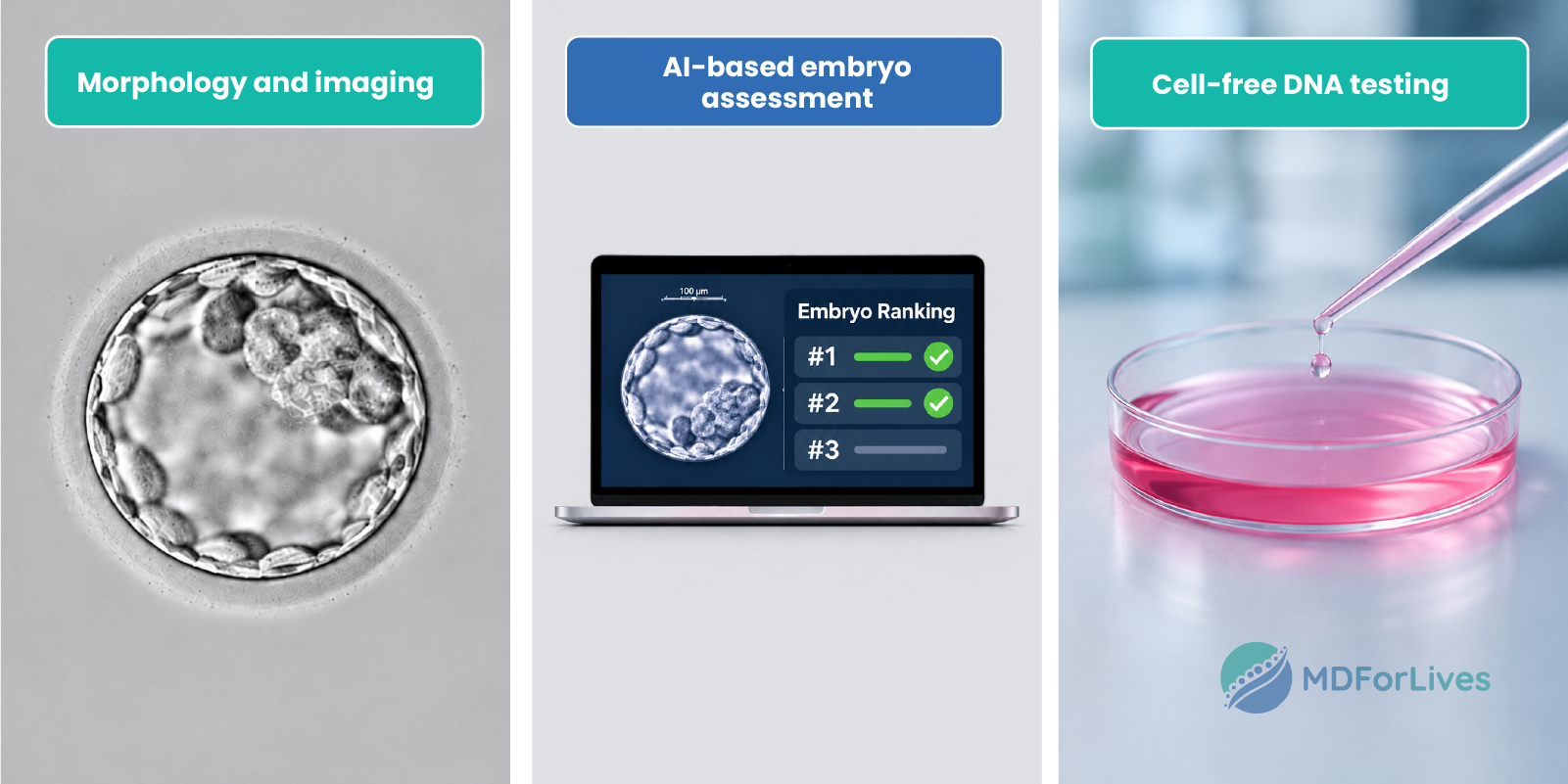
Morphology describes appearance. Time-lapse imaging captures development. AI may identify subtle patterns. Cell-free DNA may add chromosomal information. Emerging molecular approaches could eventually contribute additional biological signals.
The 2026 review of non-invasive embryo assessment described this movement toward more integrated evaluation while emphasizing the need for standardization, prospective validation and evidence of improved clinical outcomes before routine adoption.
For fertility practice, the opportunity may therefore lie in understanding how these signals complement one another without adding unnecessary complexity.
The goal is not more data for its own sake. It is better selection with less intervention and greater confidence.
Closing perspective: less invasive is promising, but outcomes remain the test
The ambition behind non-invasive embryo testing is compelling: obtain useful information while disturbing the embryo as little as possible.
Cell-free DNA, imaging and AI are making embryo assessment more sophisticated without necessarily increasing physical intervention.
But the 2026 randomized niPGT-A trial provides an important reality check.
A test can be less invasive, technologically advanced and biologically informative without yet improving ongoing pregnancy or live birth.
For fertility professionals, the question is no longer simply whether embryo selection in IVF can become less invasive. It is whether these approaches can become reliable, standardized, and clinically useful enough to improve selection beyond existing methods, and whether that improvement translates into outcomes that matter to patients.
The future may involve less biopsy. Routine adoption will depend on proving better clinical outcomes, not simply generating better predictions.