

Microneedling, laser treatments and chemical peels may all be discussed for fine lines, pigmentation, acne scars or uneven texture. That can make choosing a skin rejuvenation treatment feel like a search for which procedure is “best.”
To understand how patients experience these decisions, MDForLives surveyed people with skin rejuvenation treatment experience across the USA, UK, Canada, Italy, France and Germany. The detailed findings and methodology are available in the MDForLives Skin Rejuvenation: What Patients Expect, Experience, and Pay For Insight Report.
Start with the skin concern, not the procedure name
You may already have a treatment in mind after hearing about microneedling, seeing a laser skin treatment online or being told that a chemical peel can refresh the skin. But the procedure name should not come before the goal.
Fine lines, pigmentation, acne scarring, uneven texture, dullness and skin laxity can all fall under skin rejuvenation, yet they are different concerns.
Not every visible skin change is purely cosmetic. Some skin concerns may also reflect underlying metabolic factors. Discover how skin signals can reveal changes in metabolic health.
Make the goal specific. “I want better skin” is broad; “I want to improve pigmentation” gives your healthcare professional a clearer target.
The treatment should follow the concern, not the other way around.
The right assessment should narrow the choice
Two people asking for the same procedure may not be equally suited to it. Skin tone, pigment tendency, sensitivity, previous procedures, scarring history, medicines, sun exposure and the treatment goal can all influence which options are appropriate.
In the MDForLives survey, 54.8% of respondents said a dermatologist’s clinical examination was the assessment that most shaped their treatment plan.
Assessment is where you can discuss how much improvement is realistic, whether several sessions may be needed, what recovery could involve, and which risks matter for your skin.
Choosing an appropriate skin treatment starts with understanding the condition and assessing the skin. Explore whether an online dermatologist can diagnose a skin condition from a photo.
‘A well-matched skin rejuvenation treatment begins before treatment day.’
Microneedling vs chemical peel vs laser is a matching decision, not a ranking
Search results often turn skin rejuvenation into a competition: microneedling vs chemical peel or microneedling vs laser.
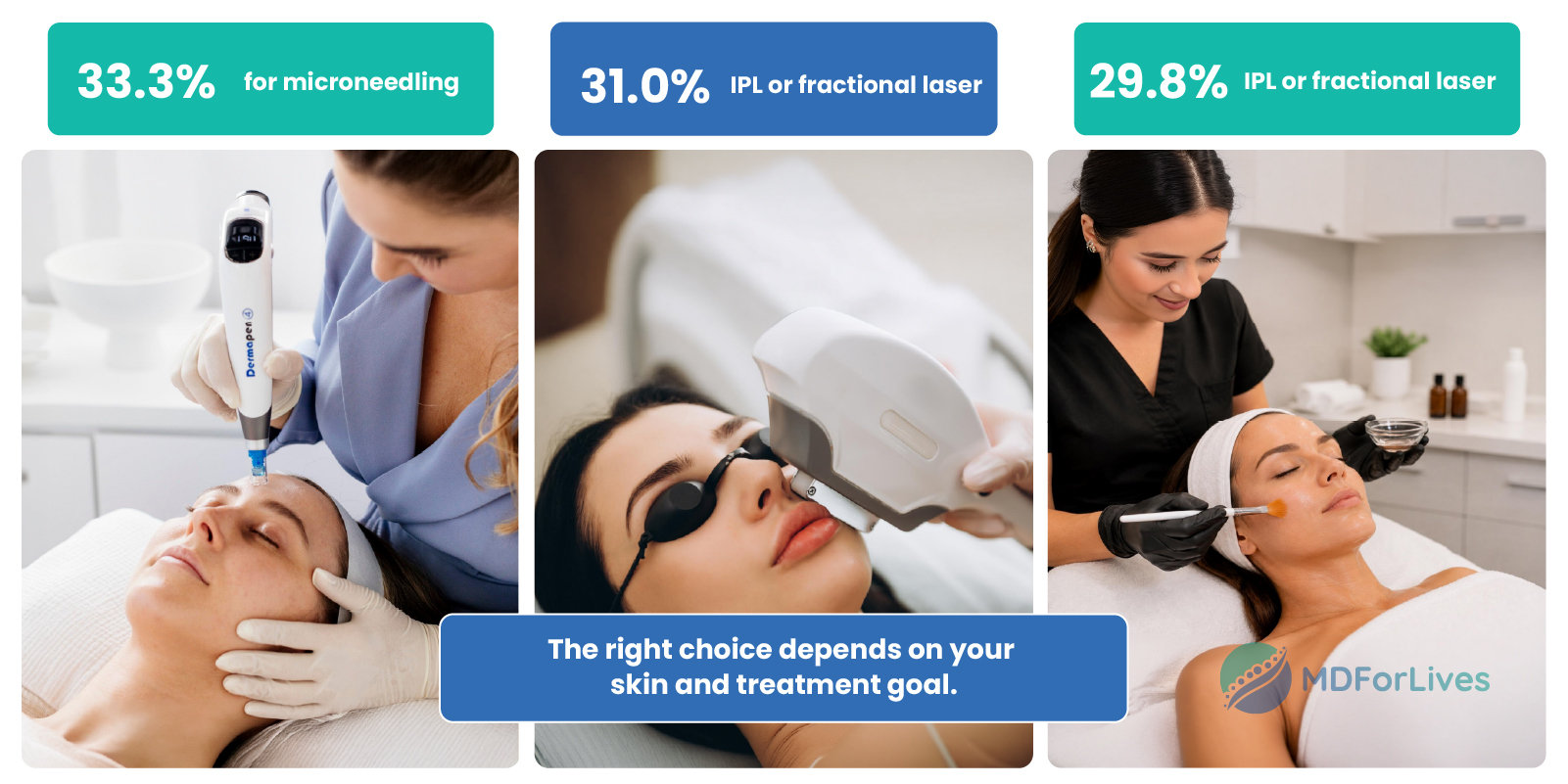
Among respondents, 33.3% reported microneedling as their first treatment, 31.0% IPL or fractional laser, and 29.8% a chemical peel.
Suitability can depend on your skin, treatment goal, provider experience, expected downtime, risk tolerance, and cost.
Instead of asking, “Which treatment is strongest?”, ask what it is intended to improve, how much change is realistic, how many sessions may be needed, what recovery looks like, and which risks are relevant to you.
An expectation gap can make a reasonable result feel disappointing
Choosing the procedure is only one part of the experience. You also need to know what a realistic result may look like.
In the MDForLives survey, 36.9% of respondents said limited visible improvement was the factor that most affected the result of their first treatment.
Disappointment does not always mean something went wrong. You may see some improvement but feel it is too subtle; results may take longer than expected, or one session may not deliver a result that requires a treatment series.
Before microneedling, laser skin resurfacing or a chemical peel treatment, ask what the procedure is expected to improve, when results are usually assessed and whether repeat treatment may be needed.
Recovery should be part of the decision before treatment day
Redness, swelling, irritation, or visible peeling can affect work, social plans, and skincare routines.
The MDForLives survey shows how different recovery can be: 35.7% reported prolonged redness or swelling as the side effect that most affected treatment, while the same proportion reported no significant side effects.
Before a laser skin treatment, microneedling procedure or chemical peel, ask what normal recovery may look like, how long visible effects may last, and which symptoms should prompt medical review.
A treatment may suit your skin but still be poorly matched if the downtime is difficult to manage.
Total cost matters more than the price of one session
In the MDForLives survey, 53.6% of respondents said out-of-pocket treatment cost was the biggest factor limiting access to skin rejuvenation treatment.
If several sessions are recommended, or maintenance may be needed later, the total treatment course can cost considerably more than the first appointment.
Before beginning, ask about the likely number of sessions, maintenance, follow-up and overall cost. Cost should be considered alongside visible benefit, recovery and time commitment.
Visible improvement must make repeating treatment feel worthwhile
Once you have experienced a procedure, the question changes from “Should I try this?” to “Was the benefit worth doing this again?”
In the MDForLives survey, 47.6% said visible skin improvement most influenced whether they continued maintenance treatment. Minimal downtime was also important.
A useful follow-up is to ask whether you can see meaningful improvement, whether recovery was manageable, whether the result seems durable enough, and whether another session fits your time and budget.
The right skin rejuvenation treatment is not necessarily the newest or most intensive option. It is the one where benefit, recovery, risk, time and cost make sense together.
Closing perspective: choose the treatment journey, not just the treatment
Microneedling, laser treatments, and chemical peels can all have a place in professional skin rejuvenation.
The MDForLives findings do not point to one universal starting procedure. Instead, they support a practical approach: define the concern, assess the skin, match the treatment, set realistic expectations, plan for recovery, and consider whether the full course is manageable.
If you are comparing microneedling vs laser or microneedling vs chemical peel, the useful question is not simply which procedure is generally “better.” Ask which option is better matched to your skin, your goal and the treatment experience you are willing to take on.
The procedure matters, but so does everything that happens before and after it.